Learn first: Evolutionary theory
Ecology is the science of how organisms interact with each other and with their environment (the term was introduced by E. Haeckel in 1866). The exam covers environmental factors and the laws governing them, types of relationship between organisms, calculation problems on food chains and ecological pyramids, succession and agricultural ecosystems.
§1. Environmental factors
The elements of the environment that act on an organism are ecological factors:
- Abiotic — factors of non-living nature: light, temperature, moisture, composition of air and water, soil, relief, pressure.
- Biotic — the influence of other organisms: feeding, competition, parasitism, pollination and so on.
- Anthropogenic — human activity: logging, ploughing, pollution, construction, hunting.
Law of the optimum: every factor has a most favourable value for the organism (the optimum) and limits of tolerance (minimum and maximum); beyond them the organism dies.
Law of the limiting factor (J. Liebig): an organism’s survival is limited by the factor that deviates most from the optimum. In a desert it is water; in the tundra, heat.
Organisms with wide tolerance limits are eurybionts; those with narrow limits are stenobionts.
Light: plants may be light-loving, shade-tolerant or shade-loving. The response to day length is photoperiodism: short-day plants (of southern origin, such as cotton and rice) and long-day plants (northern, such as wheat and rye). In animals, day length controls the timing of moulting, migration and breeding.
Temperature: in cold-blooded (poikilothermic) animals body temperature depends on the surroundings (fish, amphibians, reptiles, invertebrates); warm-blooded (homeothermic) animals are birds and mammals.
Moisture: plants are hydrophytes (in water), hygrophytes (in damp places), mesophytes (moderate moisture) and xerophytes (dry places: succulents store water, e.g. cacti; sclerophytes are tough, small-leaved and deep-rooted, e.g. saxaul and camel thorn).
§2. Living environments
- Water: plankton — organisms drifting passively in the water (tiny algae, small crustaceans); nekton — active swimmers (fish, whales); benthos — bottom dwellers (molluscs, some algae).
- Land-air environment — plenty of oxygen, but temperature and moisture change sharply.
- Soil — no light, stable temperature; its inhabitants are edaphobionts (earthworm, mole).
- A living organism — the environment of parasites: internal (Ascaris) and external (lice, ticks).
§3. Relationships between organisms
Symbols: + benefit, − harm, 0 no effect.
- Neutralism (0 0) — no direct effect: a squirrel and an elk in the same forest.
- Mutualism (+ +) — beneficial to both and often obligatory: the fungus and alga in a lichen, mycorrhiza (fungus and tree roots), legumes and nodule bacteria, termites and the protists in their gut.
- Commensalism (+ 0) — one benefits, the other is unaffected: the remora and the shark, animals that feed on a predator’s leftovers.
- Amensalism (− 0) — one is harmed, the other unaffected: light-loving grasses suppressed in the shade of tall trees.
- Competition (− −) — struggle for a shared resource: weeds and crops.
- Predation and parasitism (+ −): wolf and hare; Ascaris and humans.
Worked example
Identify the relationship: 1) a legume and nodule bacteria; 2) a wolf and a fox hunting the same hare population; 3) Echinococcus in a cow.
- The plant supplies the bacteria with organic matter; the bacteria fix nitrogen from the air — mutualism (+ +).
- Two predators need the same prey — competition (− −).
- The parasite lives at the host’s expense — parasitism (+ −).
§4. Populations and their characteristics
A population is a group of individuals of one species that live in a particular area for a long time, interbreed freely and are relatively separate from other such groups. The population is the form in which a species exists and the elementary unit of evolution.
Main characteristics of a population:
- size — the total number of individuals;
- density — the number of individuals per unit area or volume;
- birth rate and death rate — the numbers born and dying per unit of time;
- age structure — the ratio of age groups: many young individuals mean a growing population, many old ones a shrinking population;
- sex ratio — the ratio of males to females.
Population growth = births − deaths (+ immigrants − emigrants).
Density = number of individuals / area.
With unlimited resources a population grows quickly along a J-shaped (exponential) curve; in reality food, space and other resources are limited, growth slows and an S-shaped curve results — numbers approach the level the environment can support (the carrying capacity) and fluctuate around it.
Factors regulating numbers: food shortage, predators, parasites and disease, competition, weather. As density rises, most of these factors act more strongly (less food, faster spread of disease), which brings numbers back towards balance. Periodic fluctuations in numbers are called population waves (“waves of life”, S. S. Chetverikov). For example, when hares become numerous, their predators increase too; then hares decline, and after a delay the predators decline as well. In a small population, chance events can wipe out genetic diversity — which is why increasing numbers matters when protecting rare species.
Worked example
A reserve has 200 hares at the start of the year. During the year 60 leverets are born and 20 hares die (no migration). What is the population at the end of the year, and what is the growth rate?
- Growth: 60 − 20 = 40.
- Population at year end: 200 + 40 = 240.
- Growth rate: 40 / 200 × 100% = 20%.
- Answer: 240 hares, annual growth 20%.
Worked example
120 field voles are counted on a 4-hectare plot. Find the density. How many voles will there be if density reaches 60 per hectare?
- Density: 120 / 4 = 30 per ha.
- New number: 60 × 4 = 240 voles.
- Answer: 30 per ha; at 60 per ha there will be 240 voles (the population has doubled).
§5. Ecosystems, food chains and the ecological pyramid
A biogeocoenosis (V. N. Sukachev) or ecosystem (A. Tansley) is a single system of living organisms and their non-living environment in a given area, linked by the exchange of matter and energy.
Functional groups in an ecosystem:
- Producers — autotrophs that make organic matter from inorganic substances (green plants, cyanobacteria, chemosynthetic bacteria).
- Consumers — feed on ready-made organic matter: primary (herbivores), secondary (predators that eat herbivores), tertiary and so on.
- Decomposers — break organic remains down to mineral substances (bacteria, fungi).
A food chain is the transfer of matter and energy from one trophic level to the next. Grazing chains start with producers; detritus chains start with dead organic matter.
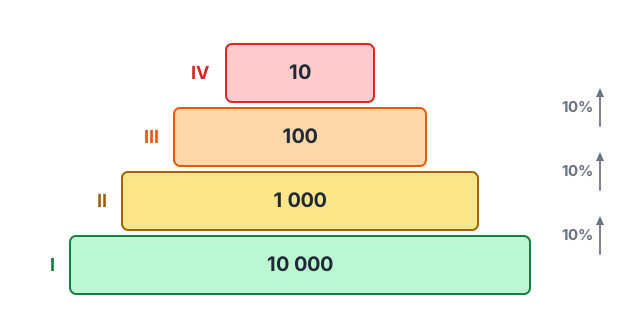
The ecological pyramid rule (10% rule): about 10% of the energy (biomass) of one trophic level passes to the next; the rest is spent on respiration, lost as heat or left undigested. That is why food chains rarely have more than 4–5 links.
Worked example
Chain: grass → grasshopper → frog → snake → eagle. How much grass is needed for the eagle to gain 5 kg? What order of consumer is the eagle?
- Each level passes on 10%, so moving down the chain the mass is multiplied by 10.
- Snake: 5 × 10 = 50 kg; frog: 500 kg; grasshopper: 5,000 kg; grass: 50,000 kg.
- Consumer order: grasshopper — primary (1st), frog — 2nd, snake — 3rd, eagle — 4th order.
- Answer: 50 tonnes of grass; the eagle is a fourth-order consumer.
§6. Ecosystem change and agroecosystems
Succession is the regular replacement of one community by another.
- Primary succession starts where there was no life (bare rock, sand): lichens settle first, then mosses, grasses, shrubs and trees; soil forms gradually.
- Secondary succession occurs where a community has been disturbed (after a fire, logging or on an abandoned field); the soil remains, so it goes faster.
Succession ends with a stable, balanced climax community.
An agroecosystem (artificial ecosystem: a field, an orchard) differs from a natural one:
- low species diversity, often one main species (monoculture);
- short food chains, so the ecosystem is unstable;
- artificial selection acts as well as natural selection;
- human energy (tillage, fertiliser, irrigation) is used in addition to solar energy;
- substances are removed with the harvest, so the cycle is not closed and fertilisers are needed.
Check yourself
- What is the main limiting factor for desert plants?
- What is the relationship between a shark and a remora called?
- What order of consumer is the first animal after a plant in a chain?
- How much plant matter is needed for an owl to gain 1 kg in the chain "plants → mice → owl"?
- Which organisms settle first on bare rock?
- Why is an agroecosystem less stable than a natural ecosystem?
- A population has 500 individuals; during a year 50 are born and 75 die. Size at the end of the year?
- Which curve describes population growth when resources are limited?
Common mistakes
- Miscounting consumer order — the organism after the plant is a primary consumer.
- Confusing commensalism (+ 0) with amensalism (− 0).
- Dividing by 10 instead of multiplying when working down a chain (the lower level is 10 times larger).
- Mixing up plankton and nekton: plankton drifts passively, nekton swims actively.
- Counting decomposers as consumers — they are a separate functional group.
- Thinking the nutrient cycle in an agroecosystem is closed — substances leave with the harvest.
Score: 0 / 8 correct (0 attempted)