Learn first: Metabolism and energy exchange, Structure of plant organs
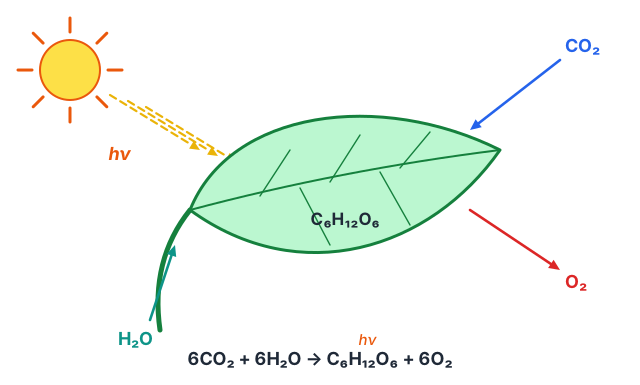
Photosynthesis is the process by which green plants, algae and cyanobacteria make organic substances from inorganic ones (CO₂ and H₂O) using the energy of light. It is the source of almost all organic matter on Earth and of the oxygen in the atmosphere: the bread, fruit and meat we eat and the coal and oil we burn are ultimately products of photosynthesis. Photosynthesis is the most important form of anabolism (assimilation), because it turns light energy into the energy of chemical bonds. Exams ask about its stages, where they occur and what they produce, the origin of the oxygen, limiting factors and chemosynthesis; calculation problems also appear.
§1. The overall process and its history
The overall equation of photosynthesis:
6CO₂ + 6H₂O → C₆H₁₂O₆ + 6O₂ (light energy, with chlorophyll)
The process absorbs energy: light energy is stored in the glucose formed as the energy of chemical bonds.
History of the discovery:
- J. B. van Helmont (17th century) grew a willow in a pot and concluded that its mass increased mainly from water, not from soil.
- J. Priestley (1771) showed that a sprig of mint “restores” air “spoiled” by a burning candle or a mouse in a closed vessel — plants release oxygen.
- Later it was found that the process happens only in light and only in green parts.
- K. A. Timiryazev explained the cosmic role of photosynthesis: the plant captures the Sun’s energy and passes it on to life on Earth; he also showed that chlorophyll absorbs mainly red light.
§2. The chloroplast and pigments
Photosynthesis takes place in chloroplasts. A chloroplast is a double-membrane organelle; the inner membrane forms flat sacs — thylakoids — stacked like coins into grana. The fluid between the grana is the stroma; it contains enzymes, DNA and ribosomes (the chloroplast makes some of its own proteins).
The pigments sit in the thylakoid membranes:
- chlorophyll a and chlorophyll b absorb mainly red and blue-violet light and reflect green (which is why leaves look green); a magnesium atom lies at the centre of the chlorophyll molecule;
- carotenoids (yellow and orange) absorb extra wavelengths, pass energy to chlorophyll and protect it from too much light. In autumn chlorophyll breaks down and the carotenoids show — leaves turn yellow.
The leaf is the organ of photosynthesis: the palisade layer has the most chloroplasts, CO₂ enters and O₂ leaves through stomata, and the veins bring water and carry away the sugars produced.
§3. The light-dependent stage
Site — the thylakoid membranes; it happens only in light.
- Chlorophyll absorbs a quantum of light; its electrons are excited (raised to a high energy level) and passed into a chain of carriers.
- Photolysis of water — light splits water: 2H₂O → 4H⁺ + 4e⁻ + O₂. The electrons fill the “gap” in chlorophyll, and free oxygen is released into the air as a by-product.
- As electrons move along the carrier chain, the energy released is used to make ATP from ADP and phosphate.
- Electrons and hydrogen ions are added to NADP⁺, forming NADPH (the reduced carrier; written NADP·H₂ in some textbooks).
Products: O₂ (to the atmosphere), ATP and NADPH (energy and hydrogen for the next stage).
The oxygen released in photosynthesis comes from water, not from CO₂.
§4. The light-independent (“dark”) stage
Site — the chloroplast stroma. This stage does not need light directly, but it needs the products of the light stage — ATP and NADPH. So in reality it runs during the day, together with the light stage; the name “dark” only means light is not directly required.
- The Calvin cycle: enzymes attach CO₂ to a five-carbon compound; the products are reduced using energy from ATP and hydrogen from NADPH; the result is glucose, while the five-carbon compound is regenerated and the cycle continues.
- Six molecules of CO₂ enter the cycle for each molecule of glucose.
- Glucose is then used to make starch (storage), sucrose (carried in the phloem), cellulose (cell walls) and, with mineral nutrients, amino acids, proteins and fats.
Light stage: thylakoids; products O₂, ATP, NADPH. Dark stage: stroma; CO₂ → glucose.
§5. Factors affecting photosynthesis; plant respiration
Factors that affect the rate of photosynthesis:
- light intensity — the rate rises with it up to a certain limit;
- CO₂ concentration — about 0.03–0.04% in air; raising CO₂ in greenhouses increases yields;
- temperature — the process is enzyme-controlled, with an optimum of about 25–30 °C; very high temperatures damage the enzymes;
- water — if water is short the stomata close and CO₂ cannot enter;
- mineral nutrition — magnesium and nitrogen are part of chlorophyll; without them leaves turn yellow.
The rate is limited by whichever factor is in shortest supply (the limiting factor).
Plant respiration goes on day and night: O₂ is taken in, organic substances are oxidised and CO₂ is released. In the daytime photosynthesis outweighs respiration, so the plant gives out O₂ overall; at night only respiration occurs. That is why keeping many plants in a bedroom at night is not recommended.
§6. Chemosynthesis and the importance of photosynthesis
Chemosynthesis is the synthesis of organic substances by certain bacteria using energy released by oxidising inorganic substances. It was discovered in 1887 by S. N. Winogradsky. No light or chlorophyll is used.
- nitrifying bacteria: NH₃ → HNO₂ → HNO₃ — nitrates build up in the soil;
- iron bacteria: Fe²⁺ → Fe³⁺ — help form bog iron ores;
- sulfur bacteria: H₂S → S → H₂SO₄.
Chemosynthetic organisms are autotrophs too, but their global contribution is tiny compared with photosynthesis.
Importance of photosynthesis:
- the main source of organic matter on Earth — every food chain starts with plants;
- it enriches the atmosphere with oxygen and removes CO₂;
- oxygen in the upper atmosphere formed the ozone layer, which protects life from ultraviolet radiation;
- products of ancient photosynthesis — coal, oil, peat — are energy sources.
Worked example
A plant made 90 g of glucose. How many moles of CO₂ were absorbed and what volume (at STP) of O₂ was released? (M(C₆H₁₂O₆) = 180 g/mol)
- Amount of glucose: 90 / 180 = 0.5 mol.
- By the equation, 1 mol of glucose needs 6 mol of CO₂ and releases 6 mol of O₂.
- CO₂: 0.5 × 6 = 3 mol; O₂: 0.5 × 6 = 3 mol.
- Volume of O₂: 3 × 22.4 = 67.2 l.
- Answer: 3 mol of CO₂ absorbed, 67.2 l of O₂ released.
Worked example
How was it shown experimentally whether the oxygen released comes from water or from CO₂?
- A plant was given water labelled with the heavy oxygen isotope ¹⁸O — ¹⁸O appeared in the O₂ released.
- When the label was put into CO₂ instead, the O₂ released contained no ¹⁸O.
- Answer: the oxygen comes from water, that is, from photolysis of water.
Worked example
During photosynthesis 13.44 l (at STP) of CO₂ were absorbed. How many grams of glucose were formed?
- Amount of CO₂: 13.44 / 22.4 = 0.6 mol.
- 6 mol of CO₂ give 1 mol of glucose: 0.6 / 6 = 0.1 mol.
- Mass: 0.1 × 180 = 18 g.
- Answer: 18 g of glucose.
Check yourself
- In which stage and where does photolysis of water happen?
- Where does the Calvin cycle take place?
- Which products of the light stage does the dark stage need?
- How do nitrifying bacteria obtain food?
- How many moles of CO₂ are needed to make 180 g of glucose?
- What does a plant do at night?
- Which metal atom is at the centre of the chlorophyll molecule?
- How many moles of O₂ are released when 36 g of glucose are formed?
Common mistakes
- Thinking O₂ comes from CO₂ — it comes from water.
- Believing the dark stage happens only at night.
- Mixing up the sites — the light stage is in the thylakoids, the dark stage in the stroma.
- Calling chemosynthesis a type of photosynthesis — it uses no light.
- Saying plants respire only at night — respiration goes on around the clock.
- Writing that chlorophyll absorbs green light — it reflects it.
Score: 0 / 8 correct (0 attempted)