Learn first: The musculoskeletal system
Blood is the body’s liquid connective tissue; the heart and blood vessels keep it moving, bringing oxygen and nutrients to every cell and carrying away carbon dioxide and wastes. If circulation stops, brain cells die within minutes — that is why the heart works all our lives without rest. Circulation is closely linked to breathing, digestion, excretion and immunity. Exams ask a lot about the composition of blood, clotting, the structure of the heart and the cardiac cycle, the circulations, the properties of vessels and first aid for bleeding.
§1. Composition of blood
An adult has about 4.5–6 l of blood (about 7–8% of body mass). Blood has two parts.
Plasma (about 55%) is a yellowish liquid: about 90% water, 7–8% proteins (albumins, globulins — antibodies are among them — and fibrinogen, the clotting protein), glucose (about 0.1%), fats, mineral salts (about 0.9%). Physiological saline is a 0.9% salt solution; its concentration equals that of plasma, so it is given into veins after blood loss.
Formed elements (about 45%):
- Red blood cells (erythrocytes) — biconcave discs (larger surface), without a nucleus (more room for haemoglobin). They contain the iron-containing protein haemoglobin, which carries O₂ and some CO₂. There are about 4.5–5 million per mm³. They are made in red bone marrow, live about 120 days and are broken down in the liver and spleen. Too few red cells or too little haemoglobin is anaemia.
- White blood cells (leucocytes) — nucleated, colourless, larger than red cells; about 6–8 thousand per mm³. Moving like amoebae, they can squeeze through capillary walls into tissues. Their job is defence: phagocytosis (I. I. Mechnikov) and making antibodies (lymphocytes). Their number rises in inflammation.
- Platelets (thrombocytes) — small cell fragments without a nucleus; about 200–400 thousand per mm³. They take part in clotting.
Functions of blood: transport (nutrients, wastes, hormones), respiratory (carrying O₂ and CO₂), protective (white cells, antibodies, clotting), hormonal (humoral) control, temperature regulation (distributing heat), maintaining homeostasis.
§2. Blood clotting
When a vessel is damaged, clotting is a protective response that prevents blood loss.
Clotting: platelets break down → thromboplastin is released → with Ca²⁺ ions and vitamin K, prothrombin → thrombin → thrombin turns soluble fibrinogen into insoluble fibrin threads → blood cells are trapped in the threads, forming a clot (thrombus).
Blood normally clots in 3–5 minutes. In the inherited disease haemophilia clotting is impaired, so even a small wound bleeds for a long time. A clot formed inside a vessel is dangerous because it can block it.
§3. Structure of the heart
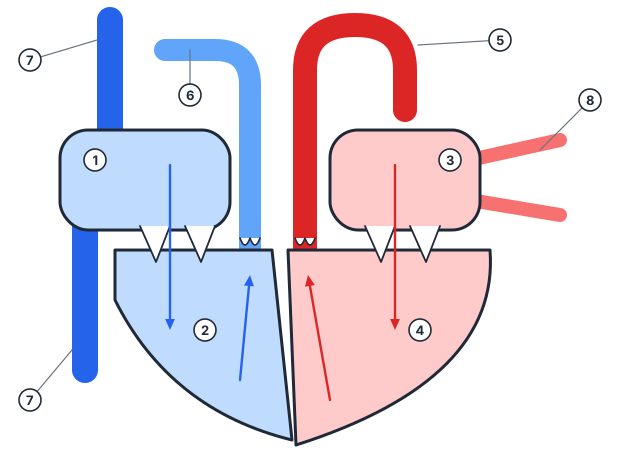
The heart is a muscular organ in the chest, shifted to the left, about the size of a fist. It has four chambers: two atria (above) and two ventricles (below); the right and left halves are completely separated by a septum, so oxygenated and deoxygenated blood do not mix.
- The wall of the left ventricle is the thickest — it pumps blood into the systemic circulation, round the whole body.
- The heart wall has three layers: the outer pericardium (a sac whose fluid reduces friction), the middle myocardium (heart muscle) and the inner endocardium.
- Atrioventricular (flap) valves lie between atrium and ventricle: the bicuspid (mitral) valve on the left and the tricuspid valve on the right. When a ventricle contracts they close and stop blood flowing back into the atrium.
- Semilunar valves lie at the start of the aorta and pulmonary artery and stop blood flowing back into the ventricles.
Thanks to the valves, blood moves through the heart in one direction only.
Heart muscle has automaticity: it contracts rhythmically in response to impulses generated in the heart itself, by the sinoatrial node in the wall of the right atrium. Heart activity is adjusted by the nervous system (sympathetic nerves speed it up, the vagus nerve slows it down) and hormones (adrenaline strengthens it). The heart itself is supplied by the coronary arteries.
§4. The cardiac cycle
At rest the heart beats about 70–75 times a minute; one cycle lasts about 0.8 s:
Atrial contraction (systole) — 0.1 s; ventricular contraction — 0.3 s; general relaxation (diastole) — 0.4 s.
The atria work for 0.1 s and rest for 0.7 s; the ventricles work for 0.3 s and rest for 0.5 s — that is why the heart does not tire.
With each beat the left ventricle pumps about 60–70 ml of blood into the aorta (stroke volume); the blood pumped per minute is the cardiac output (minute volume) — about 4.5–5 l at rest. A trained heart pumps more blood per beat, so it beats more slowly at rest.
§5. The circulations and blood vessels
Blood circulation was discovered by W. Harvey in 1628; capillaries were later seen under the microscope by M. Malpighi.
Systemic circulation: left ventricle → aorta → arteries → capillaries (gas exchange in tissues; blood becomes deoxygenated) → veins → superior and inferior venae cavae → right atrium.
Pulmonary circulation: right ventricle → pulmonary artery (deoxygenated blood) → lung capillaries (gas exchange) → pulmonary veins (oxygenated blood) → left atrium.
The systemic circulation supplies all organs; the pulmonary circulation loads the blood with oxygen in the lungs.
Vessels:
- arteries carry blood away from the heart; their walls are thick, elastic and muscular; pressure is high;
- veins carry blood to the heart; their walls are thinner, and many (especially in the legs) have valves; contractions of skeletal muscles help the blood along;
- capillaries are the narrowest vessels, with walls one cell thick; here substances are exchanged between blood and tissues.
A vessel is named by the direction of flow, not by the type of blood: the pulmonary artery carries deoxygenated blood and the pulmonary veins carry oxygenated blood.
- Blood pressure is highest in the aorta and lowest in the venae cavae (even below atmospheric). In a healthy adult the pressure in the brachial artery is about 120/80 mmHg (systolic/diastolic). Persistently high pressure is hypertension.
- Blood flow speed is greatest in the aorta (about 0.5 m/s) and lowest in the capillaries (about 0.5 mm/s) — good for exchange, because the total cross-section of the capillaries is enormous.
- The pulse is the throb of an artery wall as the heart contracts; it is counted at the wrist and equals the heart rate.
§6. Lymph, disease and first aid
The lymphatic system collects part of the tissue fluid and returns it to the veins; lymph nodes clean it of microbes.
Cardiovascular diseases: atherosclerosis (fatty deposits build up in vessel walls and narrow them), hypertension, heart attack (myocardial infarction) — death of part of the heart muscle deprived of blood — and stroke. Risk factors: smoking, alcohol, lack of exercise, excess weight, salty and fatty food, stress. Regular exercise trains the heart.
First aid for bleeding:
- arterial — bright red blood spurting: apply a tourniquet above the wound (nearer the heart) and put a note with the time under it (it must not stay on longer than 2 hours in summer or 1 hour in winter);
- venous — dark red blood flowing steadily: apply a pressure bandage (if needed, a tourniquet below the wound);
- capillary — blood oozing: clean the wound and apply an ordinary dressing.
Worked example
The heart beats 75 times a minute and the left ventricle ejects 70 ml per beat. Find the cardiac output and the length of one cycle.
- Cardiac output: 75 × 70 = 5250 ml ≈ 5.25 l.
- One cycle: 60 / 75 = 0.8 s.
- Answer: about 5.25 l/min; a cycle of 0.8 s.
Worked example
If the cardiac cycle is 0.8 s, how long in a day do the ventricles spend contracting?
- Cycles per day: 86 400 / 0.8 = 108 000.
- The ventricles contract for 0.3 s per cycle: 108 000 × 0.3 = 32 400 s.
- 32 400 s = 9 h.
- Answer: about 9 hours; for the other 15 hours the ventricles rest.
Worked example
A drug is injected into a vein in the arm. By what route does it reach the lungs?
- Arm vein → superior vena cava → right atrium.
- Right atrium → right ventricle.
- Right ventricle → pulmonary artery → lung capillaries.
- Answer: vein → superior vena cava → right atrium → right ventricle → pulmonary artery → lungs.
Check yourself
- Where are red blood cells made?
- Which ion and which vitamin are needed for clotting?
- What kind of blood flows in the pulmonary veins?
- Where is the bicuspid valve?
- In which vessels does blood flow most slowly?
- Who discovered blood circulation?
- What is the cardiac output if the heart beats 80 times a minute, ejecting 60 ml each time?
- Where is a tourniquet applied for arterial bleeding?
Common mistakes
- Writing that the pulmonary artery carries oxygenated blood — it carries deoxygenated blood.
- Defining an artery as “a vessel with oxygenated blood” — an artery carries blood away from the heart.
- Swapping the bicuspid and tricuspid valves — the bicuspid is on the left.
- Thinking red blood cells have a nucleus.
- Writing that blood flows fastest in the capillaries — it flows slowest there.
- Applying a tourniquet above the wound for venous bleeding.
Score: 0 / 8 correct (0 attempted)