Learn first: Living nature and its features
Cytology is the science of the cell. The cell is the smallest structural and functional unit of life: nothing smaller than a cell can live independently (viruses, too, multiply only inside cells). Metabolism, protein synthesis, energy release and the storage of hereditary information all happen in the cell, which makes cytology the basis of genetics, physiology and biotechnology. Exams ask many questions about cell theory, the structure and functions of organelles, transport across membranes and comparisons of cells from different kingdoms.
§1. Cell theory and methods of study
- R. Hooke (1665), looking at a slice of cork through a microscope he had improved, introduced the term “cell”.
- A. van Leeuwenhoek (17th century) was the first to see single-celled organisms, bacteria and red blood cells.
- R. Brown (1831) described the nucleus in plant cells.
- M. Schleiden (plants, 1838) and T. Schwann (animals, 1839) created the cell theory: all organisms are made of cells.
- R. Virchow (1858): “Every cell comes from a cell.”
Modern cell theory: the cell is the unit of structure, function and development of living things; all cells are alike in structure and chemical make-up; new cells arise only by division of a parent cell; the cells of a multicellular organism are specialised and form tissues.
Methods: the light microscope (shows the nucleus, chloroplasts, vacuoles), the electron microscope (internal structure of organelles — cristae, ribosomes, membranes), centrifugation (separating organelles), the labelled-atom method.
§2. The plasma membrane and transport
The plasma membrane is a thin boundary separating the cell from its surroundings. Structure (fluid mosaic model): a phospholipid bilayer with proteins embedded in it and lying on its surface; animal cells have an outer carbohydrate layer — the glycocalyx.
Functions: boundary and protection, selective permeability, receiving signals (receptors), contact with neighbouring cells.
How substances cross:
- passive transport (no energy used): diffusion — from higher to lower concentration (O₂, CO₂); osmosis — movement of water through a partially permeable membrane from a less concentrated to a more concentrated solution; facilitated diffusion through channel proteins;
- active transport — against a concentration gradient, using ATP (for example, the sodium–potassium pump);
- endocytosis: phagocytosis — engulfing solid particles, pinocytosis — taking in droplets of liquid; exocytosis — releasing substances outside in vesicles.
If a plant cell is put into a concentrated salt solution, water leaves the vacuole and the cytoplasm pulls away from the wall — plasmolysis; returned to pure water, the cell takes up water and recovers — deplasmolysis. The pressure of the cell contents against the wall — turgor — keeps plants firm.
§3. The nucleus and single-membrane organelles
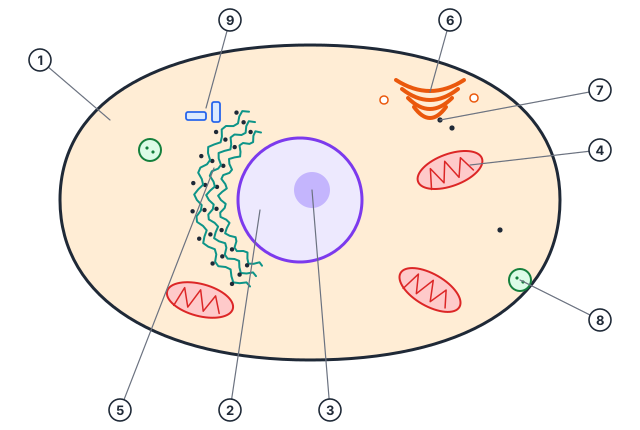
- The nucleus is surrounded by a double-membrane envelope with pores (exchange between nucleus and cytoplasm). Inside are nuclear sap, chromatin (DNA + protein, which forms chromosomes during division) and one or more nucleoli (where rRNA is made and ribosomal subunits are assembled). The nucleus stores hereditary information and controls the cell.
- The ER (endoplasmic reticulum) — a system of membrane channels and spaces: rough ER (ribosomes on its surface) — synthesis and transport of proteins; smooth ER — synthesis of lipids and carbohydrates, detoxification.
- The Golgi apparatus — a stack of flat cisternae: it collects, modifies and “packages” substances from the ER and releases them from the cell; it forms lysosomes; in plants it makes cell-wall materials.
- Lysosomes — vesicles full of digestive (hydrolytic) enzymes: digestion inside the cell, breakdown of worn-out organelles.
- Vacuoles — a plant cell has one large central vacuole filled with cell sap (salts, sugars, pigments) that maintains turgor. Animal cells have small food and contractile vacuoles.
§4. Double-membrane and non-membrane organelles
Mitochondria are double-membraned: the outer membrane is smooth and the inner one folds into cristae; the interior is the matrix. Here organic substances are oxidised with oxygen and ATP is made — the “power station of the cell”. Active cells (muscle, liver) have many mitochondria.
Plastids (plants only) are double-membraned:
- chloroplasts — green, with chlorophyll; thylakoids inside form grana; the organelle of photosynthesis;
- chromoplasts — with yellow, orange or red pigments (carotenoids): petals, ripe fruit, autumn leaves;
- leucoplasts — colourless; store reserves, mainly starch (potato tuber).
Plastids can change into one another: a leucoplast becomes a chloroplast in light (green potatoes), a chloroplast becomes a chromoplast (a tomato turning red).
Mitochondria and plastids have their own circular DNA and 70S ribosomes — they are semi-autonomous organelles.
Non-membrane organelles:
- ribosomes — made of a large and a small subunit; protein synthesis; 80S in eukaryotic cytoplasm, 70S in prokaryotes, mitochondria and plastids;
- the cell centre — two centrioles; in animal cells it forms the spindle (usually absent in higher plants);
- the cytoskeleton — microtubules and microfilaments: keeps cell shape and moves organelles;
- cilia and flagella — organelles of movement.
§5. Comparing different cells
Plant cell: cellulose wall, plastids, large central vacuole, starch store, usually no centrioles.
Animal cell: no wall (glycocalyx instead), no plastids, centrioles present, small vacuoles, glycogen store.
Fungal cell: chitin wall, no plastids, glycogen store.
Bacterial cell: murein wall, no nucleus or membrane-bound organelles, nucleoid, plasmids, 70S ribosomes.
Common to all cells: plasma membrane, cytoplasm, ribosomes and DNA as hereditary material.
§6. Symbiogenesis and the cell as a whole
The fact that mitochondria and chloroplasts have their own DNA, 70S ribosomes and two membranes, and divide by themselves, is explained by the endosymbiotic theory: ancient free-living aerobic bacteria and photosynthetic cyanobacteria entered a large cell, lived inside it in symbiosis and gradually became organelles.
The cell is an integrated system: its organelles work together. For example, a protein is made on a ribosome from the information in nuclear DNA, travels along the rough ER to the Golgi apparatus, is packaged there and released from the cell; mitochondria supply the energy for all this.
Worked example
Which organelles have their own DNA, and what does this show?
- Mitochondria and chloroplasts contain circular DNA and 70S ribosomes.
- These features make them resemble prokaryotes.
- The endosymbiotic theory: ancient free-living bacteria entered a eukaryotic cell and became organelles.
- Answer: mitochondria and plastids — semi-autonomous organelles.
Worked example
Match organisms whose cell walls are made of murein (a), cellulose (b) and chitin (c): Nostoc, field mushroom, cotton.
- Murein — bacteria and cyanobacteria: Nostoc → a.
- Cellulose — plants: cotton → b.
- Chitin — fungi: field mushroom → c.
- Answer: Nostoc — a, cotton — b, field mushroom — c.
Worked example
Onion skin cells were placed in a 10% salt solution. What is seen under the microscope, and why?
- The outside solution is more concentrated than the cell sap.
- By osmosis, water leaves the cell towards the more concentrated outside solution.
- The vacuole shrinks and the cytoplasm pulls away from the cell wall.
- Answer: plasmolysis; if the cell is returned to pure water, deplasmolysis occurs.
Check yourself
- Who said “every cell comes from a cell”?
- Which organelle has cristae?
- In which plastids is starch stored in a potato tuber?
- Which organelle forms lysosomes?
- What type of ribosomes do prokaryotes have?
- How does phagocytosis differ from pinocytosis?
- What is transport against a concentration gradient using ATP called?
- Which plastids form when a tomato turns red?
Common mistakes
- Calling the ribosome a membrane-bound organelle — it has no membrane.
- Thinking fungal walls are cellulose — they are chitin.
- Writing that centrioles are typical of higher plant cells — they are typical of animal cells.
- Mixing up the functions of rough and smooth ER.
- Naming Hooke as the author of cell theory — Schleiden and Schwann created it.
- Writing that in osmosis water moves from the concentrated solution to the dilute one — it is the other way round.
Score: 0 / 8 correct (0 attempted)