Learn first: Electric field and potential
Electric current is the ordered (directed) motion of charged particles. Direct-current circuits work everywhere, from a pocket torch to a car, a phone and a computer. If you know the link between current, voltage and resistance (Ohm’s law) and the rules for connecting conductors, you can simplify and solve even a complicated circuit step by step. This topic underlies “Work and power of current”, “Capacitors” and “Current in different media”.
§1. Electric current and current strength
A current needs three conditions:
- free charges (free electrons in a metal, ions in an electrolyte);
- an electric field that drives them, created by a source;
- a closed circuit.
Current is the charge passing through a cross-section of a conductor per unit time:
I = q/t, unit ampere (A): 1 A = 1 C/s
By convention the direction of current is the direction in which positive charges move: from the “+” terminal through the external circuit to “−”. In a metal the electrons move the opposite way.
Current can also be written through microscopic quantities:
I = n·e·v·S
where n is the concentration of free charges (number per m³), e the charge, v the drift speed and S the cross-sectional area. The drift speed of electrons is tiny (fractions of a millimetre per second), yet a lamp lights at once: the electric field travels along the circuit at nearly the speed of light, and all the electrons start moving together.
Worked example
A current of 1 A flows in a copper wire of cross-section 1 mm². The concentration of free electrons is n = 8.5·10²⁸ m⁻³. Find the drift speed.
- S = 1 mm² = 1·10⁻⁶ m².
- v = I/(neS) = 1/(8.5·10²⁸·1.6·10⁻¹⁹·10⁻⁶).
- v ≈ 7.4·10⁻⁵ m/s, only 0.07 mm per second.
§2. Voltage and Ohm’s law for a section of a circuit
Voltage is the work done by the electric field in moving a unit charge:
U = A/q, unit volt (V): 1 V = 1 J/C
The German physicist Georg Ohm (1827) found that the current in a conductor is directly proportional to the voltage across it:
I = U/R
The quantity R is the resistance, unit ohm (Ω): 1 Ω = 1 V/A. For a metal conductor the I(U) graph (current–voltage characteristic) is a straight line through the origin; the smaller its slope, the larger the resistance.
Meters: an ammeter is connected in series and must have a very small resistance; a voltmeter is connected in parallel with the part being measured and must have a very large resistance. Then the meters hardly change the current and voltage in the circuit.
§3. What resistance depends on
Moving electrons collide with the ions of the crystal lattice; this is the cause of resistance.
R = ρ·l/S
- ρ is the resistivity, Ω·m (in practice often Ω·mm²/m): copper 0.017, aluminium 0.028, nichrome 1.1 Ω·mm²/m. 1 Ω·mm²/m = 10⁻⁶ Ω·m.
- Doubling the length doubles R; doubling the diameter makes the area 4 times larger (S = πd²/4) and R 4 times smaller.
- The resistance of a metal grows with temperature: the ions vibrate more strongly and hinder the electrons more.
R = R₀(1 + αt), α is the temperature coefficient of resistance, K⁻¹
Some materials lose their resistance completely at very low temperature; this is superconductivity (discovered by Kamerlingh Onnes in mercury in 1911).
Worked example
An aluminium wire has a resistance of 3.5 Ω at 0 °C, α = 0.0028 K⁻¹. By how much does it increase at 200 °C?
- ΔR = R₀·α·t = 3.5·0.0028·200.
- ΔR = 1.96 Ω, so the resistance becomes 5.46 Ω.
§4. Connecting conductors
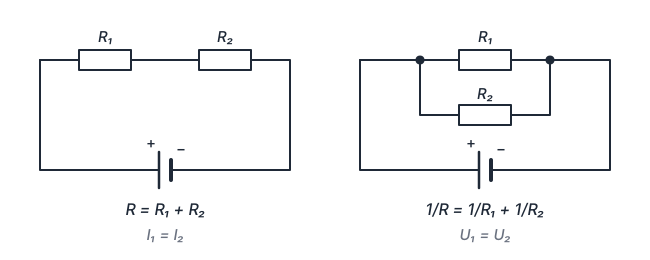
Series: R = R₁ + R₂ + ..., same I, U = U₁ + U₂ + ...
Parallel: 1/R = 1/R₁ + 1/R₂ + ..., same U, I = I₁ + I₂ + ...
- Two resistors in parallel: R = R₁R₂/(R₁ + R₂); n identical R₀: R = R₀/n.
- In parallel the total resistance is smaller than the smallest single resistance.
- In series the voltage divides in direct proportion to the resistances: U₁/U₂ = R₁/R₂.
- In parallel branches the current is inversely proportional to the resistances: I₁/I₂ = R₂/R₁.
Solving a mixed circuit: starting from the innermost parallel or series group, reduce the circuit to one equivalent resistance, find the total current, then work back to the voltage and current in each part. Household sockets are connected in parallel: each appliance gets 220 V, and switching one off does not affect the others.
Worked example
A 4 Ω resistor is in series with a parallel group of 6 Ω and 12 Ω; the circuit is connected to 24 V. Find the current in each resistor.
- Parallel part: 6·12/(6 + 12) = 4 Ω.
- Total resistance: R = 4 + 4 = 8 Ω; total current I = 24/8 = 3 A, which flows through the 4 Ω resistor.
- Voltage across the parallel part: U = 3·4 = 12 V.
- Branch currents: I₆ = 12/6 = 2 A, I₁₂ = 12/12 = 1 A (they add up to 3 A, correct).
§5. Extending the range of ammeters and voltmeters
- To let an ammeter measure a larger current, a small resistance, a shunt, is connected in parallel with it. To measure n times more current:
R_sh = R_A/(n − 1)
- To let a voltmeter measure a larger voltage, a series (multiplier) resistor is added:
R_s = R_V·(n − 1)
The idea is simple: the shunt takes the extra current, the multiplier takes the extra voltage.
Worked example
An ammeter of resistance 0.9 Ω and range 1 A must measure up to 10 A. What shunt is needed?
- n = 10/1 = 10.
- R_sh = 0.9/(10 − 1) = 0.1 Ω, connected in parallel with the ammeter.
§6. EMF and Ohm’s law for a complete circuit
Inside a source, charges are pushed against the electric forces by non-electrostatic forces: chemical in a battery, electromagnetic in a generator. The electromotive force (EMF) ℰ is the work these forces do in moving a unit positive charge; it is measured in volts. The source itself has resistance, the internal resistance r.
I = ℰ/(R + r)
Terminal voltage: U = IR = ℰ − Ir
- Open circuit (I = 0): U = ℰ, so a voltmeter shows the EMF.
- Short circuit (R ≈ 0): I = ℰ/r, the largest current; the source can overheat and fail, which is why fuses are used.
- Sources in series (same direction): ℰ = ℰ₁ + ℰ₂, r = r₁ + r₂.
- n identical sources in parallel: the EMF is still ℰ, the internal resistance is r/n.
Worked example
A source with ℰ = 6 V, r = 0.25 Ω delivers 2 A. Find the terminal voltage and the external resistance.
- U = ℰ − Ir = 6 − 2·0.25 = 5.5 V.
- R = U/I = 5.5/2 = 2.75 Ω.
- Check: I = 6/(2.75 + 0.25) = 2 A, correct.
Check yourself
- A charge of 240 C passes through a wire in 2 minutes. What is the current?
- Resistance of a copper wire 100 m long with cross-section 1.7 mm² (ρ = 0.017 Ω·mm²/m)?
- Four 8 Ω resistors are connected in parallel. Total resistance?
- ℰ = 12 V, r = 1 Ω, R = 5 Ω. Current?
- Short-circuit current of this source?
- A wire is stretched to twice its length at constant volume. How does its resistance change?
- A voltmeter of resistance 1000 Ω and range 10 V must measure up to 100 V. Series resistor?
- Two cells (1.5 V; 0.5 Ω) in series are connected to a 2 Ω resistor. Current?
Common mistakes
- Simply adding resistances that are in parallel.
- Mixing mm² and m²: check the units of ρ.
- Always taking the terminal voltage equal to the EMF: U = ℰ − Ir.
- Forgetting how diameter relates to area: S ∝ d².
- Connecting the ammeter in parallel and the voltmeter in series.
- Thinking electrons race along the wire at the speed of light: the field travels fast, the electrons drift slowly.
Score: 0 / 8 correct (0 attempted)