Learn first: Kinetic theory of matter
The ideal gas is one of the most successful models in physics: the molecules are as small as points and interact only when they collide. Under ordinary conditions air, oxygen, nitrogen and hydrogen obey this model very well, and three macroscopic quantities, pressure p, volume V and temperature T, are linked by a single equation. This equation explains tyres, gas cylinders, balloons, engines and weather, and it is the basis of thermodynamics.
§1. The ideal gas and the state variables
In the ideal-gas model:
- the molecules’ own volume is tiny compared with the container;
- attraction between molecules is neglected;
- collisions are perfectly elastic.
A real gas behaves almost ideally at low pressure and high temperature; when strongly compressed or cooled it turns into a liquid and the model fails.
The state of a gas is given by three state variables:
- Pressure p: the force of molecular impacts on the wall per unit area, Pa: 1 atm ≈ 1.013·10⁵ Pa, 760 mmHg.
- Volume V, m³: 1 l = 1 dm³ = 10⁻³ m³.
- Absolute temperature T, K: T = t + 273. Gas laws always use kelvins, because they contain proportionality to T, and 0 K is the lowest limit of molecular thermal motion.
These variables fully describe the state of the gas: knowing two of them, the third follows from the equation of state.
The amount of gas is the amount of substance ν = m/M = N/N_A (mol), N_A = 6.02·10²³ mol⁻¹.
§2. The ideal gas equation (Mendeleev–Clapeyron)
The equation of state of an ideal gas:
pV = νRT = (m/M)·RT, R = 8.31 J/(mol·K)
It can also be written with the number density n = N/V:
p = nkT, k = R/N_A = 1.38·10⁻²³ J/K (Boltzmann constant)
The equation gives the density of a gas:
ρ = pM/(RT)
At standard conditions (T = 273 K, p = 1.013·10⁵ Pa) one mole of any gas occupies 22.4 l: the kind of gas does not matter, only the number of moles.
Worked example
A cylinder of volume 8.31 l holds 2 mol of gas at 300 K. What is the pressure?
- Convert the volume: V = 8.31·10⁻³ m³.
- p = νRT/V = 2·8.31·300/(8.31·10⁻³).
- p = 600/10⁻³ = 6·10⁵ Pa.
Worked example
Find the density of air at 27 °C and 10⁵ Pa (M = 0.029 kg/mol).
- T = 27 + 273 = 300 K.
- ρ = pM/(RT) = 10⁵·0.029/(8.31·300).
- ρ ≈ 1.16 kg/m³.
§3. The combined gas law and isoprocesses
If the mass (and kind) of gas is fixed, the ideal gas equation gives pV/T = νR = const:
p₁V₁/T₁ = p₂V₂/T₂ (the combined gas law)
Processes in which one variable is constant are called isoprocesses:
- Isothermal (T = const), Boyle’s law: pV = const. When a gas is compressed slowly, its temperature keeps level with the surroundings.
- Isobaric (p = const), Gay-Lussac’s law: V/T = const. For example, heating gas in a cylinder with a free piston.
- Isochoric (V = const), Charles’s pressure law: p/T = const. For example, heating a closed cylinder or a tyre.
Molecular explanation: in isothermal compression the molecules keep their speed but their concentration rises, so there are more impacts on the wall and the pressure grows. In isochoric heating the concentration is unchanged, but the molecules move faster and hit the wall harder and more often. In isobaric heating the gas expands, lowering the concentration and so compensating for the higher speed.
These laws are special cases of the ideal gas equation; they were discovered separately by experiment between the seventeenth and nineteenth centuries.
Worked example
A gas is heated at constant pressure from 27 °C to 127 °C. By what factor does its volume increase?
- Convert to kelvins: T₁ = 300 K, T₂ = 400 K.
- V₂/V₁ = T₂/T₁ = 400/300 ≈ 1.33.
- Note: working in °C gives 127/27 ≈ 4.7, which is completely wrong.
Worked example
A 1 cm³ air bubble forms at the bottom of a lake 10 m deep and rises. The temperature is constant and atmospheric pressure is 10⁵ Pa. What is its volume at the surface?
- Pressure at the bottom: p₁ = p₀ + ρgh = 10⁵ + 1000·10·10 = 2·10⁵ Pa.
- Isothermal process: p₁V₁ = p₂V₂.
- V₂ = 2·10⁵·1/10⁵ = 2 cm³.
§4. Graphs of isoprocesses
On p–V, V–T and p–T axes:
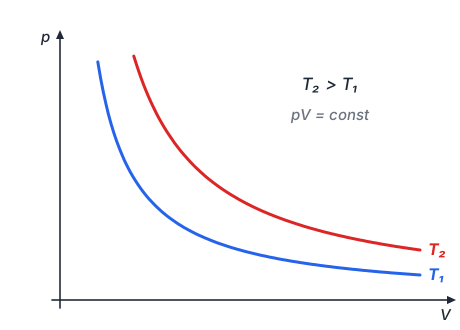
- An isotherm is a hyperbola on p–V (a higher hyperbola means a higher temperature); on V–T and p–T it is a line perpendicular to the T axis.
- An isobar on V–T is a straight line through the origin; the steeper it is, the lower the pressure (V = νRT/p). On p–V it is a line parallel to the V axis.
- An isochore on p–T is a straight line through the origin; steeper means smaller volume. On p–V it is a line parallel to the p axis.
In a graph problem, first decide which quantity is constant on each part, then “redraw” the process on the other axes. Remember: a line through the origin is an isobar on V–T and an isochore on p–T.
§5. Processes with changing mass and Dalton’s law
If gas leaves or enters a cylinder, the combined gas law does not apply; write the ideal gas equation separately for each state. At constant V, the mass m ∝ p/T.
In a mixture of gases that do not react, each gas behaves as if it were alone in the container:
Dalton’s law: p = p₁ + p₂ + ..., each pᵢ = νᵢRT/V
pᵢ is the partial pressure. Air pressure is the sum of the partial pressures of nitrogen, oxygen and other gases.
Worked example
Gas in a cylinder was at 10 MPa and 300 K. After part of it was used, the temperature fell to 270 K and the pressure to 6 MPa. What fraction of the gas was used?
- Since V = const, m₂/m₁ = (p₂/T₂)/(p₁/T₁).
- m₂/m₁ = (6/270)/(10/300) = 0.0222/0.0333 ≈ 0.667.
- Two thirds remain, so 1/3 of the gas was used.
Worked example
A 0.0249 m³ vessel at 300 K contains 1 mol of nitrogen and 0.5 mol of oxygen. Pressure of the mixture?
- Total amount: ν = 1 + 0.5 = 1.5 mol.
- p = νRT/V = 1.5·8.31·300/0.0249.
- p ≈ 1.5·10⁵ Pa (partial pressure of nitrogen 10⁵ Pa, of oxygen 0.5·10⁵ Pa).
Check yourself
- In isothermal compression the volume falls 3 times. How does the pressure change?
- Gas in a cylinder is heated from 0 °C to 273 °C (V = const). By what factor does the pressure rise?
- What volume does 1 mol of gas occupy at standard conditions?
- The volume doubles and the temperature triples. How does the pressure change?
- 16 g of oxygen (M = 32 g/mol) at 300 K occupies 0.0249 m³. Pressure?
- Half the gas is let out of a cylinder at constant temperature. How does the pressure change?
- Tyre pressure is 2·10⁵ Pa at 7 °C. What is it at 37 °C (V = const)?
- Which process is a straight line through the origin on a V–T graph?
Common mistakes
- Using °C: gas laws need kelvins only.
- Applying p₁V₁/T₁ = p₂V₂/T₂ when the mass of gas changes.
- Leaving volume in litres or mass in grams when using R = 8.31.
- Misreading the slope of an isobar on V–T: steeper means lower pressure.
- Forgetting to add atmospheric pressure to the pressure under a liquid.
Score: 0 / 8 correct (0 attempted)