PhysicsPhysics · 5 / 36
Gravitational, elastic and friction forces
School curriculum· 30 min· 21 questions
Learn first: Newton's laws
To apply Newton’s laws you must know exactly which forces act on a body. In mechanics problems three forces matter most: gravity (weight), the elastic force and friction. Each has its own nature, its own formula and its own traps. This topic is the basis for drawing and calculating forces correctly in problems on Newton’s laws, statics, energy and oscillations.
§1. Force and resultant force
A force measures the action of one body on another; it is force that changes a body’s velocity (gives it acceleration) or deforms it.
- Force is a vector: it has a size, a direction and a point of application.
- The unit is the newton (N): 1 N = 1 kg·m/s², the force that gives a 1 kg mass an acceleration of 1 m/s².
- Force is measured with a newton meter (a spring balance, based on Hooke’s law).
Several forces acting on a body can be replaced by a single resultant, their vector sum. Forces in the same direction add, opposite forces subtract, and for perpendicular forces R = √(F₁² + F₂²). For example, perpendicular forces of 3 N and 4 N give a resultant of 5 N.
When solving a problem, first isolate the body and draw all the forces on it: weight, normal reaction, tension, friction, any applied pull. Then choose axes and write Newton’s second law in components.
§2. Gravity and the weight of a body
The Earth attracts all bodies:
F = mg, g ≈ 9.8 ≈ 10 m/s²
The force of gravity always points vertically downwards and acts at the body’s centre of gravity. It is the special case of universal gravitation near the Earth’s surface.
The weight P in the strict sense is a different force: the force with which a body presses on its support or stretches its suspension; it acts on the support. For a body at rest or moving uniformly P = mg, but with acceleration it differs:
- a lift accelerating upwards: P = m(g + a), overload;
- accelerating downwards: P = m(g − a);
- in free fall (a = g): P = 0, weightlessness. Astronauts in orbit are in permanent free fall.
Worked example
A 60 kg person stands in a lift. What do the scales read when the lift accelerates at 2 m/s² upwards and downwards?
- Upwards: P = m(g + a) = 60·(10 + 2) = 720 N.
- Downwards: P = m(g − a) = 60·(10 − 2) = 480 N.
- At rest it would be P = mg = 600 N.
§3. The elastic force and Hooke’s law
When a body is deformed (stretched, compressed, bent), the distances between its particles change and an elastic force appears that tries to restore the shape. Its nature is electromagnetic (forces between atoms).
Hooke’s law: F_el = k·Δx, k is the stiffness (spring constant), N/m
- The force opposes the deformation (as a component, F = −kx).
- Δx is the deformation, i.e. the change in length, not the spring’s length.
- The law holds only for small elastic deformations (ones that disappear when the load is removed).
Combining springs:
Parallel: k = k₁ + k₂ (stiffer) · Series: 1/k = 1/k₁ + 1/k₂ (softer)
If a spring is cut in half, each half has stiffness 2k.
The normal reaction N and tension T are elastic forces too: N is perpendicular to the surface, T acts along the string.
Worked example
A 0.5 kg load hangs from a spring of stiffness 200 N/m. How much does the spring stretch?
- In equilibrium kΔx = mg.
- Δx = mg/k = 0.5·10/200 = 0.025 m = 2.5 cm.
§4. Friction
Surfaces in contact produce a force that opposes motion: friction. It comes from interlocking surface roughness and attraction between molecules.
- Static friction: until the body moves, it equals the applied force and opposes it; it can take any value from 0 up to a maximum μN.
- Sliding (kinetic) friction opposes the motion:
F_fr = μN
μ is the coefficient of friction (dimensionless); it depends on the materials and smoothness of the surfaces and hardly at all on the contact area. On a horizontal surface N = mg, but if you pull or push at an angle, N changes!
- Rolling friction is much smaller than sliding friction, which is why wheels and bearings were invented. Lubrication also reduces friction.
Friction is not always harmful: without it we could not walk, and a car could neither start nor brake.
Worked example
A braking car leaves a 25 m skid mark and stops; μ = 0.45. What was its initial speed?
- Only friction decelerates it: μmg = ma → a = μg = 4.5 m/s².
- v₀² = 2as = 2·4.5·25 = 225.
- v₀ = 15 m/s (54 km/h).
Worked example
A 10 kg box is pulled by a 50 N force at 30° above the horizontal; μ = 0.2. Find the acceleration.
- The vertical component lifts the box slightly: N = mg − F·sin 30° = 100 − 25 = 75 N.
- Friction: F_fr = μN = 0.2·75 = 15 N; horizontal pull: F·cos 30° ≈ 43.3 N.
- a = (43.3 − 15)/10 ≈ 2.8 m/s².
§5. The inclined plane
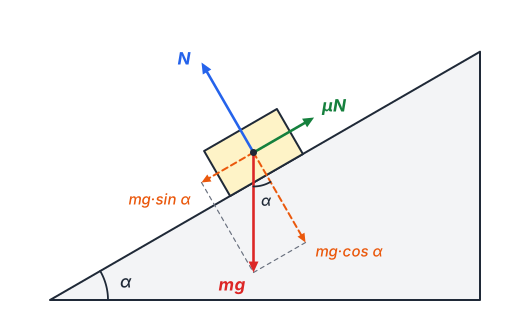
For a body on a slope of angle α, take axes along and perpendicular to the slope and split the weight into two components:
along the slope mg·sin α, perpendicular to it mg·cos α; N = mg·cos α
- Sliding without friction: a = g·sin α.
- Sliding down with friction: a = g(sin α − μ·cos α).
- The body stays at rest if tg α ≤ μ, which is a way to measure μ.
- To pull the body steadily up the slope: F = mg(sin α + μ·cos α).
Worked example
A body slides down a 30° slope with μ = 0.2. Acceleration?
- sin 30° = 0.5, cos 30° ≈ 0.87.
- a = g(sin α − μcos α) = 10·(0.5 − 0.2·0.87).
- a ≈ 3.3 m/s².
Check yourself
- A 4 N force stretches a spring by 2 cm. Stiffness?
- Two springs of 100 N/m are joined in series. Total stiffness?
- A steady pull of 30 N moves a 10 kg box along a horizontal floor. Coefficient of friction?
- A 5 N horizontal force acts on a 5 kg body on a table, μ = 0.2. Friction force?
- Acceleration on a smooth 30° slope?
- What minimum μ keeps a body at rest on a 45° slope?
- A 50 kg person is in a freely falling lift. Weight?
- Forces of 3 N and 4 N are perpendicular. Resultant?
Common mistakes
- Always taking friction as μmg: on a slope it is μmg·cos α, and for a body at rest it equals the applied force.
- Swapping the formulas for springs in series and in parallel.
- Using the spring’s length in Hooke’s law instead of its extension Δx.
- Always assuming N = mg.
- Treating the force of gravity and weight as the same thing: they act on different bodies and differ when there is acceleration.
Score: 0 / 8 correct (0 attempted)