Learn first: Work, power and energy
An oscillation is a motion that repeats exactly or nearly over time: a clock pendulum, a mass on a spring, a car’s suspension, a heartbeat, a guitar string. When an oscillation spreads through a medium, a wave is formed. The formulas of oscillations look the same in mechanics, acoustics and electrical engineering, so this topic underlies sound, alternating current, electromagnetic oscillations and waves.
§1. Quantities that describe an oscillation
An oscillation needs two things: a force that pulls the body back to equilibrium, and inertia (the body overshoots equilibrium).
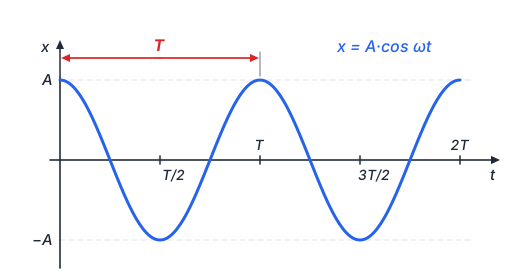
- Amplitude A: the greatest displacement from equilibrium (m).
- Period T: the time of one complete oscillation (s): T = t/N.
- Frequency ν = 1/T = N/t: oscillations per second (Hz).
- Angular frequency ω = 2πν = 2π/T (rad/s).
- Phase ωt + φ₀ describes the state of the oscillation at a given moment; φ₀ is the initial phase.
In one complete oscillation the body travels 4A: from equilibrium to one extreme, back to equilibrium, to the other extreme and back again.
§2. Simple harmonic motion
The most important case is simple harmonic motion: the position varies as a sine or cosine.
x = A·cos(ωt + φ₀)
v = −Aω·sin(ωt + φ₀), a = −Aω²·cos(ωt + φ₀) = −ω²x
- The speed is greatest at equilibrium (v_max = Aω) and zero at the extremes.
- The acceleration, conversely, is greatest at the extremes (a_max = Aω²) and zero at equilibrium; it always points towards equilibrium.
- a = −ω²x is the “fingerprint” of SHM: the acceleration is proportional to the displacement and opposite to it.
Worked example
A body oscillates as x = 0.05·cos(10t) (m). Find the amplitude, period, maximum speed and maximum acceleration.
- From the equation: A = 0.05 m, ω = 10 rad/s.
- T = 2π/ω = 6.28/10 ≈ 0.63 s.
- v_max = Aω = 0.05·10 = 0.5 m/s, a_max = Aω² = 0.05·100 = 5 m/s².
§3. The mass–spring oscillator
If a mass on a spring is displaced by x, a restoring force F = −kx acts (Hooke’s law). Newton’s second law gives ma = −kx, i.e. a = −(k/m)x, which is SHM with ω² = k/m:
T = 2π√(m/k), ω = √(k/m)
- The period does not depend on the amplitude or on g: a mass on a spring oscillates the same way on the Moon or in a spacecraft.
- Quadrupling the mass doubles the period; quadrupling the stiffness halves it.
- For a vertical spring, gravity only shifts the equilibrium position by Δl = mg/k and does not affect the period; hence the handy formula T = 2π√(Δl/g).
§4. The simple pendulum
A simple pendulum is a point mass on a light, inextensible string. For small swings (up to about 10°) the restoring force is −mg·x/l and the motion is harmonic:
T = 2π√(l/g)
- The period does not depend on the mass, only on the length and g; for small swings it does not depend on the amplitude either (isochronism, discovered by Galileo).
- A pendulum with a period of 2 s is about 1 m long, as in old wall clocks.
- In an accelerating lift: upwards g_eff = g + a, downwards g − a; on another planet g changes.
A pendulum can measure g accurately: g = 4π²l/T². A physical pendulum (any rigid body, such as a swinging ruler or a person’s leg) also oscillates, but its period depends on the body’s shape.
Worked example
A 0.5 m pendulum is taken to a planet with twice the Earth’s mass and twice its radius, and placed in a lift accelerating upwards at 5 m/s². What is its period?
- On the planet g′ = g·M′R²/(MR′²) = 10·2/2² = 5 m/s².
- In the lift g_eff = 5 + 5 = 10 m/s².
- T = 2π√(0.5/10) = 2π·0.224 ≈ 1.4 s.
§5. Energy, damping and resonance
In SHM potential and kinetic energy keep turning into each other, while the total energy is conserved:
E = kA²/2 = mv_max²/2 = kx²/2 + mv²/2
At an extreme all the energy is potential; at equilibrium it is all kinetic.
- Free oscillations: the system is left to itself; its frequency is the natural frequency.
- Damped oscillations: friction and air resistance remove energy and the amplitude falls.
- Forced oscillations: driven by a periodic external force; the system oscillates at the driving frequency.
- Resonance: a sharp rise in amplitude when the driving frequency equals the natural frequency. That is why soldiers break step on bridges and why machines and buildings are designed against vibration; musical instruments and radio receivers, on the other hand, use resonance to advantage.
Worked example
A 0.5 kg mass on a 100 N/m spring oscillates with an amplitude of 10 cm. Find the total energy and the maximum speed.
- E = kA²/2 = 100·0.1²/2 = 0.5 J.
- mv_max²/2 = E → v_max = √(2E/m) = √(2·0.5/0.5) = √2 ≈ 1.41 m/s.
§6. Mechanical waves
A wave is an oscillation spreading through an elastic medium: each particle sets its neighbour moving. A wave carries energy, not matter; a float on water bobs up and down instead of drifting away with the wave.
- Transverse wave: particles oscillate at right angles to the direction of travel (a wave on a rope, on the surface of water). Inside matter it travels only in solids, since it needs shear deformation.
- Longitudinal wave: particles oscillate along the direction of travel, forming compressions and rarefactions (sound). It travels in any medium.
λ = v·T = v/ν
The wavelength λ is the distance between the nearest points oscillating in phase (two neighbouring crests or compressions), i.e. how far the wave travels in one period.
Wave speed depends on the medium, frequency on the source; so when a wave enters another medium its frequency stays the same and its wavelength changes. Waves reflect from obstacles (echoes), add up to reinforce or cancel each other (interference) and bend around obstacles (diffraction).
Worked example
The distance between the 1st and 3rd crests of a wave is 20 cm and the wave speed is 0.1 m/s. What is the period?
- There are two wavelengths between the 1st and 3rd crests: 2λ = 0.2 m → λ = 0.1 m.
- T = λ/v = 0.1/0.1 = 1 s.
Check yourself
- A body makes 20 oscillations in 10 s. Period and frequency?
- A pendulum string is made 4 times longer. How does the period change?
- The mass on a spring is made 4 times larger. How does the frequency change?
- A 0.4 kg mass hangs on a 40 N/m spring. Period?
- A 5 Hz wave travels at 2 m/s. Wavelength?
- Amplitude 5 cm, ω = 10 rad/s. Maximum speed?
- Length of a simple pendulum with period 2 s (g = 10 m/s²)?
- How far does a body with amplitude 3 cm travel in one complete oscillation?
Common mistakes
- Thinking the period of a simple pendulum depends on its mass.
- Taking the distance between the 1st and 3rd crests as one λ.
- Putting g into the period of a mass–spring system.
- Thinking a wave carries matter: it carries only energy.
- Taking the distance per period as 2A: it is 4A.
Score: 0 / 8 correct (0 attempted)