Learn first: Electrolytic dissociation, Redox reactions
The electrochemical series of metals and electrolysis are two sides of one idea: which particle gives up electrons more easily and which accepts them more easily. In a galvanic cell the energy of a chemical reaction becomes electrical energy (batteries, accumulators); in electrolysis, the reverse happens — an electric current forces a redox reaction that would not go by itself. Electrolysis is used to produce reactive metals (sodium, aluminium), chlorine, hydrogen and alkali, to purify metals and to plate one metal with another. Exam papers regularly ask you to predict electrode products and to calculate using Faraday’s law.
§1. The electrochemical series of metals
Li K Ba Ca Na Mg Al Mn Zn Cr Fe Ni Sn Pb (H) Cu Hg Ag Pt Au
From left to right the reducing power of the metals (their tendency to give up electrons) decreases and the oxidising power of their ions increases. Rules that follow from the series:
- A metal displaces a metal further right from a solution of its salt: Zn + CuSO₄ → ZnSO₄ + Cu; Fe + CuSO₄ → FeSO₄ + Cu. The reverse does not happen: copper cannot displace zinc.
- Metals before hydrogen displace H₂ from dilute HCl and H₂SO₄; those after it (Cu, Hg, Ag, Pt, Au) do not.
- Exception: very reactive metals that react with water (Li–Na) react with the water of a salt solution first: 2Na + 2H₂O → 2NaOH + H₂, and the alkali then reacts with the salt: 2NaOH + CuSO₄ → Cu(OH)₂↓ + Na₂SO₄. So sodium does not displace copper from a solution.
Worked example
A zinc plate was placed in copper(II) sulfate solution, and 0.1 mol of zinc reacted. How does the mass of the plate change?
- Zn + CuSO₄ → ZnSO₄ + Cu: 0.1 mol Zn dissolves and 0.1 mol Cu is deposited.
- Zinc dissolved: 0.1·65 = 6.5 g; copper deposited: 0.1·64 = 6.4 g.
- The plate loses 6.5 − 6.4 = 0.1 g.
§2. Galvanic cells and corrosion
If two different metals are placed in an electrolyte and connected by a wire, the more reactive metal gives up electrons and dissolves (the anode, negative terminal), while the electrons flow through the wire to the less reactive metal, where reduction occurs (the cathode, positive terminal). The Daniell cell: Zn | ZnSO₄ || CuSO₄ | Cu, with Zn → Zn²⁺ + 2e⁻ and Cu²⁺ + 2e⁻ → Cu. The farther apart the metals are in the series, the larger the cell voltage.
Corrosion of metals is also often speeded up by a galvanic couple: iron rusts faster where it touches copper because the iron becomes the anode. Conversely, in galvanised iron the zinc is the anode, corrodes and protects the iron (sacrificial protection). Other ways to prevent corrosion are painting and greasing, coating with another metal (nickel or chromium plating), using stainless alloys and adding inhibitors to the environment.
§3. Electrolysis of solutions
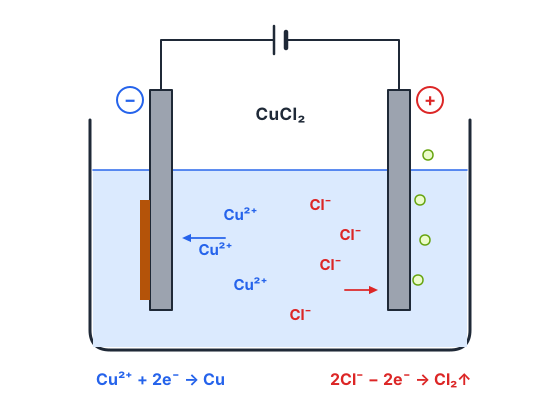
Electrolysis is a redox process at the electrodes when direct current passes through a solution or melt of an electrolyte. Rule: cathode (−) — reduction; anode (+) — oxidation.
At the cathode (depending on the metal’s reactivity):
- ions from Li…Al are not reduced in solution — water is reduced instead: 2H₂O + 2e⁻ → H₂ + 2OH⁻.
- Mn…Pb (after Al, before H) — both the metal and H₂ may form.
- Cu, Ag, Hg, Au — the metal only: Cu²⁺ + 2e⁻ → Cu.
- In acid solutions: 2H⁺ + 2e⁻ → H₂.
At an inert (carbon, platinum) anode:
- oxygen-free anions (Cl⁻, Br⁻, I⁻, S²⁻) are oxidised: 2Cl⁻ − 2e⁻ → Cl₂.
- oxoanions (SO₄²⁻, NO₃⁻, PO₄³⁻) and F⁻ are not oxidised — water is: 2H₂O − 4e⁻ → O₂ + 4H⁺.
- in alkali solution: 4OH⁻ − 4e⁻ → O₂ + 2H₂O.
At an active (for example copper) anode the anode metal itself is oxidised and dissolves: Cu − 2e⁻ → Cu²⁺. Copper refining and electroplating rely on this.
2NaCl + 2H₂O → H₂↑ (cathode) + Cl₂↑ (anode) + 2NaOH — the chlor-alkali industry
2CuSO₄ + 2H₂O → 2Cu + O₂↑ + 2H₂SO₄
Na₂SO₄ or KNO₃ solutions: in effect water is split 2H₂O → 2H₂ + O₂, and the salt becomes more concentrated
Worked example
A solution containing 23.4 g of NaCl was electrolysed completely. What volume of gas (STP) forms at each electrode, and what mass of NaOH forms?
- n(NaCl) = 23.4/58.5 = 0.4 mol.
- 2NaCl → H₂ + Cl₂ + 2NaOH: 0.2 mol each of H₂ and Cl₂, each 0.2·22.4 = 4.48 L.
- n(NaOH) = 0.4 mol, m = 0.4·40 = 16 g.
§4. Electrolysis of melts
A melt contains no water, so the metal ion itself is reduced at the cathode, and even the most reactive metals can be obtained:
2NaCl(melt) → 2Na + Cl₂; CaCl₂(melt) → Ca + Cl₂
Molten alkali: 4NaOH → 4Na + O₂ + 2H₂O
Aluminium: from Al₂O₃ dissolved in molten cryolite, 2Al₂O₃ → 4Al + 3O₂
Cryolite Na₃AlF₆ lowers the working temperature from above 2000 °C (the melting point of alumina) to about 950 °C, saving energy. Alkali and alkaline-earth metals, magnesium and aluminium are produced only by electrolysis of melts, because they are very hard to reduce with chemical reducing agents.
§5. Faraday’s laws
M. Faraday (1833–1834) found that the mass of substance released at an electrode is directly proportional to the charge passed.
m = M·I·t/(n·F); F = 96 500 C/mol — the charge on 1 mol of electrons (the Faraday constant)
Here I is the current (A), t the time (s) and n the number of electrons gained or lost per particle. It is easiest to work in two steps: first the amount of electrons n(e⁻) = I·t/F, then the amount of substance from the electrode equation. Cells connected in series pass the same charge, so the same amount of electrons flows through each.
Worked example
CuSO₄ solution was electrolysed with a current of 5 A for 1930 s (inert electrodes). Calculate the products at the cathode and anode.
- Q = 5·1930 = 9650 C → n(e⁻) = 9650/96500 = 0.1 mol.
- Cathode Cu²⁺ + 2e⁻ → Cu: n(Cu) = 0.05 mol, m = 0.05·64 = 3.2 g.
- Anode 2H₂O − 4e⁻ → O₂ + 4H⁺: n(O₂) = 0.025 mol, V = 0.56 L (STP).
Check yourself
- What forms at the cathode and anode in the electrolysis of KI solution?
- Which metal displaces iron from FeSO₄ solution: Cu, Zn, Ag?
- Electrolysis of AgNO₃ solution deposited 10.8 g of silver. What volume of O₂ (STP) formed at the anode?
- Why is sodium not obtained by electrolysing NaCl solution?
- How does the solution change during electrolysis of KNO₃?
- How many faradays are needed to produce 1 mol of aluminium?
- How many seconds does a 10 A current take to deposit 6.4 g of copper?
- What is released at the cathode in the electrolysis of molten CaCl₂?
Common mistakes
- Mixing up cathode and anode: in electrolysis the cathode is negative and reduction occurs there.
- Writing that ions of reactive metals (Na, K, Al) are reduced from solution.
- Thinking sulfate and nitrate ions are oxidised at the anode: water is oxidised instead.
- Writing that sodium displaces copper from a solution of its salt.
- Forgetting the ion charge (n) in Faraday’s law.
Score: 0 / 8 correct (0 attempted)