Learn first: Types of chemical reactions
Some reactions are instantaneous (explosions, precipitation between ions), others take months or years (rusting, weathering of rocks). The study of reaction rates is chemical kinetics. Controlling rates is the basis of industrial chemistry: in making ammonia and sulfuric acid, the temperature, pressure and catalyst are chosen precisely from the laws of rate and chemical equilibrium; keeping food in a refrigerator and protecting metals from corrosion are everyday examples of slowing reactions down. Exam questions regularly test the rate law, the van ’t Hoff rule and Le Chatelier’s principle.
§1. Reaction rate and the factors affecting it
In a homogeneous reaction (all substances in one phase — gas or solution), the rate is the change in concentration of a reactant or product per unit time:
v = ΔC/Δt (mol/(L·s))
In a heterogeneous reaction (between different phases, such as a metal and an acid) the reaction happens at the boundary, so the rate is expressed per unit surface area.
Factors affecting rate:
- the nature of the reactants (potassium reacts violently with water, magnesium slowly);
- concentration;
- temperature;
- a catalyst or inhibitor;
- surface area in heterogeneous reactions (grinding speeds things up — flour dust can explode);
- pressure, for gases.
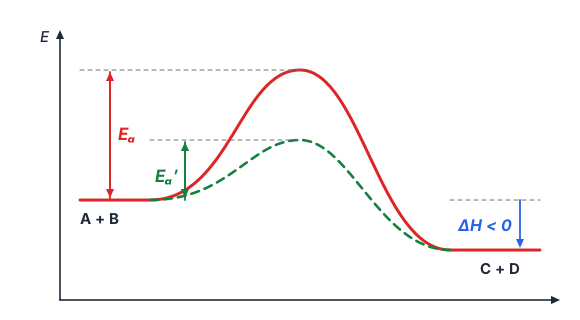
For a reaction to happen, particles must collide, and the collision must have enough energy. The minimum extra energy that particles need in order to react is the activation energy.
Worked example
In 10 s the concentration of a substance fell from 1.2 to 0.8 mol/L. Find the average rate.
- ΔC = 1.2 − 0.8 = 0.4 mol/L.
- v = ΔC/Δt = 0.4/10.
- v = 0.04 mol/(L·s).
§2. The effect of concentration — the rate law
aA + bB → …: v = k·[A]ᵃ·[B]ᵇ (k is the rate constant; for elementary reactions)
Higher concentration means more collisions per unit time and a faster rate. The rate constant k depends on the nature of the substances and on temperature, not on concentration. Concentrations of solids are not included: for C(s) + O₂ → CO₂, v = k[O₂]. If the pressure of a gas mixture is increased n times (the volume reduced n times), the concentration of each gas also increases n times.
Worked example
2NO + O₂ → 2NO₂. The pressure was tripled. By what factor does the rate change?
- v = k[NO]²[O₂].
- Each concentration triples.
- v₂/v₁ = 3²·3 = 27 — the rate increases 27 times.
§3. The effect of temperature — the van ’t Hoff rule
v₂/v₁ = γ^((t₂ − t₁)/10), γ = 2–4 (the temperature coefficient)
For every 10 °C rise in temperature, most reaction rates increase 2–4 times. The reason is not just more collisions: mainly, the fraction of active molecules with energy above the activation energy rises sharply. Reaction time is inversely proportional to rate: if the rate rises 8 times, the time falls 8 times. That is why food spoils more slowly in a fridge and cooks faster in a pressure cooker.
Worked example
The rate of A + B → C at 60 °C is 3.6 mol/(L·min). At 30 °C, [A] fell from 0.6 to 0.3 mol/L in 40 s. Find the temperature coefficient.
- Rate at 30 °C: 0.3/40 = 0.0075 mol/(L·s) = 0.45 mol/(L·min).
- 3.6/0.45 = 8 = γ^((60 − 30)/10) = γ³.
- γ = 2.
§4. Catalysts and inhibitors
A catalyst speeds up a reaction without being used up: by forming an intermediate with the reactants it opens a pathway with a lower activation energy. A catalyst speeds up the forward and reverse reactions equally, so it does not shift the equilibrium — it only helps reach it sooner. Examples: MnO₂ (decomposition of H₂O₂ and KClO₃), V₂O₅ (oxidation of SO₂), iron (ammonia synthesis), platinum (oxidation of ammonia), nickel (hydrogenation). Enzymes are biological catalysts; they are very selective and work at body temperature. Inhibitors slow reactions down (against corrosion, in food preservation).
§5. Chemical equilibrium and Le Chatelier’s principle
In a reversible reaction the forward rate falls and the reverse rate rises; when they become equal, chemical equilibrium is established. Equilibrium is dynamic: both reactions continue, but the concentrations stay constant. Irreversible reactions, by contrast, go to completion.
Le Chatelier’s principle: if a system at equilibrium is disturbed, the equilibrium shifts so as to reduce the disturbance
- Adding a reactant or removing a product → the equilibrium shifts to the right.
- Raising the temperature → towards the endothermic direction; lowering it → towards the exothermic direction.
- Raising the pressure → towards fewer moles of gas; if the numbers are equal, pressure has no effect.
- A catalyst does not shift the equilibrium.
An industrial example is the Haber process N₂ + 3H₂ ⇌ 2NH₃ + Q. The reaction is exothermic and reduces the number of gas molecules, so low temperature and high pressure favour the equilibrium. But at low temperature the reaction is very slow, so a compromise temperature (about 450 °C), high pressure (200–300 atm) and an iron catalyst are used, and the ammonia formed is cooled, liquefied and continuously removed — which also shifts the equilibrium to the right. Unreacted nitrogen and hydrogen are recycled to the reactor.
Worked example
What conditions increase the yield of CO in CH₄(g) + CO₂(g) ⇌ 2CO(g) + 2H₂(g) − Q?
- The reaction is endothermic → raise the temperature.
- 2 mol of gas on the left, 4 mol on the right → lower the pressure.
- Remove the products or add CH₄ and CO₂.
§6. The equilibrium constant
aA + bB ⇌ cC + dD: K = [C]ᶜ·[D]ᵈ/([A]ᵃ·[B]ᵇ) (equilibrium concentrations)
The equilibrium constant depends only on temperature and the nature of the substances; concentration, pressure and catalysts do not change it. A large K means the equilibrium lies towards the products. Solids and water in solution are not included. If the concentration ratio in a system is less than K, the reaction proceeds towards the products; if greater, in reverse; when they are equal, the system is at equilibrium.
Worked example
At equilibrium in H₂ + I₂ ⇌ 2HI, [H₂] = [I₂] = 0.1 mol/L and [HI] = 0.8 mol/L. Find the equilibrium constant.
- K = [HI]²/([H₂]·[I₂]).
- K = 0.8²/(0.1·0.1) = 0.64/0.01.
- K = 64.
Check yourself
- γ = 3, and the temperature rose from 20 °C to 50 °C. By what factor does the rate increase?
- How should temperature and pressure be changed to increase the yield of SO₃ in 2SO₂ + O₂ ⇌ 2SO₃ + Q?
- Which way does the equilibrium H₂ + I₂ ⇌ 2HI shift when pressure is raised?
- In A + 2B → C, [B] is doubled. By what factor does the rate increase?
- At 20 °C a reaction takes 81 minutes. How long does it take at 60 °C if γ = 3?
- Does a catalyst affect the equilibrium constant?
- By what factor does the rate of C(s) + O₂ → CO₂ increase if the oxygen concentration is quadrupled?
- Which way does the equilibrium of an exothermic reaction shift on heating?
Common mistakes
- Including the concentration of a solid in the rate expression.
- Thinking a catalyst shifts the equilibrium.
- Forgetting to divide the temperature difference by 10 in the van ’t Hoff rule.
- Writing that pressure affects an equilibrium with equal numbers of moles of gas.
- Thinking reactions stop at equilibrium: equilibrium is dynamic.
Score: 0 / 8 correct (0 attempted)