Learn first: Points, lines and angles
The circle is the most frequent figure in geometry: it appears in problems on triangles, polygons, coordinates and even trigonometry. Most circle problems rest on three facts: a tangent is perpendicular to the radius, an inscribed angle is half its arc, and the products of the segments of intersecting chords are equal. Spotting them in a diagram turns a complicated picture into simple right-angled triangles. Below we also explain why each rule is true.
§1. Basic elements and formulas
A circle is the set of all points of a plane at the same distance R from a given point (the centre). A disc is the circle together with its interior. Keep them apart: a circle has a length, a disc has an area.
Basic elements:
- radius R — a segment from the centre to a point of the circle;
- diameter d = 2R — a chord through the centre;
- chord — a segment joining two points of the circle; the longest chord is a diameter;
- arc — the part of the circle between two points; measured in degrees (the whole circle is 360°);
- tangent — a line with exactly one common point with the circle;
- secant — a line cutting the circle at two points.
Circumference C = 2πR = πd; disc area S = πR²
Arc length l = πRα/180°; sector area S = πR²α/360° = lR/2
The arc and sector formulas make sense: an arc of α degrees is α/360 of the whole circle, so both length and area are taken in that proportion.
Two important facts about chords:
- The perpendicular from the centre to a chord bisects it. Reason: the centre and the chord’s endpoints form an isosceles triangle (two sides equal to R), and its altitude is also a median. Hence R² = h² + (chord/2)², where h is the distance from the centre to the chord.
- Equal chords are equidistant from the centre and subtend equal arcs.
Worked example
In a circle of radius 5 a chord is drawn at distance 3 from the centre. Find the chord’s length.
- Drop a perpendicular from the centre to the chord; it bisects the chord.
- In the right-angled triangle the hypotenuse is R = 5 and a leg is h = 3.
- Half the chord: √(25 − 9) = 4.
- Chord length: 2 · 4 = 8.
§2. Tangents
A tangent is perpendicular to the radius drawn to the point of contact
The two tangent segments from one external point are equal
Why is the first fact true? The shortest distance from the centre to a line is the perpendicular. Every other point of the tangent lies outside the circle, i.e. farther than R from the centre; so the nearest point is the point of contact, and the radius to it is the perpendicular.
The second fact follows from congruent right-angled triangles: if tangents are drawn from P to points A and B, triangles OPA and OPB share the hypotenuse OP and have legs OA = OB = R. Therefore PA = PB, and OP bisects angle APB.
These facts are used constantly with incircles: the tangent segments from each vertex are equal, so each side splits into a sum of such segments.
The position of a line relative to a circle depends on the distance h from the centre to the line: h < R — two intersection points, h = R — tangent, h > R — no common points.
Worked example
Point P is 13 from the centre, R = 5. Find the length of the tangent segment from P.
- Let T be the point of contact; OT ⊥ PT, so OTP is a right-angled triangle.
- Hypotenuse OP = 13, leg OT = 5.
- PT = √(169 − 25) = √144 = 12.
§3. Central and inscribed angles
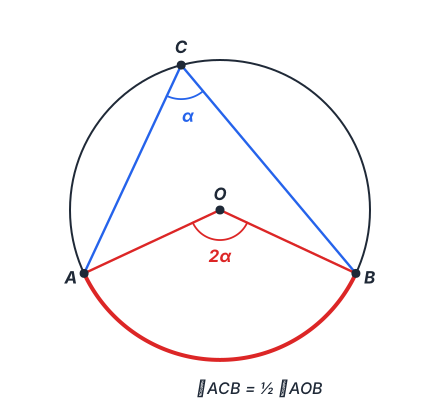
A central angle has its vertex at the centre. An inscribed angle has its vertex on the circle and chords as its sides.
A central angle equals its arc; an inscribed angle equals half its arc
Why half? If one side of the inscribed angle is a diameter, the centre and two points form an isosceles triangle; its exterior angle (the central angle) equals the sum of the two equal base angles, i.e. twice the inscribed angle. The general case reduces to this one.
Consequences:
- Inscribed angles subtending the same arc are equal.
- An inscribed angle subtending a diameter is 90° (a semicircle is 180°, half is 90°).
- In a cyclic quadrilateral opposite angles add up to 180°.
- The angle between a chord and a tangent equals half the arc between them.
Worked example (official sample)
A circle is divided into three arcs in the ratio 13 : 14 : 9; the division points form a triangle whose shortest side is ⁴√12. Find the area of the equilateral triangle circumscribed about this circle.
- Arcs: 13 + 14 + 9 = 36 parts, one part is 10° → 130°, 140°, 90°.
- The triangle’s angles are half the arcs: 65°, 70°, 45°.
- The shortest side is opposite the smallest angle 45°: by the sine rule 2R sin 45° = R√2 = ⁴√12.
- Square both sides: 2R² = √12 → R² = √12/2 = √3.
- The circle is inscribed in the equilateral triangle, so r = R; the area of an equilateral triangle is S = 3√3 r².
- S = 3√3 · √3 = 9.
§4. Segment relations
Chords meeting at E: AE · EB = CE · ED
Tangent and secant: PT² = PA · PB (PA is the external part, PB the whole secant)
Two secants: PA · PB = PC · PD
These formulas come from similar triangles. For intersecting chords, triangles AEC and DEB are similar: inscribed angles on the same arc are equal, and vertical angles are equal. Similarity gives AE/DE = CE/EB, that is AE · EB = CE · ED.
Worked example
Chords AB and CD meet at E: AE = 4, EB = 6, CE = 3. Find CD.
- AE · EB = CE · ED → 4 · 6 = 3 · ED.
- ED = 24/3 = 8.
- CD = CE + ED = 3 + 8 = 11.
§5. Triangles and circles
Every triangle has exactly one circumcircle and exactly one incircle.
Circumcircle: R = abc/(4S) = a/(2 sin A); incircle: r = S/p, p is the semi-perimeter
- The circumcentre is where the perpendicular bisectors of the sides meet (equidistant from the vertices).
- The incentre is where the angle bisectors meet (equidistant from the sides).
- In a right-angled triangle R = c/2 (the hypotenuse is a diameter) and r = (a + b − c)/2.
- In an equilateral triangle R = 2r and the side is a = R√3.
An excircle touches one side of a triangle and the extensions of the other two. In a right-angled triangle the radius of the excircle touching the hypotenuse equals the semi-perimeter.
Worked example (official sample)
A circle touches the axes Ox and Oy and the segment joining (6; 0) and (0; 8) (on the side of the segment away from the origin). Find its radius.
- Segment length: √(36 + 64) = 10; with the axes it forms a triangle with legs 6 and 8.
- The circle touches the hypotenuse and the extensions of the legs, so it is an excircle; its centre is (R; R), touching the axes at (R; 0) and (0; R).
- Tangent segments from one point are equal: (R − 6) + (R − 8) = 10.
- 2R = 24 → R = 12 (the semi-perimeter (6 + 8 + 10)/2 = 12).
Worked example
For the triangle with sides 13, 14, 15 find R and r.
- p = 21; Heron’s formula: S = √(21 · 8 · 7 · 6) = 84.
- r = S/p = 84/21 = 4.
- R = abc/(4S) = 2730/336 = 8.125.
Check yourself
- An inscribed angle is 35°. What is the central angle on the same arc?
- Find the area of the disc bounded by a circle of length 10π.
- A tangent is 6, the external part of a secant is 4. Find the whole secant.
- The circumradius of a right-angled triangle with legs 5 and 12.
- The angle between two tangents from a point is 60°, R = 3. Distance from the point to the centre?
- Area of a sector of radius 6 with central angle 60°.
- Length of a 120° arc of a circle of radius 6.
- One angle of a cyclic quadrilateral is 110°. The opposite angle?
Common mistakes
- Taking an inscribed angle as equal to its arc — it is half the arc.
- Using the internal part instead of the whole secant in the tangent–secant formula.
- Not noticing the right angle between a tangent and the radius.
- Confusing arc length (πRα/180) with sector area (πR²α/360).
- Mixing circumference and area: 2πR is a length, πR² is an area.
- Taking R equal to the hypotenuse itself in a right-angled triangle (R = c/2).
Score: 0 / 8 correct (0 attempted)