MathematicsMathematics · 22 / 54
Logarithms and logarithmic equations
School curriculum· 35 min· 2 questions
Learn first: Exponential equations and inequalities
A logarithm answers the question “to what power must a number be raised?”. It is needed to solve exponential equations, to work with very large numbers and to simplify complicated expressions; it also appears in physics, chemistry (pH) and economics (compound interest). The exam almost always contains a logarithmic expression to evaluate, an equation or an inequality. The first step in every logarithm problem is the domain: skip it and extraneous roots appear.
§1. Definition
The logarithm of b to base a is the exponent to which a must be raised to give b:
log_a b = c ⇔ aᶜ = b, where a > 0, a ≠ 1, b > 0
The reason for the conditions: every power of a positive base is positive, so negative numbers and zero have no logarithm; if a = 1, then 1ᶜ = 1 and no other number can be obtained.
Examples: log₂ 32 = 5, since 2⁵ = 32; log₃(1/9) = −2, since 3⁻² = 1/9; log₃(1/27) = −3; log₄ 2 = 1/2, since 4^(1/2) = 2.
There are two special logarithms:
- lg b — the common logarithm (base 10): lg 1000 = 3, lg 0.01 = −2.
- ln b — the natural logarithm (base e ≈ 2.718): ln e = 1, ln 1 = 0.
§2. The basic identity and simplest values
Substituting c from the definition into aᶜ = b gives the basic logarithmic identity:
Basic identity: a^(log_a b) = b; log_a 1 = 0, log_a a = 1, log_a aⁿ = n
For example, 5^(log₅ 7) = 7; 2^(2 + log₂ 5) = 2² · 2^(log₂ 5) = 4 · 5 = 20; 9^(log₃ 2) = 3^(2 log₃ 2) = 3^(log₃ 4) = 4.
The key to using the identity is to match the base of the power with the base of the logarithm. If the bases differ (9 and 3), first rewrite them with one base.
§3. Properties
The laws of logarithms are a “translation” of the laws of indices: when powers are multiplied, the exponents add, so the logarithm of a product is the sum of the logarithms. For b > 0, c > 0:
log_a(bc) = log_a b + log_a c, log_a(b/c) = log_a b − log_a c
log_a(bⁿ) = n·log_a b, log_(aᵏ) b = (1/k)·log_a b
Change of base: log_a b = log_c b / log_c a; in particular log_a b = 1/log_b a
Chain rule: log_a b · log_b c = log_a c
Careful: there is no formula for log_a(b + c), and log_a b · log_a c is not log_a(bc).
Taking out an even power produces an absolute value: log_a x² = 2 log_a |x|, because x may be negative.
Worked example
Evaluate log₃ 18 − log₃ 2 + log₄ 8.
- Combine the difference into one logarithm: log₃(18/2) = log₃ 9 = 2.
- Change the base: log₄ 8 = log₂ 8 / log₂ 4 = 3/2.
- Total: 2 + 3/2 = 3.5.
Worked example
Evaluate log₂ 3 · log₃ 8.
- Chain rule: log₂ 3 · log₃ 8 = log₂ 8.
- log₂ 8 = 3. Answer: 3.
§4. The logarithmic function
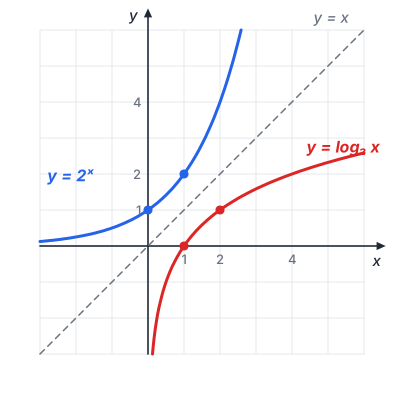
y = log_a x is the inverse of y = aˣ; their graphs are symmetric in the line y = x.
- Domain x > 0, range — all real numbers.
- The graph passes through (1; 0); the y-axis is a vertical asymptote.
- For a > 1 it is increasing, for 0 < a < 1 decreasing.
Monotonicity gives a rule for comparing logarithms. For a > 1: if x > 1, then log_a x > 0; if 0 < x < 1, then log_a x < 0. For example, log₂ 3 > 1 (since 3 > 2) and log₃ 2 < 1 (since 2 < 3), so log₂ 3 > log₃ 2.
§5. Logarithmic equations
The procedure:
- Domain: every expression under a logarithm is > 0; a variable base is > 0 and ≠ 1.
- Solve by the definition (log_a f = c → f = aᶜ), by using the same base (log_a f = log_a g → f = g) or by substitution.
- Check the roots against the domain.
Applying the properties can widen the domain: log₂(x − 1) + log₂(x + 1) is defined for x > 1, while log₂(x² − 1) is also defined for x < −1. So write the domain from the original equation.
If the base contains the variable, add the conditions x > 0 and x ≠ 1. For example, log_x 16 = 2 → x² = 16 → x = ±4; x = −4 fails the base condition, so the answer is x = 4.
Worked example
Solve log₂(x − 1) + log₂(x + 1) = 3.
- Domain: x − 1 > 0 and x + 1 > 0 → x > 1.
- log₂((x − 1)(x + 1)) = 3 → x² − 1 = 8 → x = ±3.
- x = −3 is outside the domain. Answer: x = 3.
Worked example
Solve lg²x − 3 lg x + 2 = 0.
- Domain: x > 0. Substitute t = lg x: t² − 3t + 2 = 0 → t = 1; 2.
- lg x = 1 → x = 10; lg x = 2 → x = 100.
- Both are in the domain. Answer: x = 10; 100.
§6. Logarithmic inequalities
As with exponential inequalities, the base decides:
a > 1: log_a f > log_a g ⇔ f > g > 0
0 < a < 1: log_a f > log_a g ⇔ 0 < f < g (the sign is reversed)
The domain must be written together with the inequality; otherwise values with a negative number under the logarithm get into the answer.
Worked example
Solve log_(1/2)(x − 1) > −2.
- Domain: x − 1 > 0 → x > 1.
- −2 = log_(1/2) 4, since (1/2)⁻² = 4.
- The base 1/2 < 1, so the sign reverses: x − 1 < 4 → x < 5.
- Intersect with the domain: 1 < x < 5. Answer: (1; 5).
Check yourself
- log₂ 32 = ?
- log₃ 18 − log₃ 2 = ?
- 5^(log₅ 7) = ?
- log₄ 8 = ?
- Solve log₃(2x − 1) = 2.
- Solve log_(1/2)(x − 1) > −2.
- The sum of the roots of log₂(x² − 3x) = 2.
- 2^(2 + log₂ 5) = ?
Common mistakes
- Not writing the domain and keeping an extraneous root.
- Assuming log(b + c) = log b + log c.
- Not reversing the inequality sign when the base is 0 < a < 1.
- Writing log_a b·log_a c as log_a(bc).
- Forgetting the absolute value when taking out an even power: log_a x² = 2 log_a |x|.
- Writing the domain from the equation obtained after applying the properties (it may be wider).
Score: 0 / 8 correct (0 attempted)