MathematicsMathematics · 29 / 54
Angle measures and trigonometric ratios
School curriculum· 30 min· 21 questions
Learn first: Functions, domain and range
Trigonometry links angles and sides. It is used to solve triangles, to describe oscillations and waves (sound, alternating current), in navigation and in engineering. Its foundation is the unit circle: if you understand sine and cosine as the coordinates of a point on the circle, the signs, the values and the reduction formulas become logic rather than memorisation. This lesson covers angle measure, the unit circle, the key values, signs, periodicity and the definitions in a right-angled triangle.
§1. Measuring angles: degrees and radians
In degrees a full turn is divided into 360°. In mathematics, however, radians are used more often.
A radian is the central angle whose arc is equal in length to the radius. The circumference is 2πR, i.e. it holds 2π radii — so a full turn is 2π radians.
180° = π rad; 1 rad ≈ 57.3°
α (rad) = α° · π / 180, α° = α (rad) · 180 / π
Key angles: 30° = π/6, 45° = π/4, 60° = π/3, 90° = π/2, 120° = 2π/3, 135° = 3π/4, 150° = 5π/6, 180° = π, 270° = 3π/2, 360° = 2π.
Radians are convenient because the arc and sector formulas become very simple:
Arc length l = R·α, sector area S = R²α/2 (α in radians)
If no unit is given (sin 2), the angle is understood to be in radians.
Worked example
Convert 210° to radians.
- Formula: α = 210 · π/180.
- Simplify 210/180 = 7/6.
- Answer: 7π/6.
§2. The unit circle and definitions
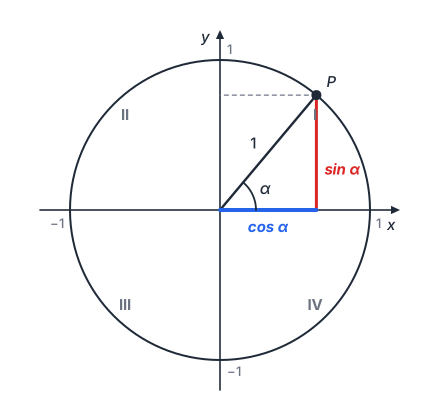
The circle centred at the origin with radius 1 is the unit circle. Angles are measured from the positive direction of the x-axis: turning anticlockwise gives a positive angle, clockwise a negative one.
The point for angle α: (cos α; sin α)
tg α = sin α / cos α (cos α ≠ 0), ctg α = cos α / sin α (sin α ≠ 0)
Tangent and cotangent are written tg and ctg here, as in Uzbek and Russian textbooks (tan and cot in English ones).
So cosine is the x-coordinate of the point and sine is the y-coordinate. This definition works for any angle, not only acute ones.
Direct consequences of the definition:
- −1 ≤ sin α ≤ 1, −1 ≤ cos α ≤ 1, since the coordinates cannot exceed the radius.
- tg α and ctg α take any value.
- tg α is undefined at α = π/2 + πk, ctg α at α = πk (the denominator is zero).
- tg α is the y-coordinate of the point where the ray OP meets the tangent line x = 1.
Worked example
Find the coordinates of the point P on the unit circle for the angle 120°, and tg 120°.
- 120° is in quadrant II and makes 60° with the negative x-axis.
- P(−cos 60°; sin 60°) = (−1/2; √3/2), so cos 120° = −1/2 and sin 120° = √3/2.
- tg 120° = (√3/2) : (−1/2) = −√3.
§3. Table of key values
- sin 0 = 0, sin 30° = 1/2, sin 45° = √2/2, sin 60° = √3/2, sin 90° = 1
- cos 0 = 1, cos 30° = √3/2, cos 45° = √2/2, cos 60° = 1/2, cos 90° = 0
- tg 0 = 0, tg 30° = √3/3, tg 45° = 1, tg 60° = √3, tg 90° — undefined
- sin 180° = 0, cos 180° = −1, sin 270° = −1, cos 270° = 0
Memory aid: the values of sin are √0/2, √1/2, √2/2, √3/2, √4/2; those of cos are in reverse order.
Where do they come from? For 45° take an isosceles right-angled triangle: legs 1, hypotenuse √2, so sin 45° = 1/√2 = √2/2. For 30° and 60° cut an equilateral triangle of side 2 along its height: legs 1 and √3, hypotenuse 2.
§4. Signs by quadrant and symmetry
Quadrant I: all +; II: only sin > 0; III: tg, ctg > 0; IV: only cos > 0
Reason: the sign comes from the signs of the point’s coordinates. In quadrant II the point has negative x and positive y — cos < 0, sin > 0, so tg < 0. In quadrant III both coordinates are negative, and their quotient tg is positive.
Even and odd: the point for −α is the reflection of the point for α in the x-axis: the x-coordinate stays, the y-coordinate changes sign.
cos(−α) = cos α (even); sin(−α) = −sin α, tg(−α) = −tg α (odd)
Worked example
Find sin 240°.
- 240° = 180° + 60° — quadrant III, sin < 0.
- The related acute angle is 60°.
- sin 240° = −sin 60° = −√3/2.
§5. Periodicity and large angles
Adding a full turn 360° (2π) to an angle brings the point back to the same place, so the value of the function does not change.
sin(α + 2πk) = sin α, cos(α + 2πk) = cos α; tg(α + πk) = tg α
The smallest positive period of sin and cos is 2π; for tg and ctg it is π (at diametrically opposite points sine and cosine both change sign, while their ratio stays the same).
How to deal with a large angle: first remove multiples of 360°, then find the quadrant and the related acute angle.
Worked example
Evaluate sin 750° and cos(−120°).
- 750° = 2 · 360° + 30°, so sin 750° = sin 30° = 1/2.
- cos(−120°) = cos 120° (cosine is even).
- 120° is in quadrant II, cos 120° = −cos 60° = −1/2.
§6. In a right-angled triangle
For an acute angle the definitions agree with those on the unit circle (place the triangle in the circle and use similarity):
sin α = opposite / hypotenuse, cos α = adjacent / hypotenuse, tg α = opposite / adjacent
This gives practical formulas: a = c · sin α, b = c · cos α, a = b · tg α. For example, measuring a height: if the top of a tree is seen at an angle of 30° from 20 m away, its height is 20 · tg 30° = 20√3/3 ≈ 11.5 m.
Worked example
The hypotenuse is 10 and α = 30°. Find the legs.
- Opposite leg: 10 · sin 30° = 10 · 1/2 = 5.
- Adjacent leg: 10 · cos 30° = 10 · √3/2 = 5√3.
- Check: 25 + 75 = 100 — correct.
Check yourself
- Convert 5π/4 to degrees.
- Evaluate cos 150°.
- Evaluate tg 315°.
- α is in quadrant III. What is the sign of sin α · cos α?
- Find the length of an arc of radius 6 with central angle π/3.
- Evaluate sin²30° + cos²60° + tg²45°.
- Evaluate cos(13π/3).
- Find the area of a sector of radius 6 with central angle π/6.
Common mistakes
- Mixing degrees and radians (sin 30 in radians is a different number).
- Getting the signs wrong in quadrants II and IV.
- Writing tg 90° = 0 or 1 (it is undefined).
- Swapping sin and cos with respect to the adjacent and opposite legs.
- Taking sin(−α) equal to sin α (sine is an odd function).
- Not removing multiples of 360° from a large angle and getting the quadrant wrong.
Score: 0 / 8 correct (0 attempted)