Learn first: Points, lines and angles
The triangle is the simplest polygon, yet most plane-geometry problems come down to it: a quadrilateral is split by a diagonal, and any polygon into several triangles. A triangle is a "rigid" shape — once its three sides are given it is completely fixed — which is why bridges and towers are built from triangles. This lesson covers the properties of angles and sides, the triangle inequality, the median, the angle bisector, the height and the midline, the special points of a triangle, and isosceles and equilateral triangles.
§1. Properties of the angles
The interior angles add up to 180°
An exterior angle equals the sum of the two interior angles not adjacent to it
Why `180°`? Through one vertex draw a line parallel to the opposite side. The alternate angles formed are equal to the other two angles of the triangle, and the three angles together make a straight angle (180°).
The exterior-angle property follows: an exterior angle and its adjacent interior angle add up to 180°, so the exterior angle equals the sum of the other two interior angles.
By angles, triangles are acute (all < 90°), right-angled (one 90°) or obtuse (one > 90°). A triangle has at most one right or obtuse angle.
Worked example
An exterior angle is 120°, and the two interior angles not adjacent to it are in the ratio 1 : 3. Find these angles.
- Exterior-angle property: x + 3x = 120°.
- x = 30°.
- The angles are 30° and 90°.
§2. Sides and the triangle inequality
Triangle inequality: |b − c| < a < b + c
Each side is shorter than the sum of the other two and longer than their difference. Meaning: the shortest path between two points is a straight segment; going round via the third vertex is always longer. If a = b + c, the three points lie on one line (a degenerate triangle).
- The longer side lies opposite the larger angle (and vice versa).
- By sides: scalene, isosceles, equilateral.
To check whether three segments form a triangle, it is enough to check that the longest is shorter than the sum of the other two.
Worked example
Two sides are 3 and 8. How many whole-number values can the third side take?
- 8 − 3 < c < 8 + 3 → 5 < c < 11.
- c = 6, 7, 8, 9, 10.
- Answer: 5 values.
§3. The median
The segment from a vertex to the midpoint of the opposite side.
The medians meet at one point (the centroid), which divides each median in the ratio 2 : 1 from the vertex
mₐ = ½√(2b² + 2c² − a²)
A median splits a triangle into two triangles of equal area (equal bases, common height); the three medians split it into 6 triangles of equal area. The centroid is the balance point in the physical sense: a cardboard triangle balances on a needle point placed there.
In a right-angled triangle, the median to the hypotenuse is half the hypotenuse.
Worked example
In isosceles triangle ABC, AB = BC, BD is a median, BD = 4, and triangle ABD has perimeter 12. Find the perimeter of ABC.
- AB + AD + BD = 12 → AB + AD = 8.
- BC = AB and AC = 2AD.
- P(ABC) = 2AB + 2AD = 2 · 8 = 16.
§4. The angle bisector and the incircle
An angle bisector is the segment that halves an angle (from the vertex to the opposite side).
The bisector divides the opposite side in the ratio of the adjacent sides: AD/DC = AB/BC
Every point of an angle bisector is equidistant from the arms of the angle. Hence the three bisectors meet at one point — the incentre, the centre of the inscribed circle; it is the same distance r from all three sides. The inradius is r = S/p (p is the semi-perimeter).
Worked example
AB = 6, BC = 9, AC = 10. Into what parts does the bisector from B divide AC?
- AD : DC = AB : BC = 6 : 9 = 2 : 3.
- AC is split into 5 parts, one part is 10 : 5 = 2.
- AD = 4, DC = 6.
§5. Height, perpendicular bisector and midline
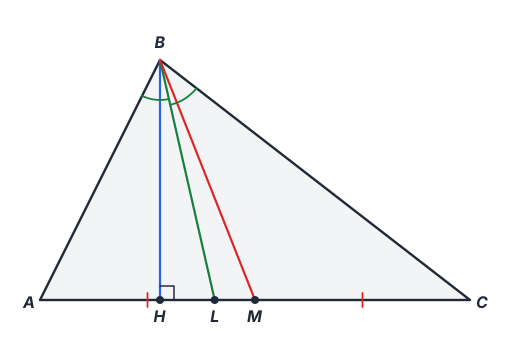
- Height (altitude) — the perpendicular from a vertex to the opposite side (or its extension). The heights (or their extensions) meet at one point, the orthocentre. Since S = ½ a·hₐ, hₐ = 2S/a: the longer side has the shorter height. In an obtuse triangle two heights fall outside, on extensions of the sides.
- Perpendicular bisectors — lines perpendicular to the sides through their midpoints. They meet at the circumcentre, the centre of the circumscribed circle (equidistant from the vertices). In a right-angled triangle it is the midpoint of the hypotenuse.
- Midline — joins the midpoints of two sides; it is parallel to the third side and half its length. The three midlines form a triangle with half the perimeter and 1/4 of the area.
Special points: medians — centroid; angle bisectors — incentre; perpendicular bisectors — circumcentre; heights — orthocentre
Worked example
The triangle with sides 13, 14, 15 has area 84. Find the height to the side 14.
- S = ½ · a · h, so h = 2S/a.
- h = 2 · 84/14.
- h = 12.
§6. Isosceles and equilateral triangles
- In an isosceles triangle the base angles are equal; the median to the base is also the angle bisector and the height. The converse holds too: a triangle with two equal angles is isosceles.
- In an equilateral triangle all angles are 60°, and all the special points coincide.
Equilateral: h = a√3/2, S = a²√3/4, R = a√3/3, r = a√3/6
These follow from the height: h = √(a² − a²/4) = a√3/2; the centre divides the median in the ratio 2 : 1, so R = 2h/3 and r = h/3.
Worked example
An isosceles triangle has sides 5, 5, 6. Find the median to the base and the area.
- The median is also the height and splits the base into 3 and 3.
- m = √(25 − 9) = 4 (the formula gives the same: ½√(50 + 50 − 36) = 4).
- S = ½ · 6 · 4 = 12.
Check yourself
- The angles are in the ratio 2 : 3 : 4. Find them.
- The base angle of an isosceles triangle is 40°. Find the apex angle.
- A median is 12. Find the distance from the centroid to the vertex.
- Two sides are 4 and 7. How many whole-number values can the third side take?
- Find the height of an equilateral triangle of side 6.
- A triangle has perimeter 24. Find the perimeter of the triangle formed by its midlines.
- Can a triangle be made from segments 2, 3, 6?
- The legs are 6 and 8. Find the median to the hypotenuse.
Common mistakes
- Confusing the median with the angle bisector (they coincide only for the base of an isosceles triangle).
- Reversing the 2 : 1 ratio at the centroid.
- Using ≤ instead of strict < in the triangle inequality (a degenerate triangle).
- Pairing sides wrongly in the bisector theorem (the side adjacent to AD is AB).
- Confusing the incentre and the circumcentre (angle bisectors ↔ perpendicular bisectors).
- Drawing every height inside an obtuse triangle.
Score: 0 / 8 correct (0 attempted)