Learn first: Mitosis and meiosis
Genetics is the science of heredity and variation. Its foundations were laid by Gregor Mendel (1865), who experimented with garden peas. In the exam it is not enough to state Mendel's laws: you must solve problems confidently — write gametes, draw a Punnett square, and calculate ratios and probabilities. This lesson builds those skills step by step.
§1. Key terms and notation
- Gene — a section of DNA carrying information about a particular trait; it occupies a specific position on a chromosome (its locus).
- Alleles — genes located at the same locus of homologous chromosomes that determine different forms of one trait: A and a.
- A dominant trait (A) shows in the heterozygote; a recessive trait (a) shows only in the homozygote (aa).
- Homozygote — identical alleles (AA, aa), produces one type of gamete; heterozygote — different alleles (Aa), produces two types of gamete.
- Genotype — the set of an organism's genes; phenotype — the set of its external and internal traits (shaped by genotype and environment).
- Notation: P — parents, ♀ — female, ♂ — male, × — cross, G — gametes, F₁, F₂ — hybrid generations.
Why Mendel succeeded: he used pure lines (homozygotes), chose clearly contrasting alternative traits, analysed results quantitatively (statistically), and followed each pair of traits separately.
Purity of gametes: each gamete receives only one allele from each pair.
§2. Monohybrid cross: the first and second laws
A monohybrid cross follows a single pair of contrasting traits.
First law (uniformity, dominance): when two pure lines are crossed, the F₁ hybrids are identical in genotype and phenotype: AA × aa → Aa.
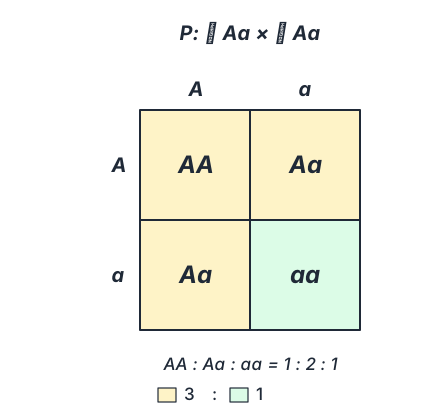
Second law (segregation): when F₁ hybrids are crossed with each other, F₂ segregates 1AA : 2Aa : 1aa by genotype and 3 : 1 by phenotype.
Incomplete dominance (intermediate inheritance): the heterozygote shows an intermediate trait. In the four-o'clock plant AA is red, aa white and Aa pink. In F₂ the genotype and phenotype ratios coincide: 1 : 2 : 1.
A test cross crosses an individual with the dominant phenotype with a recessive homozygote (aa) to find its unknown genotype:
- all offspring show the dominant phenotype → the individual is AA;
- offspring segregate 1 : 1 → the individual is Aa.
Worked example
In peas, yellow seeds (A) are dominant over green (a). Heterozygous yellow plants were crossed and 400 seeds obtained. How many are green and how many heterozygous?
- P: Aa × Aa, gametes: A, a and A, a.
- Punnett square: AA, Aa, Aa, aa → 1AA : 2Aa : 1aa.
- Green (aa) is 1/4: 400 × 1/4 = 100.
- Heterozygous (Aa) is 2/4: 400 × 1/2 = 200.
- Answer: 100 green, 200 heterozygous (2/3 of all yellow seeds).
§3. Dihybrid cross: the third law
Third law (independent assortment): genes located on different chromosomes are passed on independently of each other. AaBb × AaBb gives a 9 : 3 : 3 : 1 phenotype ratio in F₂.
An AaBb individual forms 4 types of gamete: AB, Ab, aB, ab (1/4 each). The Punnett square has 4 × 4 = 16 cells. In F₂:
- 9 A_B_ (both dominant traits);
- 3 A_bb and 3 aaB_ (one dominant trait);
- 1 aabb (both recessive).
There are 9 genotype classes and 4 phenotype classes.
Product rule: for independent traits, probabilities are multiplied. In Aa × Aa the chance of aa is 1/4, in Bb × Bb the chance of bb is 1/4, so the chance of aabb is 1/4 × 1/4 = 1/16. This lets you answer without drawing a large square.
General formulas (n — number of heterozygous gene pairs, complete dominance):
- gamete types: 2ⁿ;
- phenotype classes in F₂: 2ⁿ;
- genotype classes in F₂: 3ⁿ;
- gamete combinations in the square: 4ⁿ.
Worked example
What is the probability of an aabbcc offspring from AaBbCc × AaBbCc? How many gamete types does AaBbCc produce?
- For each pair, the chance of a recessive homozygote is 1/4.
- Three independent pairs: 1/4 × 1/4 × 1/4 = 1/64.
- Gamete types: 2³ = 8.
- Answer: 1/64; 8 gamete types.
Worked example
What is the result of the dihybrid test cross AaBb × aabb?
- Gametes of AaBb: AB, Ab, aB, ab; aabb forms only ab.
- Offspring: AaBb, Aabb, aaBb, aabb.
- Answer: 1 : 1 : 1 : 1 by phenotype.
§4. Blood groups and multiple alleles
Human blood groups (the AB0 system) are controlled by one gene with three alleles: I⁰, Iᴬ, Iᴮ (multiple allelism). Iᴬ and Iᴮ are dominant over I⁰ but codominant with each other (both show in the heterozygote).
Group I — I⁰I⁰; II — IᴬIᴬ or IᴬI⁰; III — IᴮIᴮ or IᴮI⁰; IV — IᴬIᴮ.
Worked example
The mother has group II, the father group III, and their first child has group I. What is the chance that the next child has group IV?
- A group I child (I⁰I⁰) received I⁰ from each parent, so the mother is IᴬI⁰ and the father IᴮI⁰.
- Mother's gametes: Iᴬ, I⁰; father's: Iᴮ, I⁰.
- Offspring: IᴬIᴮ (IV), IᴬI⁰ (II), IᴮI⁰ (III), I⁰I⁰ (I) — 1/4 each.
- Answer: 25%. All four groups are possible in this family.
§5. A problem-solving algorithm
- Assign letters: which trait is dominant, which recessive.
- Work out the parents' genotypes; a recessive phenotype is always homozygous (aa). If a dominant genotype is unknown, write A_ and resolve it from the offspring.
- Write the gametes (one allele from each pair).
- Draw a Punnett square or multiply probabilities.
- Answer exactly what is asked: genotype or phenotype, fraction or number.
Check yourself
- What phenotype ratio does Aa × aa give?
- How many gamete types does AaBbCcDd produce?
- What is the F₂ phenotype ratio with incomplete dominance?
- What fraction of AaBb × AaBb offspring have the A_bb phenotype?
- The father has group IV and the mother group I. Which groups are possible in the children?
- A black rabbit crossed with a white one (aa) gave 10 black and 9 white young. What is the black rabbit's genotype?
Common mistakes
- Assuming an individual with a dominant phenotype is always homozygous (AA); it may be Aa.
- Putting two alleles of one pair into a gamete (there is no Aa gamete).
- Mixing up ratios: 1 : 2 : 1 is the genotype ratio, 3 : 1 the phenotype ratio.
- Adding probabilities of independent traits instead of multiplying them.
- Applying the third law to linked genes on the same chromosome.
- Confusing codominance with incomplete dominance: in codominance both traits show fully (blood group IV); in incomplete dominance an intermediate trait appears.
Score: 0 / 6 correct (0 attempted)