Learn first: Cell structure
Cell division is one of the most important properties of life: “every cell comes from a cell” (R. Virchow). Unicellular organisms reproduce by dividing, while multicellular organisms develop from a single cell — the zygote — through divisions, grow, and repair damaged tissues. There are two main types of division: mitosis (body cells) and meiosis (formation of sex cells and spores). The most common exam task is to work out the chromosome set (n) and the amount of DNA (c) at different stages of the cell cycle, and to compare mitosis with meiosis.
§1. Chromosomes
A chromosome is a complex of DNA and proteins (mainly histones). In interphase chromosomes are uncoiled thin threads — chromatin — and cannot be seen individually; during division they coil tightly, becoming shorter and thicker.
- Parts of a chromosome: the centromere (primary constriction, where spindle fibres attach) and the arms on either side.
- After DNA replication each chromosome consists of two identical chromatids joined at the centromere; each chromatid contains one DNA molecule.
- Somatic (body) cells are diploid (2n): 46 chromosomes in humans; sex cells are haploid (n): 23 in humans.
- Homologous chromosomes are pairs alike in shape, size and gene positions: one from the father, one from the mother.
- The karyotype is the chromosome set typical of a species (number, shape, size). The human karyotype: 22 pairs of autosomes and 1 pair of sex chromosomes (XX in women, XY in men).
n — chromosome set, c — amount of DNA. The number of chromosomes equals the number of centromeres.
§2. The cell cycle and interphase
The cell cycle is the life of a cell from its formation to the end of its division: interphase + division (mitosis). Interphase is the longest part and has three periods:
- G₁ (presynthetic) — the cell grows, makes proteins and RNA, and its organelles multiply: 2n2c.
- S (synthetic) — DNA replication: every chromosome becomes double-chromatid: 2n2c → 2n4c. The number of chromosomes does not change; the amount of DNA doubles.
- G₂ (postsynthetic) — preparation for division: ATP is stored and spindle proteins are made: 2n4c.
Some cells (for example, neurons) stop dividing and carry out their special function for a long time.
§3. Mitosis
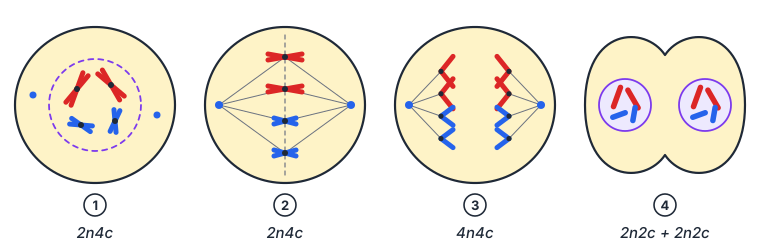
Mitosis is the division of body cells; it gives two 2n2c cells identical to the parent cell. It has four phases:
- Prophase — chromosomes coil and become clearly visible; the nuclear envelope and nucleolus disappear; in animal cells the centrioles move to the poles and the spindle forms: 2n4c.
- Metaphase — chromosomes line up in one plane at the cell’s equator, and spindle fibres attach to the centromeres. Chromosomes are clearest now — the best phase for counting and studying them: 2n4c.
- Anaphase — the centromeres divide and the chromatids separate and move as independent chromosomes to opposite poles. At this moment the cell contains 4n4c, and each pole 2n2c.
- Telophase — chromosomes uncoil at the poles, the nuclear envelope and nucleolus re-form; then cytokinesis divides the cytoplasm (a furrow in animals, a cell plate growing across the middle in plants). Each daughter cell is 2n2c.
Result of mitosis: 2 identical diploid cells (2n2c); hereditary information is preserved exactly.
Importance: growth, tissue renewal and regeneration, asexual reproduction, and unchanged passing of genetic information to daughter cells.
Amitosis is direct division of the nucleus without a spindle; the genetic material may be shared unequally. It occurs in ageing and diseased cells.
§4. Meiosis
Meiosis is the division that produces sex cells (in animals) or spores (in plants). It consists of two successive divisions with no DNA replication between them (interkinesis).
Meiosis I (reduction division):
- prophase I — the longest phase: homologous chromosomes come together and pair — synapsis (conjugation); they exchange segments — crossing over: 2n4c;
- metaphase I — homologous chromosomes line up at the equator in pairs;
- anaphase I — whole homologous chromosomes (each still of two chromatids) move to the poles; which paternal and which maternal chromosome goes to which pole is random;
- telophase I — two cells form, each n2c.
Meiosis II (equational division) is like mitosis: in metaphase II chromosomes line up at the equator (n2c), in anaphase II the chromatids separate; after telophase II there are 4 cells, each nc.
Biological significance of meiosis: it keeps the chromosome number constant across generations and creates combinative variation (crossing over and independent assortment of homologues).
Mitosis versus meiosis: mitosis has one division, no synapsis or crossing over, and gives 2 identical 2n cells; meiosis has two divisions, synapsis and crossing over, and gives 4 genetically different n cells.
§5. Gametogenesis
Gametogenesis is the formation of sex cells in the gonads. It has four stages: multiplication (mitosis), growth, maturation (meiosis), and shaping (only in spermatogenesis).
- Spermatogenesis (in the testes): one primary spermatocyte gives 4 sperm cells by meiosis; in the shaping stage they gain a tail, neck and head.
- Oogenesis (in the ovaries): one primary oocyte gives 1 large egg cell and 3 small polar bodies. The cytoplasm is shared unequally — nutrients collect in the egg, because it supports the early development of the embryo.
At fertilisation a haploid sperm (n) and egg (n) fuse into a diploid zygote (2n) — restoring the species’ chromosome number.
§6. A method for finding n and c
- Find the 2n number of the organism (for example, 2n = 46 in humans).
- Has replication happened? After the S period and until the end of meiosis II chromosomes have two chromatids — c is doubled.
- Count the independent chromosomes in anaphase: 4n4c in mitotic anaphase, 2n2c in anaphase II.
- Number of chromosomes = number of centromeres; number of chromatids = number of DNA molecules.
- Put the numbers into the formula: for example, 2n4c → 46 chromosomes, 92 chromatids.
Worked example
A chimpanzee body cell has 2n = 48. Find the number of chromosomes and chromatids in G₂, in metaphase and at the end of anaphase (at each pole).
- G₂: replication has happened (2n4c) — 48 chromosomes, 96 chromatids.
- Metaphase: the same (2n4c) — 48 chromosomes, 96 chromatids.
- End of anaphase, each pole: chromatids have become independent chromosomes (2n2c) — 48 chromosomes, each of one chromatid.
- Answer: G₂ — 48 and 96; metaphase — 48 and 96; end of anaphase at a pole — 48 and 48.
Worked example
How many chromosomes and DNA molecules are in a human cell (2n = 46) in metaphase II of meiosis?
- After meiosis I the cell is n2c: 23 chromosomes, each of 2 chromatids.
- In metaphase II the formula is unchanged: n2c.
- DNA molecules = chromatids: 23 × 2 = 46.
- Answer: 23 chromosomes, 46 DNA molecules.
Worked example
How many mature gametes form from 50 primary spermatocytes and from 50 primary oocytes?
- One primary spermatocyte gives 4 sperm: 50 × 4 = 200.
- One primary oocyte gives 1 egg: 50 × 1 = 50.
- Polar bodies: 50 × 3 = 150.
- Answer: 200 sperm cells and 50 egg cells.
Check yourself
- In which period does DNA replication occur?
- When does crossing over happen?
- What is the formula of a cell in mitotic anaphase?
- How many cells, and of what kind, does meiosis produce?
- How many egg cells come from one primary oocyte?
- What separates in anaphase I?
- How many chromatids are there in mitotic metaphase in a plant with 2n = 20?
- Which phase of mitosis is best for counting chromosomes?
Common mistakes
- Writing that crossing over also happens in mitosis — only in prophase of meiosis I.
- Thinking the chromosome number in the cell does not change in mitotic anaphase — it doubles (4n).
- Believing chromatids separate in meiosis I — homologous chromosomes do.
- Thinking replication happens between meiosis I and II.
- Confusing the number of chromosomes with the number of chromatids.
- Writing that oogenesis also produces 4 egg cells.
Score: 0 / 8 correct (0 attempted)