Learn first: Chemical composition of the cell, Metabolism and energy exchange
Protein biosynthesis is the most important process of anabolism (assimilation): hereditary information written in DNA is turned into the sequence of amino acids in a protein. Proteins act in the cell as enzymes, building material, carriers, hormones and defence molecules — in other words, an organism’s traits are expressed through its proteins. Information flows like this: DNA → mRNA → protein. The topic underpins genetics, mutations and biotechnology. Exams set problems on finding the complementary strand, the mRNA and the amino acid sequence, the numbers of nucleotides and amino acids, and the length and mass of a gene.
§1. Nucleic acids: a quick review
DNA is a double helix (J. Watson and F. Crick, 1953). A nucleotide contains deoxyribose, a phosphate group and a nitrogenous base — A (adenine), T (thymine), G (guanine), C (cytosine). The strands are joined by hydrogen bonds according to complementarity:
A = T (2 hydrogen bonds), G ≡ C (3 hydrogen bonds).
Chargaff’s rule: in DNA A = T and G = C, so A + G = T + C (purines = pyrimidines).
RNA is single-stranded; its sugar is ribose, and U (uracil) replaces thymine. Types: mRNA (messenger, carries information), tRNA (transfer, carries an amino acid and has an anticodon), rRNA (part of ribosomes).
For calculations: the distance between base pairs along the DNA helix is 0.34 nm; the average mass of a nucleotide is about 345 (Da), and of an amino acid about 110.
§2. The genetic code
A gene is a section of DNA carrying information about one polypeptide chain (protein). The amino acid sequence is written as a nucleotide sequence — this is the genetic code.
- Each amino acid is coded by three consecutive nucleotides — a triplet (a codon in mRNA). Four kinds of nucleotide give 4³ = 64 triplets.
- 61 codons code for amino acids and 3 are stop codons (UAA, UAG, UGA) that end synthesis.
- AUG is the start codon, coding for methionine; synthesis begins there.
Properties of the genetic code:
- triplet — one amino acid = 3 nucleotides;
- unambiguous (specific) — each codon codes for only one amino acid;
- degenerate (redundant) — many amino acids have 2–6 different codons (61 codons for 20 amino acids);
- universal — the code is the same in all organisms (from bacteria to humans); genetic engineering relies on this;
- continuous and non-overlapping — there are no “commas” between codons, and no nucleotide belongs to two codons at once.
§3. DNA replication
Before a cell divides, in the S phase of interphase, DNA copies itself. Enzymes unwind the double helix and separate the strands; DNA polymerase adds complementary nucleotides to each old strand.
Semi-conservative replication: each new DNA molecule has one old (template) strand and one new strand.
The result is two identical DNA molecules, so the daughter cells receive identical hereditary information. A copying error is a gene mutation.
§4. Transcription
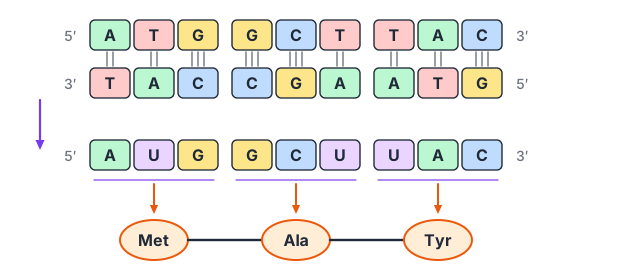
Transcription (“copying”) takes place in the nucleus of eukaryotes. The double helix unwinds over a gene, and the enzyme RNA polymerase builds an mRNA complementary to one DNA strand — the template strand:
DNA template → mRNA: A → U, T → A, G → C, C → G.
So the mRNA repeats the other — coding — strand of DNA, except that T is replaced by U.
In eukaryotes the new mRNA is processed: non-coding parts of the gene — introns — are cut out and the coding parts — exons — are joined. The mature mRNA leaves through nuclear pores into the cytoplasm and goes to a ribosome. Prokaryotes have no nucleus, so transcription and translation happen in the cytoplasm almost at the same time.
§5. Translation
Translation takes place in the cytoplasm, on ribosomes.
- Amino acid activation: each tRNA attaches its own amino acid with the help of a specific enzyme; this uses energy from ATP.
- Initiation: the mRNA binds to the small ribosomal subunit, a tRNA carrying methionine pairs with the start codon AUG, then the large subunit joins.
- Elongation: a tRNA whose anticodon is complementary to the next codon brings its amino acid; a peptide bond forms between neighbouring amino acids; the ribosome moves along the mRNA by one codon (3 nucleotides).
- Termination: when the ribosome reaches a stop codon, no tRNA matches it, the polypeptide is released and the ribosome separates into subunits.
Several ribosomes can work on one mRNA at the same time — this complex is a polysome, which makes many copies of a protein quickly. The finished polypeptide is then folded and modified in the ER and Golgi apparatus, and the secondary, tertiary and quaternary structures form from the primary one.
Protein synthesis is an energy-consuming process (anabolism): ATP is used and enzymes take part.
§6. Formulas for problems
- mRNA nucleotides = amino acids × 3 (add 3 more if the stop codon is counted).
- DNA nucleotides (double-stranded gene) = amino acids × 6.
- Gene length = nucleotides in one strand × 0.34 nm.
- Gene mass ≈ number of nucleotides × 345; protein mass ≈ amino acids × 110.
- A tRNA anticodon is complementary to the mRNA codon: codon GCU → anticodon CGA.
- The number of tRNAs taking part in translation equals the number of amino acids.
Read carefully which strand the problem calls the template: mRNA is complementary to the template strand.
Worked example
The first DNA strand is ATG ACC CAA. If the second strand is the template, what is the polypeptide? (AUG — methionine, ACC — threonine, CAA — glutamine)
- The second strand is complementary to the first: TAC TGG GTT.
- The mRNA is complementary to the second strand, so it repeats the first with T → U: AUG ACC CAA.
- Read the codons: AUG — methionine, ACC — threonine, CAA — glutamine.
- Answer: methionine — threonine — glutamine.
Worked example
A protein has 150 amino acids. Find the number of nucleotides in its mRNA and gene DNA and the gene length (without a stop codon).
- mRNA: 150 × 3 = 450 nucleotides.
- DNA (two strands): 450 × 2 = 900 nucleotides.
- Gene length along one strand: 450 × 0.34 = 153 nm.
- Answer: 450 nucleotides, 900 nucleotides, 153 nm.
Worked example
Adenine makes up 20% of a DNA fragment. Find the shares of the other nucleotides.
- By Chargaff’s rule T = A = 20%.
- G + C = 100% − 40% = 60%.
- G = C = 60% / 2 = 30%.
- Answer: T — 20%, G — 30%, C — 30%.
Check yourself
- How many codons code for amino acids?
- Where does transcription take place in eukaryotes?
- Which mRNA codon corresponds to the template DNA triplet TAC?
- What is the tRNA anticodon if the mRNA codon is GCU?
- How many amino acids does an mRNA of 600 nucleotides code for (no stop codon)?
- DNA contains 15% guanine. What percentage is adenine?
- What does the universality of the genetic code mean?
- How long is the gene for a protein of 120 amino acids?
Common mistakes
- Writing thymine (T) in mRNA — RNA has uracil (U) instead.
- Copying the coding strand instead of the template strand.
- Counting a stop codon as an amino acid.
- Saying transcription happens on the ribosome — the ribosome carries out translation.
- Multiplying all the nucleotides of both strands by 0.34 when finding gene length — use one strand only.
- Writing that replication happens during division (mitosis) — it happens in the S phase of interphase.
Score: 0 / 8 correct (0 attempted)