PhysicsPhysics · 30 / 36
Geometric optics: reflection and refraction
School curriculum· 30 min· 22 questions
Learn first: Physical quantities and measurement
Geometric optics treats light as straight-line rays and studies how they reflect and refract. The approach works when obstacles and openings are much larger than the wavelength. Mirrors, periscopes, optical fibres, water that looks "shallower" than it is and the sparkle of a diamond are all explained by the two laws of this section.
§1. Rectilinear propagation of light
In a uniform transparent medium light travels in straight lines. Evidence: shadows and half-shadows (umbra and penumbra), solar and lunar eclipses. Crossing beams do not disturb each other (independence of light beams).
The speed of light in vacuum is c = 3·10⁸ m/s; in any medium it is lower. The absolute refractive index of a medium:
n = c/v
For air n ≈ 1, water n ≈ 4/3, glass n ≈ 1.5, diamond n ≈ 2.42. The larger n, the optically denser the medium.
Shadows can be used to find heights: the Sun’s rays are parallel, so the triangles formed by an object and its shadow are similar.
Worked example
A vertical 1 m stick casts a 0.8 m shadow; at the same moment a tree casts a 12 m shadow. How tall is the tree?
- Similar triangles: H/12 = 1/0.8.
- H = 12/0.8 = 15 m.
§2. Reflection of light
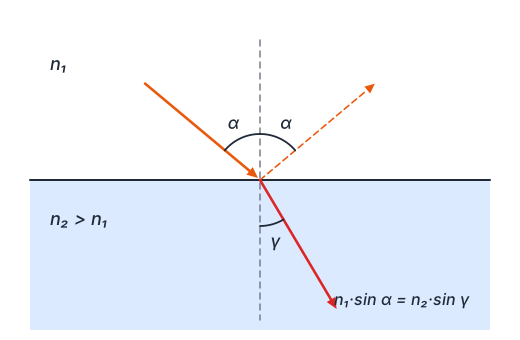
The incident ray, the reflected ray and the normal at the point of incidence lie in one plane; the angle of reflection equals the angle of incidence: β = α.
Angles are measured from the normal, not from the surface. A smooth surface gives specular (mirror) reflection, a rough one gives diffuse reflection; we see ordinary objects thanks to diffuse reflection.
Image in a plane mirror: virtual, upright, the same size as the object and symmetric to it about the mirror.
- If the mirror turns through an angle φ, the reflected ray turns through 2φ.
- If a person walks towards a mirror at speed v, the image approaches the person at 2v.
Worked example
A ray makes 30° with the surface of a mirror. Find the angle between the incident and reflected rays.
- Angle of incidence from the normal: α = 90° − 30° = 60°.
- The angle of reflection is also 60°, so the angle between the rays is 60° + 60° = 120°.
§3. Refraction of light
When light passes from one medium to another it changes direction, because its speed changes.
Law of refraction (Snell’s law): n₁·sin α = n₂·sin γ, i.e. sin α / sin γ = n₂/n₁
Why does a ray bend? By Fermat’s principle, light travels between two points along the path that takes the least time. A lifeguard on the beach runs to a swimmer not in a straight line but further along the sand and less through the water, because running is faster than swimming. Light likewise takes a longer path in the medium where it is faster and a shorter one where it is slower; Snell’s law follows from exactly this condition.
- Entering an optically denser medium, the ray bends towards the normal (γ < α); entering a less dense one, it bends away.
- On entering another medium the frequency does not change; the speed and wavelength decrease n times: λ = λ₀/n.
- A ray passing through a parallel-sided plate emerges parallel to its original direction, only shifted sideways.
- An object under water seen from directly above looks closer to the surface: h′ ≈ h/n.
Worked example
A ray goes from air into glass (n = √3) at an angle of incidence of 60°. Angle of refraction?
- sin γ = sin 60°/√3 = (√3/2)/√3 = 1/2.
- γ = 30°.
Worked example
A pool is 2 m deep (n = 4/3). How deep does it look when viewed vertically from above?
- h′ = h/n = 2·3/4.
- h′ = 1.5 m — the pool looks shallower than it is.
§4. Total internal reflection
When light travels from an optically denser medium into a less dense one (n₁ > n₂), the angle of refraction is larger than the angle of incidence. At the critical angle α₀ the refraction angle reaches 90°, and for larger angles no light enters the second medium at all — it is totally reflected.
sin α₀ = n₂/n₁, for exit into air sin α₀ = 1/n
Uses: optical fibres (internet cables, endoscopes), reflecting prisms (binoculars, periscopes), the sparkle of diamonds (small α₀ ≈ 24°).
Worked example
Find the critical angle for water (n = 4/3).
- sin α₀ = 1/n = 3/4 = 0.75.
- α₀ ≈ 48.6°.
§5. Light through a prism
In a triangular glass prism a ray refracts twice and is deviated towards the base. For a prism with a small refracting angle φ the deviation is:
δ ≈ (n − 1)·φ
In a right-angled isosceles prism the ray meets the hypotenuse face at 45°. For glass α₀ ≈ 41.8° < 45°, so total internal reflection occurs and the ray turns through 90° — such prisms replace mirrors in periscopes and binoculars.
Worked example
By how much does a thin prism with a 6° refracting angle and n = 1.5 deviate a ray?
- δ = (1.5 − 1)·6°.
- δ = 3°.
§6. Dispersion of light
Newton (1666) passed sunlight through a prism and obtained a coloured band on a screen, a spectrum: red, orange, yellow, green, cyan, blue, violet. When he isolated one colour and passed it through a second prism, no new colours appeared. Conclusion: white light is a mixture of colours, and the prism merely separates them.
The reason is dispersion: the refractive index of a material depends on the wavelength (frequency) of light. In glass n is larger for violet than for red, so violet light is refracted and deviated most and red least. In vacuum all colours travel at the same speed; in matter red light is faster.
A rainbow is also caused by dispersion: sunlight is refracted on entering raindrops, reflected inside them and refracted again on leaving, and each colour emerges at its own angle. To see a rainbow, the Sun must be behind the observer.
Worked example
For a thin prism with refracting angle 6°, the refractive index is n = 1.51 for red and n = 1.53 for violet. Over what angle is the spectrum spread?
- Deviation of red: δ_r = (1.51 − 1)·6° = 3.06°.
- Deviation of violet: δ_v = (1.53 − 1)·6° = 3.18°.
- Width of the spectrum: 3.18° − 3.06° = 0.12°.
Check yourself
- Speed of light in glass (n = 1.5)?
- A person stands 1.5 m from a plane mirror. How far is the person from the image?
- A ray leaves water (n = 4/3) into air at an angle of incidence of 30°. Angle of refraction?
- Critical angle for diamond (n = 2.42)?
- A fish is 1.2 m deep (n = 4/3). How deep does it appear when viewed from directly above?
- 600 nm light enters water. How do the wavelength and frequency change?
- A 1.8 m tall person casts a 1.2 m shadow; a tower’s shadow is 30 m at the same time. Height of the tower?
- Which colour is deviated most by a prism?
Common mistakes
- Measuring angles from the surface (they are measured from the normal).
- Thinking the frequency changes on refraction.
- Thinking total internal reflection can happen when light goes from a less dense to a denser medium: only from denser to less dense.
- Swapping n₁ and n₂ in Snell’s law.
- Calling a plane-mirror image real: it is virtual and cannot be projected on a screen.
- Thinking red is deviated most in dispersion: violet is deviated most.
Score: 0 / 8 correct (0 attempted)