Learn first: Geometric optics: reflection and refraction
A lens is a transparent body bounded by two spherical surfaces (or one spherical and one flat). Glasses, cameras, microscopes, telescopes, projectors and even our own eyes form images with lenses. In this topic we learn to construct images, use the thin-lens formula with correct signs, correct vision defects and find the magnification of optical instruments.
§1. Types of lens and optical power
- A converging lens (thicker in the middle than at the edges) brings parallel rays together at one point — the principal focus. Its focus is real, F > 0.
- A diverging lens (thinner in the middle) spreads parallel rays; their extensions meet at a virtual focus, F < 0.
The centre of the lens is the optical centre: a ray through it is not deviated. The line through the optical centre and the foci is the principal axis. The distance from the lens to the focus is the focal length F.
Optical power: D = 1/F, measured in dioptres (dptr), with F in metres
Lensmaker’s formula: D = (n − 1)(1/R₁ + 1/R₂)
For lenses in contact the powers add: D = D₁ + D₂.
Worked example
A biconvex glass lens (n = 1.5) has both radii of curvature equal to 20 cm. Optical power and focal length?
- D = (1.5 − 1)·(1/0.2 + 1/0.2) = 0.5·10 = 5 dptr.
- F = 1/D = 0.2 m = 20 cm.
§2. Constructing images
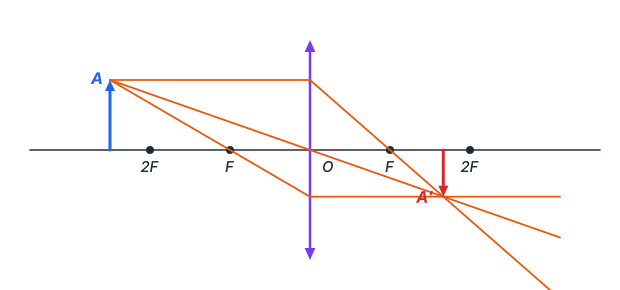
Two of the three "convenient" rays are enough:
- A ray parallel to the principal axis passes through the focus after the lens (for a diverging lens its extension comes from the focus).
- A ray through the optical centre goes straight on.
- A ray through the focus leaves the lens parallel to the axis.
If the rays themselves meet, the image is real (it can be caught on a screen); if only their extensions meet, it is virtual.
§3. The thin-lens formula
1/F = 1/d + 1/f
Magnification: Γ = H/h = |f|/d
- d — distance from object to lens, f — from lens to image.
- Signs: converging F > 0, diverging F < 0; real image f > 0, virtual image f < 0.
Worked example
A converging lens has F = 10 cm; the object is at d = 15 cm. Where is the image and what is it like?
- 1/f = 1/10 − 1/15 = (3 − 2)/30 = 1/30 → f = 30 cm.
- Γ = 30/15 = 2.
- The image is real (f > 0), inverted and magnified 2 times.
Worked example
An object 40 cm away gives a virtual upright image half its size. Type of lens and its power?
- Only a diverging lens gives a diminished virtual image.
- Γ = |f|/d = 0.5 → |f| = 20 cm; the image is virtual, so f = −20 cm.
- D = 1/0.4 + 1/(−0.2) = 2.5 − 5 = −2.5 dptr.
§4. Images formed by a converging lens
- d > 2F — diminished, real, inverted (camera, eye).
- d = 2F — same size, real, inverted, f = 2F.
- F < d < 2F — magnified, real, inverted (projector).
- d = F — no image (rays leave parallel).
- d < F — magnified, virtual, upright (magnifying glass).
A diverging lens always gives a diminished, virtual, upright image.
§5. The eye and glasses
The eye is a converging optical system: the lens forms a diminished, real, inverted image on the retina. Adjusting to different distances by changing the lens curvature is called accommodation. For a normal eye the near point (distance of most distinct vision) is d₀ = 25 cm.
- Short sight (myopia): the image forms in front of the retina — corrected with a diverging lens.
- Long sight (hypermetropia): the image forms behind the retina — corrected with a converging lens.
Worked example
A long-sighted person sees clearly only beyond 50 cm. What glasses let them read at 25 cm?
- The glasses must form a virtual image of the book (25 cm) at 50 cm: d = 0.25 m, f = −0.5 m.
- D = 1/0.25 − 1/0.5 = 4 − 2 = +2 dptr (converging).
§6. Optical instruments
- Magnifying glass: object inside the focus, magnification Γ = d₀/F.
- Camera: d > 2F, a diminished real image on the sensor.
- Projector: F < d < 2F, a magnified real image on the screen.
- Microscope: objective and eyepiece, Γ = Γ_obj·Γ_eye.
- Telescope (Keplerian): Γ = F_obj/F_eye.
§7. Deriving the formula and a two-lens system
The thin-lens formula follows from similar triangles. Let the object height be h and the image height H. A ray through the optical centre is not refracted, so the tips of the object and the image lie on one straight line through the centre: H/h = f/d. A ray parallel to the principal axis passes through the focus, and the triangles next to the focus give H/h = (f − F)/F. Equating the two: f/d = (f − F)/F, i.e. fF = fd − Fd. Dividing both sides by dfF gives 1/d = 1/F − 1/f, which is exactly 1/F = 1/d + 1/f.
Magnification can be written two ways: Γ = H/h = f/d
The formula holds for a thin lens: its thickness is much smaller than d, f and F, and the rays travel close to the principal axis (paraxial rays). Rays near the edge are refracted differently — this is spherical aberration; different refraction of different colours gives chromatic aberration.
In a system of several lenses the calculation is done step by step: the image formed by the first lens acts as the object for the second. The total magnification is the product of the individual ones: Γ = Γ₁·Γ₂. Microscopes and telescopes work on exactly this principle.
Worked example
Two converging lenses with F₁ = 10 cm and F₂ = 20 cm are 40 cm apart. An object is 15 cm from the first lens. Where is the final image and what is the total magnification?
- First lens: 1/f₁ = 1/10 − 1/15 = 1/30 → f₁ = 30 cm, Γ₁ = 30/15 = 2; the image is real and inverted.
- That image is 40 − 30 = 10 cm from the second lens and acts as its object: d₂ = 10 cm.
- Second lens: 1/f₂ = 1/20 − 1/10 = −1/20 → f₂ = −20 cm (virtual image), Γ₂ = 20/10 = 2.
- Total magnification Γ = 2·2 = 4; the final image is 20 cm from the second lens on the object side, virtual and inverted relative to the original object.
Check yourself
- A lens has a power of 4 dptr. Focal length?
- F = 20 cm, d = 30 cm. Image distance and magnification?
- F = 20 cm, d = 10 cm. What is the image like?
- Lenses of +5 dptr and −2 dptr are placed in contact. Focal length of the system?
- Magnification of a magnifying glass with a 5 cm focal length?
- A short-sighted person cannot see clearly beyond 50 cm. Power of the glasses?
- A converging lens has F = 20 cm; the object is at d = 60 cm. Image distance and magnification?
- A microscope objective magnifies 40 times and the eyepiece focal length is 2.5 cm. Total magnification?
Common mistakes
- Not making f negative for a virtual image.
- Not converting centimetres to metres when finding D.
- Taking F positive for a diverging lens.
- Thinking there is an image when d = F: the rays leave parallel and the image is at infinity.
- Mixing up the lenses for myopia and hypermetropia: diverging for short sight, converging for long sight.
- In a two-lens system, taking the object distance for the second lens without allowing for the separation of the lenses.
Score: 0 / 8 correct (0 attempted)