Learn first: Linear motion
Circular motion is everywhere: wheels, gears, centrifuges, roundabouts, satellites orbiting the Earth, an electron in a magnetic field. Even when the speed stays the same, the direction of the velocity keeps changing, so there is an acceleration and a force that causes it. The topic continues straight-line kinematics and is essential for dynamics, gravitation, planetary motion and the motion of charges in magnetic fields.
§1. Quantities that describe rotation
The simplest case is uniform circular motion: the body covers equal arcs in equal times.
- Period T: the time for one complete revolution (s). If N revolutions take time t, then T = t/N.
- Frequency ν = 1/T = N/t: revolutions per second (Hz or s⁻¹). Engineers often use revolutions per minute: 1200 rpm = 20 Hz.
- Angle turned φ is measured in radians: arc length divided by radius, φ = l/R. A full turn is 2π rad = 360°, 1 rad ≈ 57.3°.
- Angular velocity ω: the angle turned per unit time:
ω = φ/t = 2π/T = 2πν, unit rad/s
§2. Linear speed
Linear speed is the speed of a point along the circle. At every instant it points along the tangent: sparks from a grinding wheel and mud from a spinning tyre fly off tangentially.
v = l/t = 2πR/T = ωR
All points of one rigid body (a disc, a wheel, the Earth) turn with the same ω, but linear speed is proportional to radius: a point on the rim moves faster, and a point on the axis is at rest.
Worked example
Find the linear speed and centripetal acceleration of a point on the Earth’s equator (R = 6.4·10⁶ m, T = 24 h).
- T = 24·3600 = 86 400 s.
- v = 2πR/T = 2·3.14·6.4·10⁶/86 400 ≈ 465 m/s.
- a = ω²R = (2π/86 400)²·6.4·10⁶ ≈ 0.034 m/s², about 300 times smaller than g, which is why we hardly notice the Earth’s rotation.
§3. Centripetal acceleration
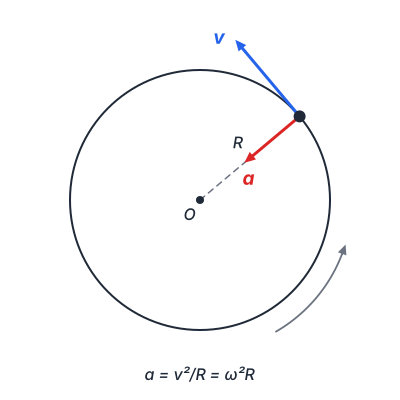
The size of the velocity does not change, but its direction keeps turning. Over a short time Δt the change Δv⃗ points towards the centre, so the acceleration points towards the centre too: this is centripetal (normal) acceleration:
a = v²/R = ω²R = 4π²R/T²
- In uniform circular motion this is the only acceleration; it is perpendicular to the velocity and does not change the speed.
- At the same v, a smaller radius means a larger acceleration: tight bends are dangerous.
- At the same ω (points of one body), the acceleration is proportional to R.
If the speed changes as well, a tangential acceleration a_τ = Δv/Δt appears; the total acceleration is a = √(a_n² + a_τ²).
Worked example
A wheel of radius 0.5 m makes 4 revolutions in 2 s. Find v and a for a point on the rim.
- T = 2/4 = 0.5 s, ω = 2π/T = 4π ≈ 12.6 rad/s.
- v = ωR = 4π·0.5 = 2π ≈ 6.3 m/s.
- a = ω²R = 16π²·0.5 ≈ 79 m/s².
§4. Dynamics of circular motion
By Newton’s second law, centripetal acceleration is produced by a resultant force towards the centre: F = ma = mv²/R. This is not a separate “new” force; the role is played by string tension, weight, the normal reaction, friction or gravity. “Centrifugal force” is introduced only in a rotating (non-inertial) frame; in an inertial frame it does not exist.
Method:
- Draw all the forces.
- Resolve them along the axis pointing to the centre.
- Write ΣF_to centre = mv²/R.
Typical cases:
- A mass on a string in a vertical circle, bottom point: T − mg = mv²/R → T = m(g + v²/R). At the top: T + mg = mv²/R; for the string to stay taut, v ≥ √(gR).
- A humpback bridge, top point: mg − N = mv²/R, so the car presses less on the bridge; on a dip it presses more.
- A flat bend: friction holds the car: μmg ≥ mv²/R → v_max = √(μgR).
- A banked road: if the road on a bend tilts inwards, the horizontal component of the normal reaction also points to the centre, and the car can take the bend even without friction: tg α = v²/(gR). That is why a cyclist leans into a bend.
- A satellite: the centripetal force is the Earth’s gravity: GMm/r² = mv²/r, so v = √(GM/r).
Worked example
A 0.9 kg ball on a 1.2 m string moves in a vertical circle; at the bottom v = 4 m/s. Find the tension.
- v²/R = 16/1.2 ≈ 13.3 m/s².
- T = m(g + v²/R) = 0.9·(10 + 13.3).
- T = 21 N, much more than the weight (9 N).
Worked example
A car takes a flat bend of radius 50 m; the coefficient of friction between tyres and road is μ = 0.5. What is the maximum safe speed?
- Friction supplies the centripetal force: μmg = mv²/R.
- v_max = √(μgR) = √(0.5·10·50) = √250 ≈ 15.8 m/s ≈ 57 km/h.
Centrifuges and the spin cycle of a washing machine work on the same law: when the drum spins fast, a large centripetal force would be needed to keep water drops on the clothes, adhesion is not enough, and the drops fly off tangentially through the holes.
§5. Belt drives and rolling wheels
In a belt or gear drive without slipping, the linear speeds of points on the rims of the two wheels are equal:
ω₁R₁ = ω₂R₂, i.e. ν₁R₁ = ν₂R₂
The smaller wheel turns faster. Bicycle chains, clock mechanisms and car gearboxes work this way. Wheels fixed on the same axle have equal angular velocities.
A wheel rolling without slipping: if its axle moves forward at speed v, the wheel turns about the axle with ω = v/R. The point touching the ground is momentarily at rest, while the top point moves at 2v relative to the ground.
Worked example
Two wheels joined by a belt have radii 10 cm and 30 cm. The small one turns at 6 Hz. Frequency of the large one?
- Rim speeds are equal: ν₁R₁ = ν₂R₂.
- ν₂ = 6·10/30 = 2 Hz.
Check yourself
- A disc makes 120 revolutions per minute. Frequency and period?
- Angular velocity of the tip of a clock’s minute hand?
- A car takes a bend of radius 100 m at 20 m/s. Centripetal acceleration?
- At what speed is a car weightless at the top of a humpback bridge of radius 40 m?
- A 1000 kg car crosses the top of a humpback bridge of radius 40 m at 10 m/s. Force on the bridge?
- The radius doubles at the same ω. How does the centripetal acceleration change?
- The axle of a rolling wheel moves at 5 m/s. Speed of the top of the wheel relative to the ground?
- Is the acceleration zero in uniform circular motion?
Common mistakes
- Thinking the acceleration is zero in uniform circular motion.
- Using ω in rev/s instead of rad/s, i.e. forgetting 2π.
- Writing T = mg − mv²/R at the bottom: the sign is wrong, T = mg + mv²/R.
- Equating angular velocities in a belt drive: it is the linear speeds that are equal.
- Drawing a “centrifugal force” in an inertial frame and so counting forces twice.
Score: 0 / 8 correct (0 attempted)