Learn first: Physical quantities and measurement
Kinematics studies how a body moves (where, how fast, for how long) without asking why it moves; that is the job of dynamics. The formulas of straight-line motion are the foundation of all mechanics: they are used again and again in dynamics, energy, oscillations and even for a particle in an electric field. A student who masters this topic can later derive formulas by reasoning instead of memorising them.
§1. Basic ideas
- Mechanical motion is the change in a body’s position relative to other bodies over time.
- A point particle is a body whose size can be ignored in a given problem. A car driving from Tashkent to Samarkand is a point particle; a car parking in a garage is not.
- A frame of reference = a reference body + a coordinate system + a clock. Motion is relative: a train passenger is at rest relative to the carriage but moving relative to the Earth.
- The trajectory is the line traced by the moving body.
- Distance s is the length of the trajectory; a scalar that never decreases.
- Displacement is the directed segment from the start point to the end point; a vector.
After one full lap of a circle, the distance is 2πR and the displacement is zero. For motion along a straight line in one direction, distance equals the size of the displacement.
§2. Uniform straight-line motion
If a body makes equal displacements in any equal time intervals, the motion is uniform and the velocity is constant.
x = x₀ + vₓt, s = v·t
- vₓ is the velocity component along the axis: positive when moving along the axis, negative when moving against it.
- The x(t) graph is a straight line whose slope equals the velocity; the steeper it is, the faster the motion.
- The v(t) graph is a horizontal line; the area under it is the distance travelled.
For example, x = 100 − 5t means the body starts 100 m from the origin and moves against the axis at 5 m/s; it reaches the origin at t = 20 s.
To find where and when two bodies meet, set their equations equal: x₁(t) = x₂(t).
§3. Average speed and adding velocities
For non-uniform motion the average speed is the total distance divided by the total time:
v_av = s_total / t_total
It is not the arithmetic mean of the speeds! If equal halves of the distance are covered at v₁ and v₂:
v_av = 2v₁v₂/(v₁ + v₂)
For equal halves of the time, however, v_av = (v₁ + v₂)/2.
Adding velocities (Galileo): the velocity of a body relative to a fixed frame = its velocity relative to a moving frame + the velocity of that frame:
v⃗ = v⃗′ + v⃗₀
Two trains moving towards each other have relative speed v₁ + v₂; moving the same way, |v₁ − v₂|. A boat moves at v + u downstream and v − u upstream.
Worked example
A bus covers the first half of a route at 60 km/h and the second half at 40 km/h. What is its average speed?
- v_av = 2v₁v₂/(v₁ + v₂) = 2·60·40/(60 + 40).
- v_av = 4800/100 = 48 km/h (not 50).
Worked example
Two trains approach each other at 54 km/h and 36 km/h. How long does a passenger in one train see the other train, 150 m long, passing by?
- Convert to SI: 15 m/s and 10 m/s.
- Relative speed: 15 + 10 = 25 m/s.
- t = 150/25 = 6 s.
§4. Uniformly accelerated motion
If the velocity changes by equal amounts in equal times, the motion is uniformly accelerated: the acceleration is constant.
a = (v − v₀)/t, unit m/s²
When speeding up, a points the same way as the velocity; when slowing down, the opposite way (as a component, a < 0).
v = v₀ + at
s = v₀t + at²/2
v² − v₀² = 2as
s = (v₀ + v)t/2
The third formula is handy when the time is not given, the fourth when the acceleration is not given. Starting from rest, the distances in successive equal time intervals are in the ratio 1 : 3 : 5 : 7 … (Galileo’s rule); the distance in the n-th second is
s_n = v₀ + a(2n − 1)/2
Worked example
A car moving at v₀ = 10 m/s brakes with a = −2 m/s². How far does it travel before stopping?
- When it stops, v = 0: 0 − v₀² = 2as.
- s = v₀²/(2|a|) = 100/4 = 25 m.
§5. Motion graphs
- For uniformly accelerated motion the v(t) graph is a straight line; its slope is the acceleration and the area under it is the distance (displacement).
- The x(t) graph is a parabola: curving upwards when speeding up, downwards when slowing down.
- The a(t) graph is a horizontal line; the area under it is the change in velocity.
In graph problems it helps to split the area into triangles and rectangles.
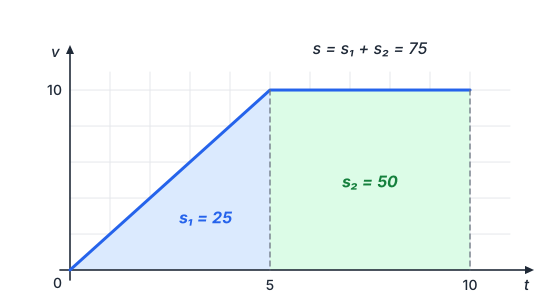
Worked example
A body starts from rest, accelerates uniformly to 10 m/s in 5 s, then moves at constant speed for 5 s. Total distance?
- First part (triangle): s₁ = 5·10/2 = 25 m.
- Second part (rectangle): s₂ = 10·5 = 50 m.
- s = 25 + 50 = 75 m.
§6. Free fall and vertical throws
Without air resistance all bodies fall with the same acceleration: g ≈ 9.8 ≈ 10 m/s² (Galileo). Free fall is a special case of uniformly accelerated motion, so the formulas of §4 apply with a = g.
- Falling down: h = v₀t + gt²/2, v = v₀ + gt; from rest: t = √(2h/g).
- Thrown up: time to rise t = v₀/g, maximum height h = v₀²/(2g); the body returns with its initial speed, and the fall takes as long as the rise.
- At the top the velocity is zero, but the acceleration is g, not zero!
Worked example
A body thrown downwards from a height of 175 m covers 25 m during the 2nd second. Find its initial speed and the distance covered in the first 4 s.
- s₂ = v₀ + g(2·2 − 1)/2 = v₀ + 15.
- v₀ + 15 = 25 → v₀ = 10 m/s.
- s(4) = 10·4 + 10·16/2 = 40 + 80 = 120 m, less than 175 m, so the body has not yet reached the ground.
Check yourself
- A body starting from rest reaches 20 m/s in 5 s. Acceleration?
- How far does it travel in those 5 s?
- A stone is thrown up at 20 m/s. Maximum height?
- A body falls from rest from 45 m. Time of fall?
- Accelerating uniformly from rest, a body covers 2 m in the 1st second. And in the 3rd?
- A cyclist rides 50 m in 10 s and then 250 m in 20 s. Average speed?
- A boat moves at 5 m/s relative to the water; the current is 1 m/s. Speed relative to the bank going upstream?
- What is the acceleration of a body thrown upwards at its highest point?
Common mistakes
- Taking average speed as the arithmetic mean of the speeds.
- Forgetting the sign of the acceleration when braking.
- Confusing distance and displacement.
- Putting km/h into formulas without converting to m/s (1 m/s = 3.6 km/h).
- Mixing up “distance in the n-th second” and “distance in n seconds”.
- Thinking the acceleration is zero at the highest point.
Score: 0 / 8 correct (0 attempted)