Learn first: Direct current and Ohm's law
A magnetic field is a form of matter that exists around moving charges and currents. It acts only on moving charges and current-carrying conductors. Electric motors, loudspeakers, meters and particle accelerators all rely on it, and the Earth’s field even produces the polar lights. In this topic we learn to describe the field and to calculate the Ampère and Lorentz forces.
§1. The magnetic field and magnetic induction
In 1820 Ørsted noticed that a compass needle near a current-carrying wire turned: a current creates a magnetic field. Sources of the field are permanent magnets, currents and moving charges.
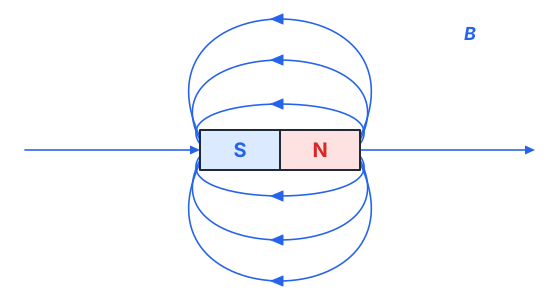
The force characteristic of the field is the magnetic induction (flux density) vector B⃗, measured in teslas (T). Field lines are always closed: outside a magnet they run from the north (N) pole to the south (S) pole. Magnetic charges (isolated poles) do not exist.
The field of a straight current forms concentric circles around the wire. Its direction is given by the right-hand grip (corkscrew) rule: if the thumb (or screw advance) points along the current, the curled fingers show the direction of the B lines.
Straight wire: B = μ₀I/(2πr)
Inside a solenoid: B = μ₀nI, n = N/l — turns per unit length
μ₀ = 4π·10⁻⁷ T·m/A is the magnetic constant.
Worked example
Find the field 2 cm from a long wire carrying 10 A.
- B = 4π·10⁻⁷·10/(2π·0.02) = 2·10⁻⁷·10/0.02.
- B = 10⁻⁴ T = 0.1 mT.
§2. The Ampère force
A magnetic field exerts a force on a current-carrying conductor:
F = BIl·sin α
- l — length of conductor in the field (m), α — angle between the current and B⃗.
- The force is greatest at α = 90° and zero at α = 0 (current along B).
- Direction — left-hand rule (Fleming’s): field lines enter the palm, four fingers along the current, the thumb at 90° gives the force.
Parallel currents in the same direction attract; in opposite directions they repel.
Worked example
A horizontal conductor of mass 10 g and length 20 cm lies in a horizontal 0.5 T field perpendicular to it. What current makes it "weightless"?
- Equilibrium: BIl = mg.
- I = mg/(Bl) = 0.01·10/(0.5·0.2) = 0.1/0.1 = 1 A.
§3. Torque on a current loop
A uniform field turns a current-carrying loop — the principle of the electric motor.
M = BIS·sin α, for N turns M = NBIS·sin α
- S — loop area (m²), α — angle between B⃗ and the loop’s normal.
- When the plane of the loop is parallel to B (α = 90°) the torque is greatest: M_max = BIS.
Worked example
A loop 2 cm × 3 cm, B = 10 T, I = 2 A. Maximum torque?
- Area: S = 0.02·0.03 = 6·10⁻⁴ m².
- M_max = 10·2·6·10⁻⁴ = 1.2·10⁻² N·m = 12 mN·m.
§4. The Lorentz force
The force on a single charge moving in the field:
F = qvB·sin α
- For a positive charge use the left-hand rule (four fingers along the velocity); for a negative charge reverse it.
- The force is always perpendicular to the velocity, so it does no work: speed and kinetic energy stay constant.
- A particle entering perpendicular to B moves in a circle:
R = mv/(qB), T = 2πm/(qB)
The period does not depend on speed — the cyclotron is based on this.
Worked example
A proton (m = 1.67·10⁻²⁷ kg, q = 1.6·10⁻¹⁹ C) enters a 0.1 T field perpendicularly at 10⁶ m/s. Radius of its path?
- R = mv/(qB) = 1.67·10⁻²⁷·10⁶/(1.6·10⁻¹⁹·0.1).
- R = 1.67·10⁻²¹/1.6·10⁻²⁰ ≈ 0.10 m = 10 cm.
Worked example
An electron moves along the y axis and feels a force towards −x. Which way does B point?
- F⃗ = qv⃗ × B⃗; for an electron q < 0, so v⃗ × B⃗ points along +x.
- ŷ × ẑ = x̂, therefore B⃗ points along +z.
§5. Magnetic properties of matter
A substance placed in a field changes it; this is described by the permeability μ (B = μB₀).
- Diamagnets (μ < 1, copper, water) are weakly pushed out of the field.
- Paramagnets (μ > 1, aluminium, air) are weakly pulled in.
- Ferromagnets (μ ≫ 1, iron, nickel, cobalt) magnetise strongly; above the Curie point this property disappears.
§6. Forces between parallel currents and magnetic flux
§2 stated that parallel currents attract or repel. Let us now explain this quantitatively. The first wire with current I₁ produces a field B = μ₀I₁/(2πd) where the second wire is. This field acts on the current I₂ in the second wire with an Ampère force (α = 90°). Combining the formulas:
Force per metre of length: F/l = μ₀I₁I₂/(2πd)
By Newton’s third law the second wire acts on the first with an equal force. For a long time this formula defined the ampere: if currents of 1 A flow in two infinitely long parallel wires 1 m apart, they interact with a force of 2·10⁻⁷ N per metre. (Since 2019 the ampere has been defined through the elementary charge, but its numerical value is unchanged.)
For the next topic, electromagnetic induction, an important quantity is the magnetic flux: it measures how many field lines “pass through” a surface.
Φ = BS·cos α, unit weber (Wb), 1 Wb = 1 T·m²
α is the angle between B⃗ and the normal to the surface. If the surface is perpendicular to B (α = 0), the flux is greatest: Φ = BS; if the surface is parallel to the field lines, the flux is zero. When the flux changes, an emf appears in the loop — generators and transformers rely on this.
Worked example
Two parallel wires 1 m long are 10 cm apart and carry currents of 10 A and 20 A in the same direction. What is the force between them and its direction?
- F = μ₀I₁I₂l/(2πd) = 2·10⁻⁷·10·20·1/0.1.
- F = 4·10⁻⁴ N.
- The currents are in the same direction, so the wires attract.
Worked example
A square loop of side 10 cm is in a field B = 0.2 T; its normal makes 60° with B⃗. Magnetic flux?
- S = 0.1·0.1 = 0.01 m².
- Φ = 0.2·0.01·cos 60° = 0.2·0.01·0.5.
- Φ = 10⁻³ Wb = 1 mWb.
Check yourself
- A 20 cm wire carries 5 A perpendicular to B = 0.5 T. Ampère force?
- The same wire makes 30° with B?
- An electron moves at 2·10⁷ m/s perpendicular to a 10⁻³ T field. Lorentz force and radius?
- A particle moves along the B lines. Lorentz force?
- A particle’s speed doubles. How do the radius and period change?
- Two parallel wires carry currents in opposite directions. How do they interact?
- A solenoid 25 cm long with 500 turns carries 2 A. Field inside?
- A loop of area 4 cm² is perpendicular to a field B = 0.5 T. Magnetic flux?
Common mistakes
- Forgetting to reverse the left-hand rule result for an electron (negative charge).
- Leaving area in cm²: 1 cm² = 10⁻⁴ m².
- Measuring α in the torque formula from the plane of the loop instead of from its normal.
- Thinking the Lorentz force speeds a particle up: it only changes the direction of motion.
- Dropping sin α in the Ampère force, or forgetting the angle is between the current and B.
- Taking the angle between the plane of the loop and B in the flux formula: the angle is measured from the normal.
Score: 0 / 8 correct (0 attempted)