Learn first: Basic concepts and laws of chemistry
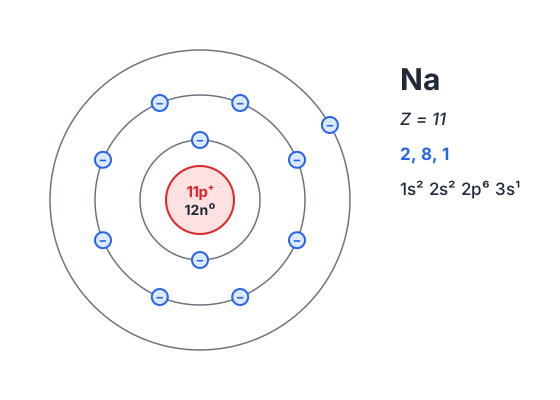
An atom is a composite particle made of a positively charged nucleus and electrons moving around it. All the chemical properties of an element — its valency, oxidation states and place in the periodic table — depend on how its electrons are arranged. Being able to work out the make-up of an atom (numbers of protons, neutrons and electrons) and to write its electron configuration is therefore the key to all of chemistry. This topic is the foundation for "The periodic law" and "Chemical bonding", and questions on isotopes, ions and electron configurations appear in every exam.
§1. Models of the atom and its components
The ancient idea of an indivisible atom changed at the end of the 19th century. J. J. Thomson discovered the electron (1897). E. Rutherford fired alpha particles through thin gold foil and showed that the atom has a tiny positive nucleus at its centre containing almost all its mass (1911), proposing the planetary model. N. Bohr showed that electrons move only in orbits of definite energy (1913). J. Chadwick discovered the neutron (1932).
Proton p⁺ (charge +1, mass ≈ 1 u), neutron n⁰ (charge 0, mass ≈ 1), electron e⁻ (charge −1, mass ≈ 1/1836)
- Atomic number Z = nuclear charge = number of protons = number of electrons in a neutral atom.
- Mass number A = Z + N, where N is the number of neutrons.
- Notation: ³⁵₁₇Cl has 17 protons, 35 − 17 = 18 neutrons and 17 electrons.
An atom is about 10⁻¹⁰ m across and the nucleus about 100 000 times smaller, yet the nucleus holds more than 99.9 % of the atom’s mass.
§2. Isotopes, isobars and average atomic mass
Isotopes are atoms of the same element with the same number of protons but different numbers of neutrons: hydrogen has ¹H (protium), ²H (deuterium, D) and ³H (tritium, T); chlorine has ³⁵Cl and ³⁷Cl. Isotopes have practically the same chemical properties because these depend on the electron shell.
Isobars are atoms of different elements (different Z) with the same mass number: ⁴⁰Ar and ⁴⁰Ca. Isotones have the same number of neutrons.
An element’s Ar in the periodic table is the average of its isotope masses weighted by natural abundance:
Ar = A₁·x₁ + A₂·x₂ + … (x is the natural mole fraction of each isotope; the fractions add up to 1)
Worked example
Natural chlorine is 75 % ³⁵Cl and 25 % ³⁷Cl. Find the average relative atomic mass of chlorine.
- Ar = 35·0.75 + 37·0.25.
- Ar = 26.25 + 9.25 = 35.5.
- That is why chlorine’s mass in the table is not a whole number: 35.5.
§3. Ions and isoelectronic species
- A cation is an atom that has lost electrons: Na → Na⁺ + e⁻ (11 p, 10 e).
- An anion is an atom that has gained electrons: Cl + e⁻ → Cl⁻ (17 p, 18 e).
When an ion forms, the number of protons (and so the element) stays the same; only the number of electrons changes: electrons = Z − (ion charge). Species with the same number of electrons are isoelectronic: N³⁻, O²⁻, F⁻, Ne, Na⁺, Mg²⁺, Al³⁺ each have 10 electrons. In an isoelectronic series the radius shrinks as nuclear charge grows: O²⁻ > F⁻ > Na⁺ > Mg²⁺.
§4. Electron shells and quantum numbers
The state of an electron is described by four quantum numbers:
- the principal quantum number n = 1, 2, 3… — the energy level (shell) and its energy;
- the orbital (azimuthal) number l = 0 … n−1 — the subshell and orbital shape: l = 0 is s (spherical), l = 1 p (dumbbell), l = 2 d, l = 3 f;
- the magnetic number m = −l … +l — the orbital’s orientation in space; a subshell has 2l + 1 orbitals;
- the spin number s = +½ or −½.
Subshell capacity: s 2, p 6, d 10, f 14; shell n holds at most 2n² electrons
The filling order follows the Klechkovsky (Madelung) rule: the subshell with the smaller n + l fills first; if the sums are equal, the one with smaller n fills first:
1s 2s 2p 3s 3p 4s 3d 4p 5s 4d 5p 6s 4f 5d 6p 7s
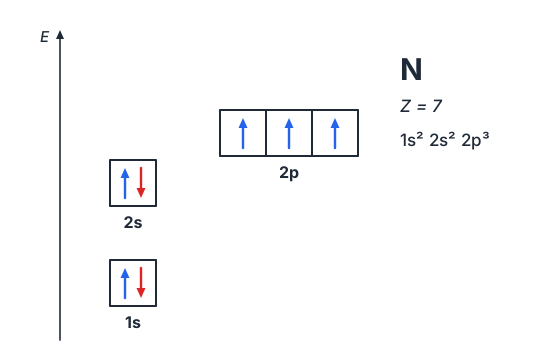
Pauli exclusion principle: no two electrons in an atom have the same four quantum numbers, so one orbital holds at most 2 electrons of opposite spin. Hund’s rule: electrons occupy the orbitals of a subshell singly with parallel spins before pairing. For example, nitrogen’s 2p³ electrons sit one in each of three orbitals, giving three unpaired electrons.
Worked example
Write the configurations of iron (Z = 26) and its ions.
- Fe: 1s² 2s² 2p⁶ 3s² 3p⁶ 4s² 3d⁶, or [Ar] 4s² 3d⁶.
- When an ion forms, the outer 4s electrons leave first, then the 3d electrons.
- Fe²⁺: [Ar] 3d⁶; Fe³⁺: [Ar] 3d⁵ (a half-filled d subshell, which makes Fe³⁺ stable).
Electron "promotion": Cr is [Ar] 4s¹ 3d⁵ and Cu is [Ar] 4s¹ 3d¹⁰. Half-filled and completely filled d subshells are energetically favoured, so one 4s electron moves into 3d. Mo and Ag behave similarly.
§5. Element blocks and valence electrons
Depending on which subshell receives the last electron there are s-block elements (groups IA, IIA and He), p-block elements (groups IIIA–VIIIA), d-block elements (transition metals) and f-block elements (lanthanoids and actinoids).
Valence electrons are those that take part in bonding. For main-group elements they are the outer-shell electrons, and their number equals the group number: sulfur 3s² 3p⁴ has 6. For d-block elements the d electrons of the shell below also count. When an atom is excited, paired electrons can move into empty orbitals, increasing the number of unpaired electrons (and the valency): carbon 2s² 2p² → 2s¹ 2p³ (valency IV).
§6. An official test item
Match the species with their configurations: a) hydride ion H⁻; b) nitride ion N³⁻; c) Fe³⁺; d) Zn²⁺.
Worked example
- H⁻: 1 + 1 = 2 electrons → 1s².
- N³⁻: 7 + 3 = 10 electrons → 1s² 2s² 2p⁶.
- Fe³⁺: 26 − 3 = 23 electrons → [Ar] 3d⁵.
- Zn²⁺: Zn is [Ar] 4s² 3d¹⁰; the two 4s electrons leave → 1s² 2s² 2p⁶ 3s² 3p⁶ 3d¹⁰.
Check yourself
- How many protons, neutrons and electrons are in ⁵⁶Fe³⁺?
- Copper has isotopes ⁶³Cu and ⁶⁵Cu, Ar = 63.5. What fraction is ⁶³Cu?
- Give the electron configuration of sulfur (Z = 16) and its number of valence electrons.
- Which species are isoelectronic: Na⁺, Ne, F⁻, Mg²⁺?
- What is the maximum number of electrons in the third shell?
- What is the electron configuration of Cr³⁺?
- How many unpaired electrons does a nitrogen atom have?
- Which subshell has l = 2, and how many orbitals does it contain?
Common mistakes
- Removing 3d electrons first when forming a cation: the 4s electrons leave first.
- Confusing isotopes and isobars: isotopes share Z, isobars share A.
- Treating mass number and relative atomic mass as the same: Ar is an average and can be fractional.
- Forgetting the electron promotion in Cr and Cu.
- Thinking the number of protons changes in an ion: only the number of electrons does.
Score: 0 / 8 correct (0 attempted)