Learn first: Atomic structure
In 1869 D. I. Mendeleev arranged the 63 elements then known, discovered that their properties repeat periodically and built the periodic table. Today we know the reason for this periodicity: the structure of the outer electron shell repeats periodically, and chemical properties depend on the outer electrons. A student who can "read" the periodic table can predict an element’s properties without memorising them: atomic radius, metal or non-metal, the nature of its oxides and hydroxides, its highest and lowest oxidation states — all follow from its position. This topic continues "Atomic structure".
§1. The periodic law and its history
Mendeleev arranged the elements in order of increasing atomic mass and placed elements with similar properties in the same column. His statement was: the properties of elements and their compounds depend periodically on their atomic masses. Later the English physicist H. Moseley (1913) showed that an element’s atomic number equals its nuclear charge, and the law was restated:
The properties of elements and their compounds depend periodically on the charge of the atomic nucleus (modern statement)
Although Mendeleev relied on atomic masses, in some pairs (Ar–K, Co–Ni, Te–I) he deliberately broke the mass order to keep similar elements together. For example, potassium’s mass (39.1) is less than argon’s (39.9), yet potassium comes after argon. The nuclear charge, however, always rises by one: Ar 18, K 19. This proved Mendeleev right.
§2. The structure of the periodic table
- A period is a horizontal row; it begins with an alkali metal and ends with a noble gas (except period 1). Period number = number of electron shells. There are 7 periods: 1–3 short, 4–7 long.
- A group is a vertical column; there are 8 groups, each divided into a main (A) and a sub- (B) group. For main-group elements, group number = number of outer-shell electrons = highest oxidation state (except fluorine and oxygen).
- A groups contain s- and p-block elements, B groups d-block elements; the lanthanoids and actinoids (f-block) are shown separately below the table.
The lowest (negative) oxidation state of a non-metal is group number − 8: nitrogen −3, sulfur −2, chlorine −1.
Worked example
An element is in period 3, group VIA. Identify it and write its main compounds.
- Period 3 means three shells; group VIA means 6 outer electrons.
- Configuration 1s² 2s² 2p⁶ 3s² 3p⁴ — sulfur (Z = 16).
- Highest oxide SO₃ (+6); hydride H₂S (6 − 8 = −2).
§3. Periodic trends in atomic properties
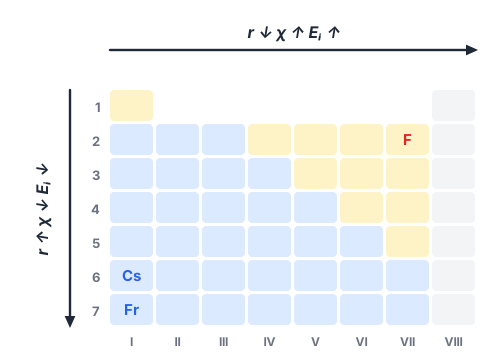
Across a period (left to right): radius decreases, electronegativity increases, metallic character weakens, non-metallic character strengthens
Down a group: radius increases, electronegativity decreases, metallic character strengthens
The reason: across a period the nuclear charge rises while the number of shells stays the same, so the outer electrons are pulled in more strongly and the atom "shrinks". Going down a group, each step adds a new shell, the outer electron is farther from the nucleus and inner electrons shield the nuclear charge, so the electron is lost more easily.
- Electronegativity is an atom’s ability to attract the shared electrons of a bond. The most electronegative element is fluorine (4.0 on the Pauling scale), followed by oxygen (3.5) and nitrogen (3.0).
- Ionisation energy is the energy needed to remove one electron from an atom: it rises across a period and falls down a group. Caesium and francium have the lowest ionisation energies and are the most reactive metals.
- Electron affinity is the energy released when an atom gains an electron; it is largest for the halogens.
The boundary between metals and non-metals runs along the boron — silicon — arsenic — tellurium diagonal. Elements near it (silicon, germanium) have intermediate properties and are used as semiconductors. Metals lie to the left of and below the line, non-metals to the right and above; so the most typical metal sits in the bottom-left corner of the table and the most typical non-metal in the top-right corner (fluorine).
§4. Trends in oxides and hydroxides
Across period 3, properties change from basic to acidic:
Na₂O, MgO — basic; Al₂O₃ — amphoteric; SiO₂, P₂O₅, SO₃, Cl₂O₇ — acidic
NaOH (strong alkali) → Mg(OH)₂ → Al(OH)₃ (amphoteric) → H₂SiO₃ → H₃PO₄ → H₂SO₄ → HClO₄ (strongest acid)
Down a group, basic character increases: Be(OH)₂ is amphoteric, Mg(OH)₂ a weak base, and Ca(OH)₂, Sr(OH)₂, Ba(OH)₂ are alkalis.
Volatile hydrides: SiH₄, PH₃, H₂S, HCl — acidity rises to the right across a period; it also rises down a group: HF < HCl < HBr < HI.
General formulae (main groups I–VII): highest oxide R₂O, RO, R₂O₃, RO₂, R₂O₅, RO₃, R₂O₇; hydrides in groups IV–VII RH₄, RH₃, H₂R, HR.
Worked example
An element’s highest oxide is RO₃, and the mass fraction of hydrogen in its hydride is 5.88 %. Identify the element.
- RO₃ → group VI → hydride H₂R.
- ω(H) = 2/(2 + Ar) = 0.0588 → 2 + Ar = 34.
- Ar = 32 — sulfur.
Worked example
The mass fraction of oxygen in the highest oxide of a group V element is 56.34 %. Identify the element.
- Highest oxide R₂O₅: ω(O) = 80/(2Ar + 80) = 0.5634.
- 2Ar + 80 = 80/0.5634 = 142 → 2Ar = 62.
- Ar = 31 — phosphorus, oxide P₂O₅.
§5. A plan for describing an element
From its position in the table, describe an element in this order: atomic number, period and group; composition of the atom (p, n, e); electron configuration and valence electrons; metal or non-metal; highest and lowest oxidation states; formula and nature of the highest oxide and hydroxide; hydride; comparison with neighbours. For example, phosphorus (Z = 15): period 3, group VA, [Ne] 3s² 3p³, non-metal, +5 and −3, P₂O₅ acidic oxide, H₃PO₄ moderately strong acid, PH₃; a weaker non-metal than nitrogen or sulfur.
§6. Importance of the periodic table
Mendeleev left gaps for undiscovered elements and predicted their properties: eka-aluminium (gallium, 1875), eka-boron (scandium, 1879) and eka-silicon (germanium, 1886). When these elements were found, their properties matched the predictions remarkably well. The periodic law paved the way for the theory of atomic structure and today guides the search for new materials (semiconductors, catalysts, alloys). Element 101, mendelevium, is named after Mendeleev.
Check yourself
- Which atom has the largest radius: Na, Mg, K, Li?
- Arrange in order of increasing electronegativity: O, F, N, C.
- Which is the strongest acid: H₂SiO₃, H₃PO₄, H₂SO₄, HClO₄?
- The highest oxide is R₂O₇ and in the hydride HR ω(H) = 2.74 %. Identify the element.
- Which element is in period 4, group IIA, and what is the nature of its hydroxide?
- Why does potassium come after argon even though its atomic mass is smaller?
- What is the lowest oxidation state of nitrogen?
- What kind of oxide is Al₂O₃?
Common mistakes
- Thinking radius increases across a period: it decreases.
- Equating the highest oxidation state of oxygen and fluorine with the group number.
- Calling Al₂O₃ a basic oxide: it is amphoteric.
- Confusing period number with the number of valence electrons: the period gives the number of shells, the A-group number the outer electrons.
- Basing the modern law on atomic mass: it is based on nuclear charge.
Score: 0 / 8 correct (0 attempted)