Learn first: The periodic law and table
Why do atoms combine? Because forming a chemical bond releases energy and the system moves to a more stable state: each atom gains a stable outer shell (usually eight electrons — an octet; two for hydrogen). The type of bond determines a substance’s most important properties: hardness, melting and boiling points, electrical conductivity and solubility in water. Table salt, for example, is hard and melts at a high temperature because it has ionic bonding, while methane is a gas at room temperature because the attraction between its molecules is very weak. This topic builds on atomic structure and the periodic law and is essential for organic chemistry.
§1. Covalent bonding
A covalent bond is formed by electron pairs shared between two atoms, usually non-metals. The polarity of the bond depends on the difference in the atoms’ electronegativity.
- A non-polar covalent bond forms between identical atoms: H₂, Cl₂, O₂, N₂. The shared pair sits symmetrically between the nuclei.
- A polar covalent bond forms between non-metals of different electronegativity: HCl, H₂O, NH₃. The shared pair is pulled towards the more electronegative atom, giving partial charges δ+ and δ−. The larger the electronegativity difference, the more polar the bond: HF > HCl > HBr > HI.
Bond order: H–H (one pair), O=O (two), N≡N (three); higher bond order means a shorter, stronger bond
Key features of covalent bonds are saturation (an atom forms a limited number of bonds, which sets its valency) and directionality (bonds point at definite angles, so molecules have definite shapes).
Dative (coordinate) bonding: one atom (the donor) supplies a lone pair and the other (the acceptor) an empty orbital: NH₃ + H⁺ → NH₄⁺. Once the ammonium ion has formed, all four N–H bonds are identical in length and energy — they differ only in how they were formed. The oxonium ion H₃O⁺ and complex compounds form in the same way.
§2. σ- and π-bonds
When orbitals overlap along the axis joining the nuclei, a σ-bond forms; when they overlap sideways, off the axis, a π-bond forms. A σ-bond is stronger; a π-bond is weaker and breaks first in reactions (the basis of addition reactions of alkenes and alkynes).
Every bond contains one σ; a double bond = σ + π; a triple bond = σ + 2π
N₂ has 1 σ- and 2 π-bonds; CO₂ (O=C=O) has 2 σ- and 2 π-bonds.
Worked example
How many σ- and π-bonds are in a propene molecule CH₂=CH–CH₃?
- C–H bonds: 2 + 1 + 3 = 6, all σ.
- C–C bonds: one single (σ) and one double (σ + π).
- Total: σ — 6 + 1 + 1 = 8, π — 1.
§3. Ionic bonding
Between a typical metal and a typical non-metal (electronegativity difference greater than about 1.7), an electron is transferred almost completely from the metal to the non-metal, and the oppositely charged ions are held by electrostatic attraction.
Na⁰ − e⁻ → Na⁺, Cl⁰ + e⁻ → Cl⁻ → Na⁺Cl⁻
Ionic bonding is non-saturated and non-directional: each ion surrounds itself with oppositely charged ions on all sides (in an NaCl crystal each Na⁺ has 6 Cl⁻ neighbours). Ionic compounds include salts, alkalis, and oxides and hydrides of reactive metals. They are hard and brittle, melt at high temperatures, and conduct electricity when molten or dissolved.
One substance can contain several kinds of bond: NaOH has an ionic bond between Na⁺ and OH⁻ and a polar covalent O–H bond; NH₄Cl has ionic, polar covalent and dative bonds; Na₂SO₄ has ionic and polar covalent bonds.
Worked example
Electronegativities: Na 0.9; H 2.1; Cl 3.0. Identify the bond type in NaCl, HCl and Cl₂.
- NaCl: difference 3.0 − 0.9 = 2.1 — greater than 1.7, so ionic.
- HCl: difference 3.0 − 2.1 = 0.9 — above zero but below 1.7, so polar covalent.
- Cl₂: difference 0 — non-polar covalent.
The 1.7 boundary is a convention: the ionic character of a bond increases gradually with the difference, and there is no sharp line between purely ionic and purely covalent bonding. Ionic bonding can be seen as the extreme case of polar covalent bonding.
§4. Metallic bonding and hydrogen bonding
- Metallic bonding holds metal cations together with delocalised electrons moving freely between them (the "electron sea"). This is why metals conduct electricity and heat well, are malleable and ductile, and shine.
- A hydrogen bond is a weak attraction between a hydrogen atom bonded to a very electronegative atom (F, O, N) and an electronegative atom in another (or the same) molecule; it is roughly 10–20 times weaker than a covalent bond. That is why water (100 °C) boils far higher than H₂S (about −60 °C), HF boils higher than HCl, alcohols and carboxylic acids dissolve well in water, and ice is less dense than water. The secondary structure of proteins and the DNA double helix are also held by hydrogen bonds.
§5. Crystal lattices
Ionic (NaCl), giant covalent (diamond, SiO₂), molecular (ice, iodine, solid CO₂ — dry ice), metallic (Fe, Cu)
The lattice type depends on the particles at the lattice points and the forces between them. Giant covalent substances are the hardest and have the highest melting points (diamond is the hardest natural substance) because the lattice points are joined by strong covalent bonds. Molecular substances melt easily and are volatile because the molecules are held only by weak intermolecular forces (iodine sublimes). Ionic substances are hard, brittle and high-melting; metallic ones are malleable and conduct electricity.
§6. Hybridisation and molecular shape
When bonds form, different (s, p) orbitals of an atom mix to give hybrid orbitals of equal shape and energy.
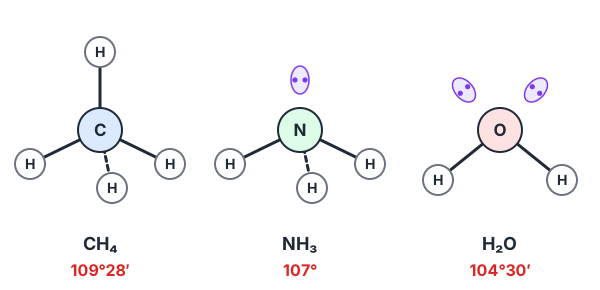
sp — linear, 180° (BeCl₂, CO₂, C₂H₂); sp² — trigonal planar, 120° (BF₃, C₂H₄); sp³ — tetrahedral, 109.5° (CH₄)
NH₃ (107°) and H₂O (104.5°) are also sp³-hybridised, but lone pairs repel the bonding pairs and close the angle: ammonia is trigonal pyramidal and water is bent. Whether a molecule is polar depends on both the polarity of its bonds and its shape. Polar substances dissolve well in polar solvents (water), non-polar ones in non-polar solvents.
Worked example
The bonds in CO₂ are polar, yet the molecule is non-polar. Why?
- The O=C=O molecule is linear (sp, 180°).
- The two bond dipoles are equal and point in opposite directions, so they cancel.
- Result: a non-polar molecule. H₂O is bent, so its dipoles do not cancel and the molecule is polar.
Check yourself
- Which substance has ionic bonding: HCl, KCl, Cl₂, CCl₄?
- How many σ- and π-bonds are in C₂H₂?
- Which substance has a giant covalent lattice: solid CO₂, SiO₂, NaCl, I₂?
- How many bonds in NH₄⁺ form by the dative mechanism?
- Why does HF boil at a higher temperature than HCl?
- What is the shape of a BF₃ molecule?
- Which bond is the most polar: H–F, H–Cl, H–Br, H–I?
- What is the hybridisation of carbon in methane?
Common mistakes
- Calling any bond between non-metals ionic: HCl is polar covalent.
- Thinking a molecule with polar bonds must be polar: CO₂ and CH₄ are non-polar.
- Confusing a hydrogen bond with the covalent O–H bond inside a molecule.
- Writing that the dative bond in NH₄⁺ differs from the others.
- Thinking a double bond is two σ-bonds: it is a σ-bond plus a π-bond.
Score: 0 / 8 correct (0 attempted)