ChemistryChemistry · 21 / 37
Basics of organic chemistry and isomerism
School curriculum· 30 min· 21 questions
Learn first: Types of chemical bonding
Organic chemistry is the chemistry of carbon compounds (apart from the carbon oxides, carbonic acid and its salts, carbides and cyanides). There are tens of millions of organic substances — several times more than inorganic ones — yet they all obey a few general rules: carbon is tetravalent, atoms in a molecule are joined in a definite order, and a substance’s properties depend not only on its composition but also on its structure. Organic substances are the basis of living things (proteins, fats, carbohydrates, nucleic acids) and also of fuels, medicines, plastics and fibres. This topic is the "grammar" of all later organic classes: isomerism, naming, hybridisation and finding formulae are learnt here.
§1. Composition and features of organic compounds
The main elements are C, H, O and N, sometimes S, P and halogens. Carbon is special because its atoms bond strongly to one another, forming long straight, branched and ring-shaped chains — hence the enormous variety of organic compounds.
Detecting carbon and hydrogen:
Heat the substance with CuO: the CO₂ released turns limewater milky (C present), and water vapour turns white anhydrous CuSO₄ blue (H present)
General features of organic compounds: mostly covalent bonds and molecular lattices, so low melting and boiling points; they burn, and on heating decompose and char; their reactions are slower than inorganic ionic reactions and often need a catalyst; several products often form.
A little history: organic substances were once thought to form only in living organisms through a "vital force". In 1828 F. Wöhler made urea (carbamide) from an inorganic substance (ammonium cyanate), disproving this idea; later ethanoic acid, fats and sugar-like substances were synthesised too. Today most organic substances are made in laboratories and factories.
§2. Butlerov’s theory of chemical structure, and isomerism
The main points of A. M. Butlerov’s theory (1861):
- Atoms in a molecule are joined in a definite sequence according to their valency; carbon is always tetravalent.
- A substance’s properties depend not only on its composition but also on its chemical structure.
- Atoms and groups of atoms in a molecule influence one another.
- The structure can be deduced from the properties, and vice versa.
Isomerism is the existence of substances with the same composition (molecular formula) but different structures and properties:
- Structural isomerism: chain (butane and methylpropane), position of a functional group or double bond (but-1-ene and but-2-ene), functional-group isomerism (C₂H₆O: ethanol and methoxymethane).
- Stereoisomerism: geometric (cis–trans, about a double bond) and optical (when there is an asymmetric carbon atom with four different groups).
Homologues differ in composition by one or more CH₂ groups and are similar in structure and properties: methane, ethane, propane; they share one general formula.
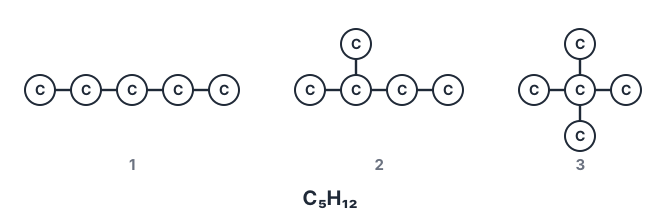
Worked example
How many structural isomers does C₅H₁₂ have?
- Pentane — a straight chain.
- 2-methylbutane — one branch.
- 2,2-dimethylpropane — two branches on one carbon. Answer: 3.
§3. Hybridisation, bonds and types of carbon atom
sp³ — 109.5°, tetrahedral (alkanes); sp² — 120°, planar (alkenes, benzene, the carbonyl group); sp — 180°, linear (alkynes)
In a σ-bond the orbitals overlap along the axis joining the nuclei — a strong bond; in a π-bond they overlap sideways — a weaker bond, so the π-bond is usually the one that breaks in reactions. A single bond is σ, a double bond σ + π and a triple bond σ + 2π. As bond order rises, the carbon–carbon bond shortens: 0.154 nm (single), 0.134 nm (double), 0.120 nm (triple).
Carbon atoms are primary (bonded to one other C), secondary (two), tertiary (three) or quaternary (four).
Worked example
Classify the carbon atoms in 2-methylbutane CH₃–CH(CH₃)–CH₂–CH₃.
- Primary: C1, C4 and the methyl branch — 3.
- Secondary: C3 (CH₂) — 1.
- Tertiary: C2 (CH) — 1; no quaternary carbon.
§4. Functional groups and naming
A functional group is a group of atoms that determines a compound’s class and main chemical properties.
–OH (alcohol, phenol), –CHO (aldehyde), >C=O (ketone), –COOH (carboxylic acid), –COO– (ester), –NH₂ (amine), –NO₂ (nitro compound)
By carbon skeleton, organic compounds are acyclic (open chain: alkanes, alkenes), carbocyclic (rings of carbon only: cyclohexane, benzene) or heterocyclic (rings containing other atoms — N, O, S: pyridine). Within each class, compounds with the same functional group form a homologous series.
IUPAC naming: 1) choose the longest chain containing the functional group or multiple bond; 2) number it from the end nearer the functional group (or multiple bond); 3) list substituents alphabetically with their positions; 4) finish with the parent chain and class ending (-ane, -ene, -yne, -ol, -al, -one, -oic acid). Example: 3-methylpentan-2-ol.
§5. Types of organic reaction
By outcome, organic reactions are substitution (halogenation of alkanes, nitration of benzene), addition (hydrogenation and bromination of alkenes), elimination (dehydration of alcohols), isomerisation, addition and condensation polymerisation, oxidation and reduction. By how the bond breaks: homolytic fission leaves one electron on each atom and gives radicals (chlorination of alkanes in light); heterolytic fission gives the electron pair to one atom and produces ions (addition of HBr to alkenes). In ionic reactions the attacking species is an electrophile (electron-seeking, H⁺, Br⁺) or a nucleophile (with a lone pair, OH⁻, NH₃).
§6. Finding formulae
For CₓHᵧOz: x : y : z = n(C) : n(H) : n(O); n(C) = n(CO₂), n(H) = 2n(H₂O), oxygen by mass difference
Molar mass from relative density: M = 2·D(H₂) = 29·D(air)
Worked example
A hydrocarbon contains 85.7 % carbon by mass, and its density relative to hydrogen is 21. Find its formula.
- M = 2·21 = 42 g/mol.
- m(C) = 0.857·42 = 36 → 3 C atoms; m(H) = 42 − 36 = 6 → 6 H atoms.
- C₃H₆ — propene or cyclopropane.
Worked example
Burning 4.6 g of an organic compound gave 8.8 g of CO₂ and 5.4 g of water; its vapour density relative to hydrogen is 23. Find its formula.
- m(C) = 8.8·12/44 = 2.4 g; m(H) = 5.4·2/18 = 0.6 g; m(O) = 4.6 − 2.4 − 0.6 = 1.6 g.
- n(C) : n(H) : n(O) = 0.2 : 0.6 : 0.1 = 2 : 6 : 1 → C₂H₆O (M = 46).
- M = 2·23 = 46 — it matches: ethanol or methoxymethane.
Check yourself
- Which pair are isomers: a) ethanol and methoxymethane; b) ethane and ethene?
- What is the hybridisation of carbon in CH₂=CH₂?
- How many isomers does C₄H₁₀ have?
- Burning 0.1 mol of a hydrocarbon gave 8.96 L of CO₂ (STP) and 9 g of water. What is its formula?
- How can nitrogen be detected in an organic compound?
- Which compound is a functional-group isomer of propanal?
- What is the relationship between methane and ethane?
- By what mechanism does chlorination of alkanes in light occur?
Common mistakes
- Counting the same chain drawn differently as a new isomer.
- Adding σ-bonds when counting π-bonds.
- Numbering from the end farther from the functional group.
- Confusing homologues with isomers: homologues differ by CH₂, isomers have the same composition.
- Assuming a compound contains only C and H without checking for oxygen in a combustion problem.
Score: 0 / 8 correct (0 attempted)