MathematicsMathematics · 25 / 54
Linear functions and their graphs
School curriculum· 25 min· 1 questions
Learn first: Functions, domain and range
The linear function is the simplest function and one of the most used: uniform motion, paying by a tariff and the equation of a tangent line are all written as y = kx + b. Exams often ask about the meaning of the coefficients, the line through two points, and the conditions for parallel and perpendicular lines.
§1. Definition and meaning of the coefficients
y = kx + b — linear function; its graph is a straight line, D = ℝ
- `k` is the slope. It shows how much y changes when x increases by one: k = Δy/Δx. Geometrically k = tg α, where α is the angle between the line and the positive direction of the Ox axis.
- `b` is the initial value. At x = 0 we have y = b, so the graph crosses the Oy axis at (0; b).
Special cases:
- b = 0: y = kx — direct proportionality, the line passes through the origin.
- k = 0: y = b — a horizontal line parallel to Ox.
- A vertical line x = a is not a function (one x corresponds to infinitely many y).
For example, for y = −x + 4 we have tg α = −1, so α = 135°.
§2. Monotonicity and axis intercepts
- k > 0 — the function is increasing (the line rises from left to right), α is acute.
- k < 0 — decreasing, α is obtuse.
Intercepts:
With Oy: (0; b); with Ox: y = 0 → (−b/k; 0)
Two points are enough to draw the graph, and these two are the most convenient.
The line and the axes form a right triangle with legs |b| and |b/k|:
S = b²/(2|k|)
Worked example
Find the area of the triangle that the line y = 2x − 6 forms with the coordinate axes.
- With Oy: x = 0 → y = −6, point (0; −6).
- With Ox: 2x − 6 = 0 → x = 3, point (3; 0).
- Legs 3 and 6: S = 3·6/2 = 9.
§3. The line through two points
Given points (x₁; y₁) and (x₂; y₂), first find the slope:
k = (y₂ − y₁)/(x₂ − x₁)
Then substitute one of the points into y = kx + b to find b. General formula:
(y − y₁)/(y₂ − y₁) = (x − x₁)/(x₂ − x₁) or y − y₁ = k(x − x₁)
To check whether a point lies on the line, substitute its coordinates: if the equality holds, it does.
Worked example
Write the equation of the line through (1; 3) and (3; 7). Does (5; 11) lie on it?
- k = (7 − 3)/(3 − 1) = 2.
- 3 = 2·1 + b → b = 1. Equation: y = 2x + 1.
- x = 5: y = 11 — yes, it lies on the line.
§4. Relative position of two lines
Let y = k₁x + b₁ and y = k₂x + b₂ be given.
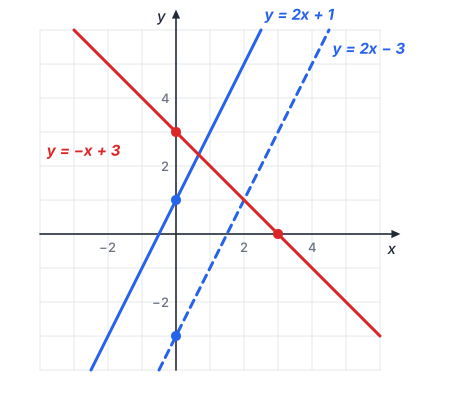
Parallel: k₁ = k₂, b₁ ≠ b₂; coincident: k₁ = k₂, b₁ = b₂
Intersecting: k₁ ≠ k₂; perpendicular: k₁·k₂ = −1
Why is the product −1? Rotating by 90° turns the direction vector (1; k) into (−k; 1), whose slope is 1/(−k) = −1/k.
The intersection point is found by equating the right-hand sides: k₁x + b₁ = k₂x + b₂.
Worked example
Find the line through (2; 1) perpendicular to y = 2x + 5, and the point where it meets y = 2x + 5.
- k = −1/2.
- 1 = −1/2·2 + b → b = 2. Equation: y = −x/2 + 2.
- 2x + 5 = −x/2 + 2 → 5x/2 = −3 → x = −6/5, y = 2·(−6/5) + 5 = 13/5.
- Intersection point (−1.2; 2.6).
§5. Parameters and linear models
- y = (m − 3)x + 2 is decreasing when m − 3 < 0 → m < 3.
- On a closed interval a linear function attains its largest and smallest values at the endpoints: on [−1; 4], y = 2x − 1 has min = −3, max = 7.
- Applied model: a taxi charges 5000 sum to start and 2000 sum per km → y = 2000x + 5000; 12 km cost 29000 sum.
§6. Intersecting lines and simultaneous equations
A common point of the graphs of two linear functions is a pair (x; y) that satisfies both equations at once. So finding the point of intersection is the same as solving a system of two linear equations in two unknowns.
y = k₁x + b₁ and y = k₂x + b₂ intersect ⇔ k₁ ≠ k₂; the x-coordinate of the intersection is x = (b₂ − b₁)/(k₁ − k₂)
There are three possible cases, and they match the relative positions from §4 exactly:
- k₁ ≠ k₂ — the lines meet at one point; the system has a unique solution.
- k₁ = k₂, b₁ ≠ b₂ — the lines are parallel; the system has no solutions.
- k₁ = k₂, b₁ = b₂ — the lines coincide; the system has infinitely many solutions.
The graphical method quickly shows how many solutions there are, but the exact values come from algebra (equating or substitution). Once you have found the point, substitute it into both equations: any slip shows up at once.
The intersection point is often part of a geometry problem: two lines and a coordinate axis form a triangle whose vertices are the intersection points.
Worked example
Find the area of the triangle bounded by the lines y = 2x − 1, y = −x + 5 and the y-axis.
- Intersection: 2x − 1 = −x + 5 → 3x = 6 → x = 2, y = 2·2 − 1 = 3; the point is (2; 3).
- Check: −2 + 5 = 3 — correct.
- Intersections with Oy: (0; −1) and (0; 5); the base on Oy is 5 − (−1) = 6.
- The height is the distance from the intersection point to Oy, i.e. |x| = 2.
- S = 6·2/2 = 6.
Check yourself
- Find k and b for the line 3y − 6x = 9.
- What angle does y = −x + 4 make with the Ox axis?
- Find the line through (−1; 2) and (3; −6).
- Find the line through (1; 5) parallel to y = 3x − 1.
- Find the area of the triangle formed by y = −2x + 4 and the axes.
- For which a are y = (a + 1)x + 3 and y = 2x − 1 perpendicular?
- Find the point of intersection of y = 3x + 2 and y = x − 4.
- The line y = kx + 3 passes through (2; 7). Find k.
Common mistakes
- Computing the slope upside down: (x₂ − x₁)/(y₂ − y₁).
- Remembering perpendicularity as k₁ = −k₂ (correct: k₁·k₂ = −1).
- Writing the Ox intercept as (b; 0) — it is (−b/k; 0).
- Reading off coefficients before rewriting the equation as y = kx + b (in 3y − 6x = 9 the slope is not 6).
- Forgetting b₁ ≠ b₂ for parallel lines: coincident lines are not called parallel.
- Computing y from only one equation after finding the intersection and never checking it in the other.
Score: 0 / 8 correct (0 attempted)