MathematicsMathematics · 26 / 54
Quadratic functions and the parabola
School curriculum· 35 min· 1 questions
Learn first: Quadratic equations and Vieta's formulas, Functions, domain and range
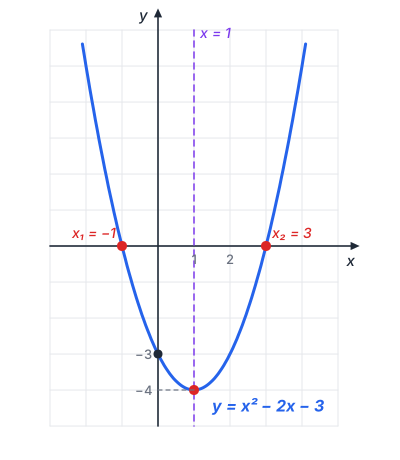
The graph of a quadratic function is a parabola. It is the main tool for solving quadratic inequalities, finding largest and smallest values and handling applied optimisation problems. Being able to find the vertex, the direction of the branches and the axis intercepts quickly saves a lot of exam time.
§1. Definition and the role of the coefficients
y = ax² + bx + c, a ≠ 0; D(y) = ℝ, the graph is a parabola
Each coefficient tells us something about the graph:
- `a` — direction and width. a > 0 — branches point up, a < 0 — down. The larger |a|, the "narrower" the parabola.
- `c` — the `Oy` intercept: at x = 0 we get y = c, point (0; c).
- `b` — position of the vertex. If a and b have the same sign, the vertex is left of Oy (x₀ < 0); if opposite signs — to the right; if b = 0, the vertex is on Oy.
The simplest parabola y = x² has its vertex at (0; 0) and is symmetric about Oy.
§2. The vertex and completing the square
Completing the square gives:
ax² + bx + c = a(x − x₀)² + y₀, where x₀ = −b/(2a), y₀ = f(x₀) = −D/(4a)
So every parabola is y = ax² shifted by x₀ horizontally and y₀ vertically. Consequently:
- Axis of symmetry: x = x₀.
- For a > 0: decreasing on (−∞; x₀], increasing on [x₀; +∞), minimum value y₀, E = [y₀; +∞).
- For a < 0: the reverse, maximum value y₀, E = (−∞; y₀].
Symmetry is handy: if f(1) = f(5), the axis is x = 3 — the vertex lies halfway between the points.
Worked example
Analyse y = 2x² − 8x + 5.
- x₀ = 8/4 = 2, y₀ = 2·4 − 16 + 5 = −3. Vertex (2; −3).
- Vertex form: y = 2(x − 2)² − 3.
- a = 2 > 0 → branches up, E = [−3; +∞).
- Decreasing on (−∞; 2], increasing on [2; +∞); crosses Oy at (0; 5).
§3. Zeros and sign: quadratic inequalities
The Ox intercepts are the roots of ax² + bx + c = 0. The discriminant decides the picture:
- D > 0 — the parabola crosses Ox at two points;
- D = 0 — it touches Ox at its vertex;
- D < 0 — no common points with Ox.
Algorithm for a quadratic inequality:
- Find the roots.
- Determine the direction of the branches (sign of a).
- For a > 0 the function is negative between the roots and positive outside them.
a > 0, D < 0 → ax² + bx + c > 0 for all x; a < 0, D < 0 → always negative
Worked example
For which m does x² + 2x + m > 0 hold for all x?
- a = 1 > 0, so the whole parabola must lie above Ox: D < 0.
- D = 4 − 4m < 0 → m > 1.
- Answer: m ∈ (1; +∞).
§4. Largest and smallest values on an interval
On a closed interval a quadratic function attains its extreme values either at the vertex or at the endpoints. So:
- Check whether x₀ belongs to the interval.
- Compute f(x₀) (if it does) and the values at the endpoints.
- Pick the largest and the smallest.
Worked example
Find the largest and smallest values of y = x² − 4x + 1 on [0; 3].
- x₀ = 2 ∈ [0; 3], f(2) = 4 − 8 + 1 = −3.
- f(0) = 1, f(3) = 9 − 12 + 1 = −2.
- min = −3, max = 1.
Worked example (applied)
What is the largest area of a rectangle with perimeter 20 m?
- Sides x and 10 − x: S(x) = x(10 − x) = −x² + 10x.
- a < 0, vertex x₀ = 5: S(5) = 25.
- Answer: a square, 25 m².
§5. Recovering a parabola from conditions
When a vertex, roots or points are given, the coefficients come from equations.
Worked example
The vertex of f(x) = ax² + bx + 6 is B(1/2; 25/4). Find the ratio of the roots x₂/x₁ (x₁ < x₂).
- −b/(2a) = 1/2 → b = −a.
- f(1/2) = a/4 − a/2 + 6 = 6 − a/4 = 25/4 → a = −1, b = 1.
- −x² + x + 6 = 0 → x₁ = −2, x₂ = 3.
- x₂/x₁ = −1.5.
§6. Vieta’s theorem and the zeros of a parabola
If the parabola y = ax² + bx + c crosses Ox at x₁ and x₂ (D ≥ 0), these numbers are the roots of ax² + bx + c = 0, and they are linked to the coefficients in a simple way:
x₁ + x₂ = −b/a, x₁·x₂ = c/a (Vieta’s theorem)
These formulas tell us a lot about the roots without finding them:
- The axis of symmetry passes midway between the roots: x₀ = (x₁ + x₂)/2 = −b/(2a) — another justification of the vertex formula from §2.
- If x₁·x₂ < 0 (that is, c/a < 0), the roots have opposite signs; in this case D > 0 holds automatically.
- For both roots to be positive: D ≥ 0, x₁ + x₂ > 0, x₁·x₂ > 0.
- Symmetric expressions in the roots can be written through the sum and product: x₁² + x₂² = (x₁ + x₂)² − 2x₁x₂, 1/x₁ + 1/x₂ = (x₁ + x₂)/(x₁x₂).
When using Vieta’s theorem, always check D ≥ 0 first: otherwise there are no real roots and conclusions about their sum and product are meaningless. For a monic equation (a = 1) the formulas are even simpler: x₁ + x₂ = −b, x₁x₂ = c.
Worked example
The parabola y = x² − 6x + c crosses Ox at x₁ and x₂, and x₁² + x₂² = 20. Find c and the points of intersection.
- Vieta: x₁ + x₂ = 6, x₁x₂ = c.
- x₁² + x₂² = (x₁ + x₂)² − 2x₁x₂ = 36 − 2c = 20 → c = 8.
- Check: D = 36 − 32 = 4 > 0 — two points exist.
- x² − 6x + 8 = 0 → x₁ = 2, x₂ = 4; 2² + 4² = 20 — correct.
- Answer: c = 8, the points are (2; 0) and (4; 0).
Check yourself
- Find the vertex of y = −x² + 6x − 5.
- Find the range of y = x² + 4x + 7.
- Where does y = x² − 2x − 8 cross Ox?
- Solve x² − 5x + 4 ≤ 0.
- Find the largest value of y = −2x² + 8x − 3.
- For which k does the graph of y = x² + kx + 4 touch Ox?
- Find the sum and the product of the roots of x² + 5x − 6 = 0.
- One root of x² − 4x + c = 0 is 1. Find the other root and c.
Common mistakes
- Dropping the sign in the vertex formula: x₀ = −b/(2a), not b/(2a).
- Judging the direction of the branches by b or c (only a decides).
- Looking for the maximum on an interval only at the vertex — the endpoints must be checked too.
- Using f(x₀) as the answer even when the vertex is outside the interval.
- For a > 0, taking the solution of < 0 outside the roots (it is between them).
- Applying Vieta’s theorem to an equation with D < 0, or losing the sign: x₁ + x₂ = b.
Score: 0 / 8 correct (0 attempted)