Learn first: Congruence and similarity of triangles
Pythagoras’ theorem is the most widely used result in geometry. It links all three sides of a right-angled triangle with one simple equation. Whenever you look for a distance, a diagonal or a height, in coordinate or solid geometry problems, a right-angled triangle is almost always "hidden" — learning to spot it is the key skill. This lesson covers the theorem itself, its proof, the converse, Pythagorean triples, the metric relations in a right-angled triangle and practical applications.
§1. Basic terms and the theorem
A right-angled triangle has one angle equal to 90°. The side opposite the right angle is the hypotenuse — it is always the longest side. The two sides that form the right angle are the legs (or catheti).
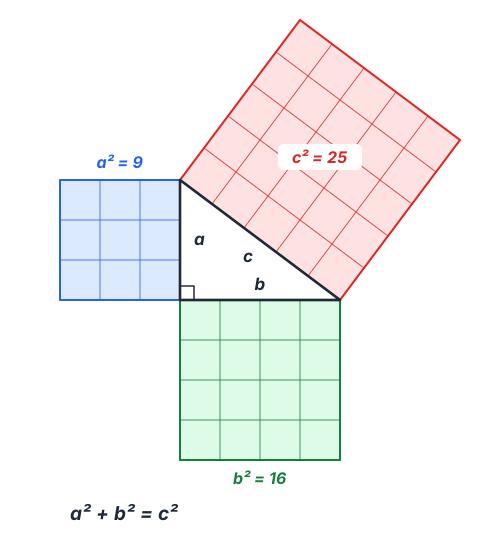
In a right-angled triangle c² = a² + b² (c — hypotenuse, a, b — legs)
In words: the square on the hypotenuse equals the sum of the squares on the legs. Two working formulas follow:
c = √(a² + b²), a = √(c² − b²)
To find the hypotenuse the squares are added; to find a leg they are subtracted. A leg is never longer than the hypotenuse — a handy check on your answer.
Why is it true? A square of side a + b can be filled with four identical right-angled triangles and a square of side c. Equating areas: (a + b)² = 4 · ab/2 + c². Expanding the left side: a² + 2ab + b² = 2ab + c², hence a² + b² = c². The proof shows the theorem is really a statement about areas: the squares built on the legs together have the same area as the square built on the hypotenuse.
Worked example
The legs are 5 and 12. Find the hypotenuse and the perimeter.
- c² = 5² + 12² = 25 + 144 = 169.
- c = √169 = 13.
- Perimeter: 5 + 12 + 13 = 30.
§2. The converse and classifying triangles
Converse: if the sides of a triangle satisfy c² = a² + b², the triangle is right-angled and the right angle lies opposite side c. This lets you determine an angle from the sides alone.
Extension (here c is the longest side):
c² = a² + b² — right-angled; c² > a² + b² — obtuse; c² < a² + b² — acute
Why? Recall the cosine rule c² = a² + b² − 2ab·cos C: if cos C < 0 (obtuse angle) then c² grows, if cos C > 0 it shrinks. Pythagoras’ theorem is the special case of the cosine rule with C = 90°.
Important: always test the longest side, because the largest angle lies opposite the longest side.
Worked example
What kind of triangle has sides 5, 6, 8?
- Longest side 8: 8² = 64.
- The others: 5² + 6² = 25 + 36 = 61.
- 64 > 61, so the triangle is obtuse.
§3. Pythagorean triples and special triangles
Whole numbers satisfying a² + b² = c² are called Pythagorean triples. The most common: 3, 4, 5; 5, 12, 13; 8, 15, 17; 7, 24, 25; 20, 21, 29; 9, 40, 41. Multiples of a triple are triples too: 6, 8, 10; 9, 12, 15; 15, 20, 25; 10, 24, 26. Recognising them saves a lot of work: seeing 15 and 20, divide by 5, recognise 3, 4 and the hypotenuse is immediately 25.
Learn two special triangles by heart:
30°–60°–90°: legs a and a√3, hypotenuse 2a (the leg opposite 30° is half the hypotenuse)
45°–45°–90°: legs a, hypotenuse a√2
The first comes from cutting an equilateral triangle along its height: side 2a, half the base a, height √(4a² − a²) = a√3. The second is half of a square cut along its diagonal.
Worked example
The hypotenuse is 10 and one angle is 30°. Find the legs.
- The leg opposite 30° is half the hypotenuse: 10 : 2 = 5.
- The other leg: √(100 − 25) = √75 = 5√3.
- Answer: 5 and 5√3.
§4. Metric relations in a right-angled triangle
Drop the height h from the right-angle vertex to the hypotenuse. It splits the hypotenuse into segments a_c and b_c (the projections of the legs). The two small triangles are similar to the original one, so:
Height to the hypotenuse: h = ab/c, h² = a_c · b_c
Each leg is the geometric mean of the hypotenuse and its projection: a² = c · a_c, b² = c · b_c
Median to the hypotenuse = c/2; circumradius R = c/2
Inradius r = (a + b − c)/2; area S = ab/2
The formula h = ab/c comes from writing the area in two ways: S = ab/2 = c·h/2. The circumcentre is the midpoint of the hypotenuse, because the right angle is an inscribed angle standing on a diameter.
Worked example
The legs are 6 and 8. Find the hypotenuse, the height and the radii.
- c = √(36 + 64) = 10.
- h = 6 · 8/10 = 4.8.
- R = 10/2 = 5, r = (6 + 8 − 10)/2 = 2.
Worked example
The height divides the hypotenuse into segments 3.6 and 6.4. Find the height and the legs.
- h² = 3.6 · 6.4 = 23.04 → h = 4.8.
- Hypotenuse c = 3.6 + 6.4 = 10.
- a² = 10 · 3.6 = 36 → a = 6; b² = 10 · 6.4 = 64 → b = 8.
§5. Practical applications
In many problems you must "draw in" the right-angled triangle yourself:
- Ladder: a 13 m ladder stands 5 m from a wall — it touches the wall at a height of √(169 − 25) = 12 m.
- Rhombus: diagonals 10 and 24 → side √(5² + 12²) = 13 (the diagonals are perpendicular and bisect each other).
- Isosceles triangle: 10, 10, 12 → height √(100 − 36) = 8, area ½ · 12 · 8 = 48.
- Rectangle: sides 9 and 40 → diagonal √(81 + 1600) = 41.
- Chord of a circle: radius 13, chord at distance 5 from the centre → half-chord 12, chord 24.
Worked example
An isosceles trapezium has bases 4 and 16 and legs 10. Find its height.
- Drop heights from the ends of the upper base: segments of (16 − 4)/2 = 6 remain at each end of the lower base.
- A leg, the height and the segment 6 form a right-angled triangle.
- h = √(10² − 6²) = √64 = 8.
§6. Pythagoras in coordinates and in space
The distance formula between two points is Pythagoras’ theorem itself: the horizontal and vertical differences are the legs and the distance is the hypotenuse.
AB = √((x₂ − x₁)² + (y₂ − y₁)²)
In space: AB = √((x₂ − x₁)² + (y₂ − y₁)² + (z₂ − z₁)²)
Diagonal of a cube a√3, diagonal of a cuboid √(a² + b² + c²)
The cuboid formula comes from applying the theorem twice: first the base diagonal √(a² + b²), then the space diagonal from it and the height c.
Worked example
Find the distance between A(1; 2) and B(4; 6).
- Differences: 4 − 1 = 3, 6 − 2 = 4.
- AB = √(3² + 4²) = √25.
- AB = 5.
Check yourself
- The hypotenuse is 17 and one leg is 8. Find the other leg.
- Is the triangle 7, 24, 25 right-angled?
- Find the diagonal of a square of side 4.
- The legs are 9 and 12. Find the inradius.
- The legs are 9 and 12. Find the height to the hypotenuse.
- Find the diagonal of a cuboid measuring 3, 4, 12.
- What kind of triangle has sides 6, 7, 9?
- In a circle of radius 26, find the length of a chord at distance 10 from the centre.
Common mistakes
- Setting a leg, rather than the hypotenuse, equal to the sum of squares.
- Applying the theorem without checking that the triangle is right-angled.
- When classifying a triangle, testing an arbitrary side instead of the longest one.
- Taking the leg opposite 30° as half the other leg instead of half the hypotenuse.
- Using whole diagonals of a rhombus instead of half-diagonals.
- "Simplifying" √(a² + b²) to a + b.
Score: 0 / 8 correct (0 attempted)