MathematicsMathematics · 37 / 54
The laws of sines and cosines
School curriculum· 30 min· 20 questions
Learn first: Angle measures and trigonometric ratios, The Pythagorean theorem
Pythagoras’ theorem works only in a right-angled triangle. To "solve" an arbitrary triangle — that is, to find the remaining sides and angles from the known ones — you need the sine rule and the cosine rule. They also give several ways of finding the area, and formulas for medians and diagonals. These rules are widely used in surveying, navigation and physics (adding forces).
§1. Notation and the main idea
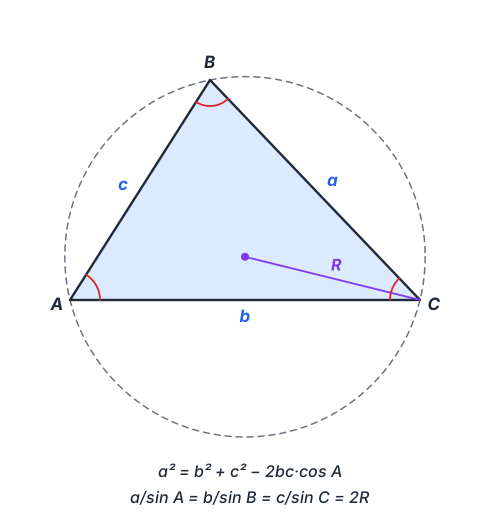
In triangle ABC the sides are labelled with small letters after the opposite vertices: a = BC (opposite angle A), b = AC, c = AB. This convention matters for writing the rules correctly: a always lies opposite angle A.
A triangle is fixed by three elements (at least one of which is a side). This gives four cases:
- three sides (SSS) — find the angles with the cosine rule;
- two sides and the included angle (SAS) — find the third side with the cosine rule;
- one side and two angles (ASA, AAS) — first the third angle from 180°, then the sine rule;
- two sides and an angle opposite one of them (SSA) — the sine rule, but there may be two, one or no solutions.
Angle sum of a triangle A + B + C = 180°; the larger side lies opposite the larger angle
§2. The cosine rule
a² = b² + c² − 2bc cos A
Similarly: b² = a² + c² − 2ac cos B, c² = a² + b² − 2ab cos C.
Why is it true? Put A at the origin and AB along the x-axis: B(c; 0), C(b cos A; b sin A). By the distance formula a² = (b cos A − c)² + b² sin² A = b²(cos² A + sin² A) − 2bc cos A + c² = b² + c² − 2bc cos A.
If A = 90°, then cos A = 0 and we get Pythagoras’ theorem — the cosine rule generalises it.
When to use it: two sides and the angle between them are given (find the third side), or three sides are given (find an angle).
cos A = (b² + c² − a²)/(2bc)
Type of angle: cos A < 0 (i.e. a² > b² + c²) — A is obtuse; cos A > 0 — acute. For an obtuse angle cos is negative, so −2bc cos A is positive and the side becomes longer.
Remember: cos 60° = ½, cos 120° = −½, cos 45° = √2/2, cos 135° = −√2/2, cos 150° = −√3/2.
Worked example
b = 5, c = 8, A = 60°. Find a.
- a² = 25 + 64 − 2 · 5 · 8 · ½.
- a² = 89 − 40 = 49.
- a = 7.
Worked example
In a triangle with sides 5, 7, 8, find the angle opposite the side 7.
- cos B = (5² + 8² − 7²)/(2 · 5 · 8).
- = (25 + 64 − 49)/80 = 40/80 = ½.
- B = 60°.
§3. The sine rule
a/sin A = b/sin B = c/sin C = 2R (R — circumradius)
Why is it true? Write the area in two ways: S = ½ bc sin A = ½ ac sin B. Hence b sin A = a sin B, i.e. a/sin A = b/sin B. To see 2R, draw the diameter BD from vertex B: triangle BCD is right-angled (the angle stands on a diameter) and ∠D = ∠A (they stand on the same arc), so a = BD · sin D = 2R sin A.
When to use it: two angles and a side are given; or R is needed from a side and its opposite angle.
The ambiguous case (`SSA`). If sin B is known, there may be two angles: B and 180° − B, since their sines are equal. If the second value still satisfies A + B < 180°, there are two different triangles. If you get sin B > 1, no triangle exists.
Worked example
A = 45°, B = 60°, a = 2√2. Find b.
- b = a · sin B / sin A.
- b = 2√2 · (√3/2) : (√2/2).
- b = 2√3.
Worked example
a = 5, b = 8, A = 30°. Find angle B.
- sin B = b · sin A / a = 8 · ½ / 5 = 0.8.
- B ≈ 53.13° or B ≈ 180° − 53.13° = 126.87°.
- In both cases A + B < 180°, so two triangles satisfy the data.
§4. Area formulas
S = ½ a·hₐ = ½ ab sin C = abc/(4R) = p·r
Heron’s formula: S = √(p(p − a)(p − b)(p − c)), p = (a + b + c)/2 — semi-perimeter
S = ½ ab sin C follows from the height: the height to side b is h = a sin C. And S = abc/(4R) comes from substituting sin C = c/(2R) into it. Choose the formula by what is given: three sides — Heron; two sides and an angle — the sine formula.
Worked example
Find the area, R and r of the triangle with sides 13, 14, 15.
- p = (13 + 14 + 15)/2 = 21.
- S = √(21 · 8 · 7 · 6) = √7056 = 84.
- R = abc/(4S) = 2730/336 = 8.125; r = S/p = 84/21 = 4.
§5. Median, parallelogram and other results
- Diagonals of a parallelogram: d₁² + d₂² = 2(a² + b²) — the cosines of adjacent angles have opposite signs, so apply the cosine rule twice and add.
- Median: mₐ² = (2b² + 2c² − a²)/4 — if the triangle is completed to a parallelogram, the median is half of its diagonal.
- The angle bisector divides the opposite side in the ratio of the adjacent sides.
Median formula: mₐ = ½ √(2b² + 2c² − a²)
Worked example
In the triangle with sides 13, 14, 15, find the median to the side 14.
- m² = (2 · 13² + 2 · 15² − 14²)/4.
- = (338 + 450 − 196)/4 = 592/4 = 148.
- m = √148 = 2√37.
§6. Practical problems
The cosine rule is used when the distance between two objects cannot be measured directly. For instance, if two ships leave port at an angle of 60° and travel 30 km and 40 km, the distance between them is √(900 + 1600 − 2 · 30 · 40 · ½) = √1300 = 10√13 ≈ 36.06 km.
The sine rule helps to find the distance to a point on the far bank of a river: measure a baseline on one bank and the angles at which the point is seen from its ends, then solve the triangle as an ASA case.
Check yourself
- b = 3, c = 5, A = 120°. Find a.
- What kind of triangle has sides 4, 5, 7?
- a = 6, A = 30°. Find R.
- Find the area of the triangle with sides 5, 5, 6.
- a = 4, b = 10, C = 150°. Find the area.
- A parallelogram has sides 3 and 5 and one diagonal 6. Find the other diagonal.
- A = 30°, B = 45°, a = 4. Find b.
- Find the inradius of the triangle 13, 14, 15.
Common mistakes
- Forgetting the sign of −2bc cos A in the cosine rule, or taking the cosine of an obtuse angle as positive.
- Writing R instead of 2R in the sine rule.
- Pairing a side with an angle that is not opposite it.
- Using the full perimeter instead of the semi-perimeter in Heron’s formula.
- Ignoring the second solution 180° − B in the SSA case.
- Classifying a triangle from its three sides by testing an angle other than the largest one.
Score: 0 / 8 correct (0 attempted)