Learn first: Triangles and their elements
The family of quadrilaterals is organised like a hierarchy: a square is both a rhombus and a rectangle, and they in turn are parallelograms. Every "lower" shape has all the properties of those above it and adds its own. Once you understand this structure you do not need to memorise the properties — you can rebuild them from where they come from. The trapezium is a separate branch: only one pair of its sides is parallel. This lesson covers the definition, properties and tests for each type, and the results linked with circles.
§1. A general quadrilateral
A quadrilateral is a polygon with four vertices and four sides. A convex quadrilateral has two diagonals, which meet inside it.
The interior angles of a convex quadrilateral add up to 360°
Why? One diagonal splits the quadrilateral into two triangles, each with an angle sum of 180°.
Varignon’s theorem: joining the midpoints of the sides of any quadrilateral in order gives a parallelogram; its sides are parallel to the diagonals and equal to half of them (by the midline property of a triangle).
Classification:
- Parallelogram — both pairs of opposite sides are parallel.
- Rectangle — a parallelogram whose angles are all right angles.
- Rhombus — a parallelogram whose sides are all equal.
- Square — both a rectangle and a rhombus.
- Trapezium — exactly one pair of sides is parallel.
§2. Parallelogram
A quadrilateral whose opposite sides are parallel in pairs.
Opposite sides and opposite angles are equal; adjacent angles add up to 180°; the diagonals bisect each other
These properties follow from the fact that a diagonal splits a parallelogram into two congruent triangles (alternate angles between parallel lines are equal). Adjacent angles are co-interior angles between parallel lines and a transversal.
Tests: a quadrilateral is a parallelogram if:
- one pair of opposite sides is equal and parallel;
- both pairs of opposite sides are equal;
- the diagonals bisect each other.
An angle bisector cuts an isosceles triangle off a parallelogram. For the diagonals: d₁² + d₂² = 2(a² + b²).
Worked example
In parallelogram ABCD, AB = 6 and BC = 10. The bisector of angle A meets BC at K. Find KC.
- ∠BAK = ∠KAD (bisector) and ∠KAD = ∠BKA (alternate angles, AD ∥ BC).
- So ∠BAK = ∠BKA and △ABK is isosceles: BK = AB = 6.
- KC = 10 − 6 = 4.
§3. Rectangle, rhombus, square
- Rectangle: all angles 90°; the diagonals are equal: d = √(a² + b²). Test: a parallelogram with equal diagonals is a rectangle.
- Rhombus: all sides equal; the diagonals are perpendicular and bisect the angles. The diagonals divide a rhombus into four congruent right-angled triangles: a² = (d₁/2)² + (d₂/2)². Test: a parallelogram with perpendicular diagonals, or with a diagonal that bisects an angle, is a rhombus.
- Square: all of the above; d = a√2, the diagonals are equal, perpendicular and make 45° with the sides.
Area of a rhombus S = d₁d₂/2; of a rectangle S = ab; of a square S = a² = d²/2
In a rectangle the intersection of the diagonals is the centre of the circumscribed circle; in a rhombus it is the centre of the inscribed circle.
Worked example
A rhombus has an angle of 60° and side 4. Find its diagonals.
- The shorter diagonal lies opposite the 60° angle and forms an equilateral triangle with two sides: d₁ = 4.
- Half the longer diagonal is the height of that triangle: 4 · √3/2 = 2√3.
- d₂ = 2 · 2√3 = 4√3.
§4. Trapezium
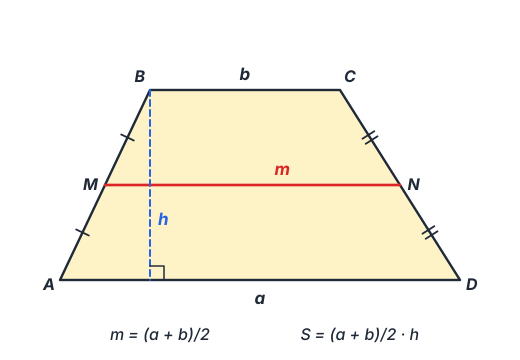
Exactly one pair of sides (the bases) is parallel; the other two are the legs.
Midline: m = (a + b)/2, parallel to the bases
Area: S = (a + b)/2 · h = m · h
- The angles along a leg add up to 180°.
- Isosceles trapezium: the base angles are equal and the diagonals are equal; a height dropped from an end of the shorter base cuts off a segment (a − b)/2 on the longer base.
- Right trapezium: one leg is perpendicular to the bases and equals the height.
- The triangles formed by the diagonals next to the bases are similar (k = a/b), so the diagonals divide each other in the ratio a : b.
Worked example
An isosceles trapezium has bases 4 and 10 and legs 5. Find its height.
- The projection of a leg onto the longer base: (10 − 4)/2 = 3.
- A leg, the height and the projection form a right-angled triangle.
- h = √(25 − 9) = 4.
Worked example
A trapezium has bases 6 and 4 and a diagonal of 15. Into what parts does the intersection point O of the diagonals divide this diagonal?
- The triangles at the bases are similar, k = 6 : 4 = 3 : 2.
- The diagonal is divided in the ratio 3 : 2: 15 : 5 = 3.
- The parts are 9 (on the side of the longer base) and 6.
§5. Cyclic and tangential quadrilaterals
Cyclic quadrilateral (vertices on a circle): opposite angles add up to 180°
Tangential quadrilateral (a circle touches all sides): sums of opposite sides are equal: AB + CD = BC + AD
The first property follows from the inscribed angle being half the arc: opposite angles together stand on the whole circle (360°), so their sum is 180°. The second follows from the equality of the two tangent segments drawn from one point.
Consequences: a cyclic parallelogram is a rectangle; a cyclic trapezium is isosceles. A circle can always be inscribed in a rhombus.
If a circle is inscribed in an isosceles trapezium, then a + b = 2c, so a leg equals the midline: c = m; moreover h² = ab and h = 2r.
Worked example
In a tangential quadrilateral ABCD, AB = 7, BC = 9 and CD = 8. Find AD and the perimeter.
- Condition for a tangential quadrilateral: AB + CD = BC + AD.
- 7 + 8 = 9 + AD → AD = 6.
- Perimeter: 2(AB + CD) = 2 · 15 = 30.
These properties are the first thing to check when a problem mentions a circle: for a cyclic quadrilateral work with the angles, for a tangential one with the sides.
Check yourself
- A parallelogram has perimeter 30 and sides in the ratio 2 : 3. Find the sides.
- The midline of a trapezium is 12 and one base is 8. Find the other base.
- The diagonals of a rhombus are 6 and 8. Find its perimeter.
- An isosceles trapezium has bases 5 and 11 and an acute angle of 45°. Find its height.
- In a cyclic quadrilateral ∠A : ∠C = 2 : 7. Find ∠A.
- A circle is inscribed in an isosceles trapezium with bases 3 and 7. Find its height.
- One angle of a parallelogram is 40° larger than another. Find the angles.
- A rectangle has diagonal 10 and one side 6. Find its area.
Common mistakes
- Assuming the diagonals of a rhombus are equal (they are perpendicular, not equal).
- Making opposite angles of a parallelogram add up to 180° (they are equal; 180° is the sum of adjacent angles).
- Taking the midline of a trapezium as half the difference of the bases.
- Mixing up the conditions for cyclic and tangential quadrilaterals.
- Using a − b instead of (a − b)/2 as the projection in an isosceles trapezium.
- Putting whole diagonals instead of half-diagonals into Pythagoras’ theorem for a rhombus.
Score: 0 / 8 correct (0 attempted)