Learn first: The shape and motions of the Earth
The atmosphere is Earth’s envelope of air. It lets sunlight through, holds in heat, protects life from harmful ultraviolet radiation and from meteors, and creates weather and climate. Without it the surface would be scorching by day and freezing by night. Exams often set calculations on temperature, pressure and humidity, and ask about types of wind and the difference between cyclones and anticyclones.
§1. Composition and structure
Nitrogen ≈ 78%, oxygen ≈ 21%, argon ≈ 0.9%, carbon dioxide ≈ 0.04%; the variable part is water vapour and dust
The proportion of nitrogen to oxygen hardly changes, whereas water vapour varies from 0 to several per cent depending on place and time. Carbon dioxide is scarce but vital: it is food for plants and a greenhouse gas that keeps heat in. Dust particles act as "nuclei" on which vapour condenses.
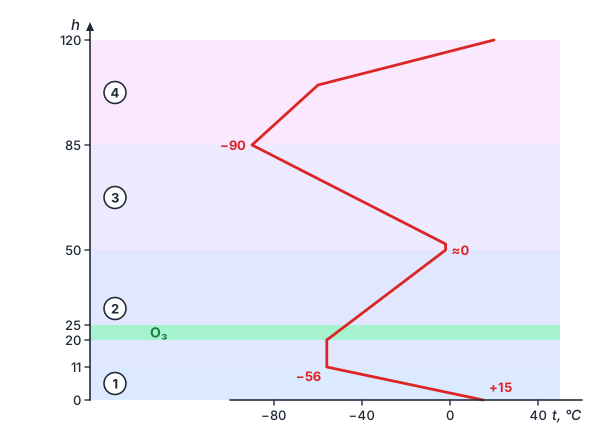
Layers from the bottom up:
- Troposphere — 8–10 km thick at the poles and 16–18 km at the equator; it holds most of the air’s mass and nearly all water vapour, and all weather (clouds, precipitation, wind) happens here.
- Stratosphere — up to about 50 km; at 20–25 km the ozone layer absorbs ultraviolet radiation, so temperature rises again in the upper part of this layer.
- Mesosphere — temperature falls again; most meteors burn up here.
- Thermosphere — very thin air; auroras appear here.
- Exosphere — the outer part, merging into space.
The troposphere is thicker at the equator because the air there is strongly heated and rises higher.
§2. Air temperature and heat
Sunlight passes through the atmosphere and heats mainly the ground; the air is heated by the ground. That is why temperature falls with height in the troposphere.
Temperature falls by ≈ 6 °C per 1 km of height (≈ 0.6 °C per 100 m)
Heating depends on the angle of the Sun’s rays: steep rays put a lot of energy on a small area. So temperature falls from the equator towards the poles. The reflectivity of a surface is its albedo: fresh snow reflects most sunlight, dark soil and forest absorb much of it.
During the day the maximum comes after noon (about 2–3 p.m.) and the minimum just before sunrise. In the Northern Hemisphere the warmest month on land is usually July and the coldest January.
Range (amplitude) = highest temperature − lowest temperature
Continental areas such as Central Asia have a large range; coasts have a small one, because water warms and cools slowly. A line joining points of equal temperature is an isotherm.
Worked example
At the foot of a mountain (500 m) it is +26 °C. What is the temperature on a summit at 3,500 m?
- Height difference: 3,500 − 500 = 3,000 m = 3 km.
- Fall: 3 · 6 = 18 °C.
- Summit temperature: 26 − 18 = 8 °C. Answer: +8 °C.
Worked example
Readings during one day were +4, +9, +17 and +10 °C. Find the mean daily temperature and the range.
- Sum: 4 + 9 + 17 + 10 = 40.
- Mean: 40 / 4 = 10 °C.
- Range: 17 − 4 = 13 °C. Answer: mean +10 °C, range 13 °C.
§3. Atmospheric pressure
Air has weight and presses on the surface. Normal pressure — at sea level, at 45° latitude and 0 °C — is 760 mm of mercury (≈ 1013 hPa). It is measured with a barometer. With height the column of air above us gets shorter, so pressure falls:
In the lower atmosphere pressure drops by 1 mm of mercury for every ≈ 10.5 m of ascent
Warmed air expands, becomes lighter and rises, giving low pressure at the surface; cold air becomes denser and sinks, giving high pressure. Lines joining points of equal pressure are isobars.
Pressure belts alternate over the globe: low at the equator, high at about 30° latitude (near the tropics), low in the temperate latitudes (about 60°) and high at the poles.
Worked example
Pressure is 750 mm at the foot of a mountain and 690 mm at the top. What is the relative height of the mountain?
- Pressure difference: 750 − 690 = 60 mm.
- 10.5 m per 1 mm: 60 · 10.5 = 630 m.
- Answer: about 630 m.
§4. Wind
Wind is the horizontal movement of air from high to low pressure. The greater the pressure difference, the stronger the wind. Because Earth rotates, the Coriolis force deflects winds to the right in the Northern Hemisphere and to the left in the Southern.
- Trade winds blow steadily from the subtropical high-pressure belts towards the equator: north-easterly in the Northern Hemisphere, south-easterly in the Southern.
- Westerlies blow in temperate latitudes and bring moist ocean air.
- Monsoons are seasonal winds: in summer from ocean to land (moist, rainy), in winter from land to ocean (dry). They are strongest in South and East Asia.
- Breezes blow from sea to land by day and from land to sea by night, because land and water heat differently.
- A föhn is a warm, dry wind descending from mountains: sinking air is compressed and warms.
- Local winds of Uzbekistan include the garmsil (a hot dry wind) and the Kokand and Bekabad winds.
§5. Humidity, clouds and precipitation
- Absolute humidity is the mass of water vapour in 1 m³ of air (g/m³).
- Relative humidity is the ratio of the vapour present to the amount that would saturate the air at that temperature, in %:
Relative humidity = absolute humidity / saturation amount · 100%
Warm air can hold more vapour: at +20 °C 1 m³ holds about 17 g, at 0 °C about 5 g. When air warms the saturation amount rises, so relative humidity falls. When air cools to 100% condensation begins, forming clouds, fog, dew and frost. Precipitation is water falling from clouds: rain, snow, hail.
Precipitation is heavy where air rises: at the equator, on windward mountain slopes and in cyclones.
- A cyclone has low pressure at its centre; air flows in and rises, bringing cloud and precipitation. In the Northern Hemisphere it turns anticlockwise.
- An anticyclone has high pressure at its centre; air sinks and spreads out, bringing clear dry weather — frosty in winter, hot in summer.
Worked example
At +20 °C 1 m³ of air can hold about 17 g of vapour. It actually holds 8.5 g. What is the relative humidity?
- Formula: relative = absolute / saturation · 100%.
- 8.5 / 17 = 0.5.
- 0.5 · 100% = 50%. Answer: 50%.
Check yourself
- In which layer is the ozone layer?
- It is +18 °C at the foot. What is it 2 km higher?
- Pressure is 760 mm at the foot and 718 mm at the top. Relative height?
- What weather does a cyclone bring?
- Absolute humidity 6 g/m³, saturation 12 g/m³. Relative humidity?
- Which way does a breeze blow at night?
- Maximum +31 °C, minimum +12 °C. Range?
- Steady winds blowing from the tropics to the equator?
Common mistakes
- Putting the ozone layer in the troposphere — it is in the stratosphere.
- Thinking air is heated directly by the Sun — it is heated by the ground, which is why it is colder higher up.
- Swapping the weather of cyclones and anticyclones.
- Inverting the fraction for relative humidity: the actual amount is divided by the saturation amount.
- Dividing millimetres by 10.5 instead of multiplying in pressure–height problems.
Score: 0 / 8 correct (0 attempted)