GeographyGeography · 3 / 26
The shape and motions of the Earth
School curriculum· 25 min· 21 questions
Learn first: Maps, scale and coordinates
The Earth makes two movements at once: it spins on its axis and travels in orbit around the Sun. Day and night, the seasons, the zones of illumination, polar day and polar night, differences in local time and the deflection of winds all result from these two movements and from the tilt of the Earth’s axis. The topic is the basis for understanding climate, natural zones and timekeeping. Exams ask you to link cause and effect correctly, to know the key dates and to calculate the Sun’s noon altitude.
§1. The Solar System and the shape of the Earth
The Sun is a medium-sized star holding almost all the mass of the Solar System. Eight planets orbit it: Mercury, Venus, Earth and Mars (the terrestrial planets) and Jupiter, Saturn, Uranus and Neptune (the giant planets). The Earth is the third planet from the Sun, on average about 150 million km away.
The Moon is the Earth’s natural satellite, about 384,000 km away; it orbits the Earth in about 27.3 days and always shows the same face. The Moon’s gravity causes the tides in the oceans.
The Earth’s shape is a geoid: a sphere slightly flattened at the poles. The flattening is a result of the Earth’s rotation.
Mean radius ≈ 6,371 km; equator ≈ 40,075 km long; the polar radius is ≈ 21 km shorter than the equatorial
Because the Earth is round, sunlight strikes different latitudes at different angles — the main reason heat is distributed unevenly.
§2. Rotation on the axis
The Earth turns from west to east (anticlockwise seen from above the North Pole), making one turn in about 24 hours. So the Sun, Moon and stars appear to rise in the east and set in the west.
Consequences:
- Day and night alternate, so the surface warms and cools evenly and living things follow this rhythm.
- The Coriolis force: moving bodies (winds, currents, river water) are deflected to the right in the Northern Hemisphere and to the left in the Southern. That is why rivers in the Northern Hemisphere erode their right banks more and the trade winds blow from the north-east.
- The Earth is flattened at the poles.
- Local time depends on longitude: 360° in 24 hours means 15° per hour and 1° in 4 minutes.
Worked example
The equator is about 40,075 km long. How fast does a point on the equator move because of the Earth’s rotation?
- In 24 hours the point travels the length of the equator.
- Speed: 40,075 / 24 ≈ 1,670 km/h.
- Answer: about 1,670 km/h; the speed falls towards the poles and is zero at the pole itself.
§3. Revolution around the Sun
The Earth travels round the Sun on an elliptical orbit in about 365 days 6 hours. A calendar year has 365 days, so the extra 6 hours add up to a whole day every 4 years — that year is a leap year (366 days, with 29 days in February).
The Earth’s axis is tilted at 66.5° to the plane of its orbit (23.5° from the perpendicular) and keeps the same direction in space as the Earth moves. So during the year first the Northern and then the Southern Hemisphere is turned more towards the Sun.
The seasons are caused by the tilt of the axis and its fixed direction, not by changing distance from the Sun!
Proof: the Earth is closest to the Sun in early January and farthest in early July, yet January is winter and July summer in the Northern Hemisphere.
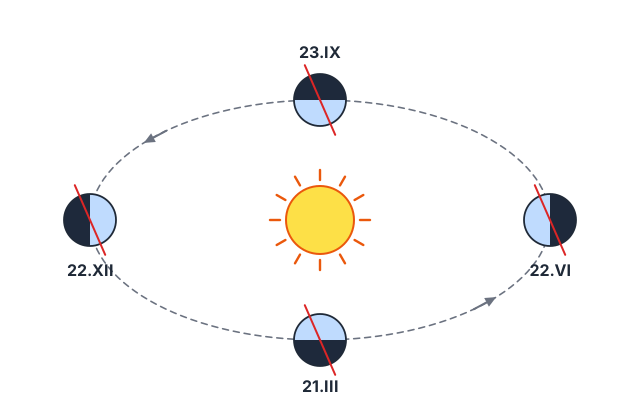
§4. Key dates
- 21 March — the spring equinox; at noon the Sun is overhead at the equator; day and night are equal everywhere (12 hours each).
- 22 June — the summer solstice: the Sun is overhead at the Tropic of Cancer (23.5° N); the Northern Hemisphere has its longest day and shortest night; north of the Arctic Circle there is polar day.
- 23 September — the autumn equinox; the Sun is again overhead at the equator.
- 22 December — the winter solstice: the Sun is overhead at the Tropic of Capricorn (23.5° S); the Northern Hemisphere has its shortest day; north of the Arctic Circle there is polar night.
The seasons are reversed in the Southern Hemisphere: 22 December is the start of summer there.
Day length depends on latitude: at the equator day and night are almost equal all year (about 12 hours each), while towards the poles summer days lengthen and winter days shorten. In Tashkent a summer day lasts about 15 hours and a winter day about 9. In its orbit the Earth moves at about 30 km per second, though we do not feel it.
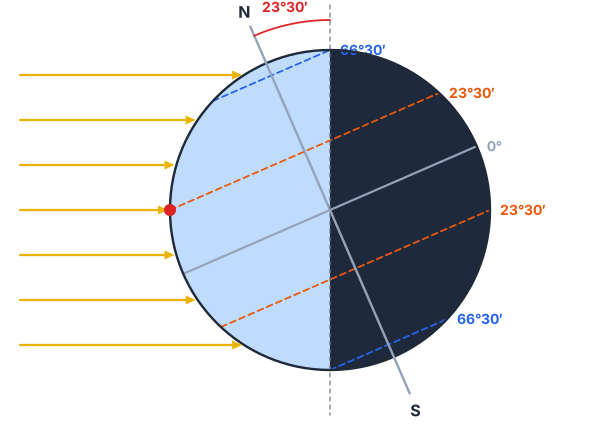
Worked example
What happens at 70° N on 22 June?
- 70° > 66.5°, so the point is north of the Arctic Circle.
- On 22 June the Northern Hemisphere receives the most sunlight, and north of the Arctic Circle the Sun does not sink below the horizon.
- Answer: polar day — the Sun does not set.
§5. Zones of illumination
The tropics (±23.5°) and the polar circles (±66.5°) divide the Earth into 5 zones of illumination:
- The hot zone (between the tropics) — the Sun is overhead once a year (on the tropics) or twice; hot all year.
- Two temperate zones (between a tropic and a polar circle) — the Sun is never overhead; four clear seasons. Uzbekistan is in the northern temperate zone.
- Two cold zones (from the polar circles to the poles) — they have polar day and polar night. On the polar circle these last one day; they lengthen towards the pole and last about half a year at the pole itself.
Tropics — 23.5° = 90° − 66.5°; polar circles — 66.5° = 90° − 23.5°
These figures follow from the angle of the axis.
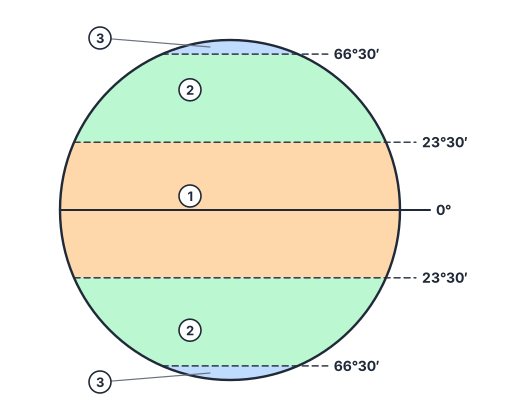
§6. The Sun’s noon altitude
The Sun’s noon altitude (h) is the angle between the Sun’s rays and the horizon. For temperate latitudes of the Northern Hemisphere:
At the equinoxes: h = 90° − φ
On 22 June: h = 90° − φ + 23.5°; on 22 December: h = 90° − φ − 23.5°
Here φ is the latitude of the place. The higher the Sun, the steeper its rays and the more the ground is heated.
Worked example
Find the Sun’s noon altitude in Tashkent (φ ≈ 41° N) on 21 March, 22 June and 22 December.
- 21 March: 90 − 41 = 49°.
- 22 June: 90 − 41 + 23.5 = 72.5°.
- 22 December: 90 − 41 − 23.5 = 25.5°.
- Answer: 49°, 72.5°, 25.5° — the summer Sun stands 47° higher than the winter Sun, which is why summer is hot.
Check yourself
- What is the main cause of the seasons?
- Which way are winds deflected in the Northern Hemisphere?
- Over which parallel is the Sun overhead on 22 December?
- The Sun’s noon altitude at 30° N on an equinox?
- Is the Sun ever overhead in the temperate zone?
- Why do we need leap years?
- The Sun’s noon altitude at 50° N on 22 June?
- From which latitudes are polar day and polar night observed?
Common mistakes
- Explaining the seasons by the Earth moving closer to the Sun — in the northern summer the Earth is actually slightly farther away.
- Mixing up the axis angles: 66.5° to the orbital plane, 23.5° from the perpendicular.
- Swapping the latitudes of the tropics and polar circles: tropics 23.5°, polar circles 66.5°.
- Writing that the Earth turns from east to west — it turns from west to east.
- Adding 23.5° in the 22 December formula — in winter it is subtracted.
Score: 0 / 8 correct (0 attempted)